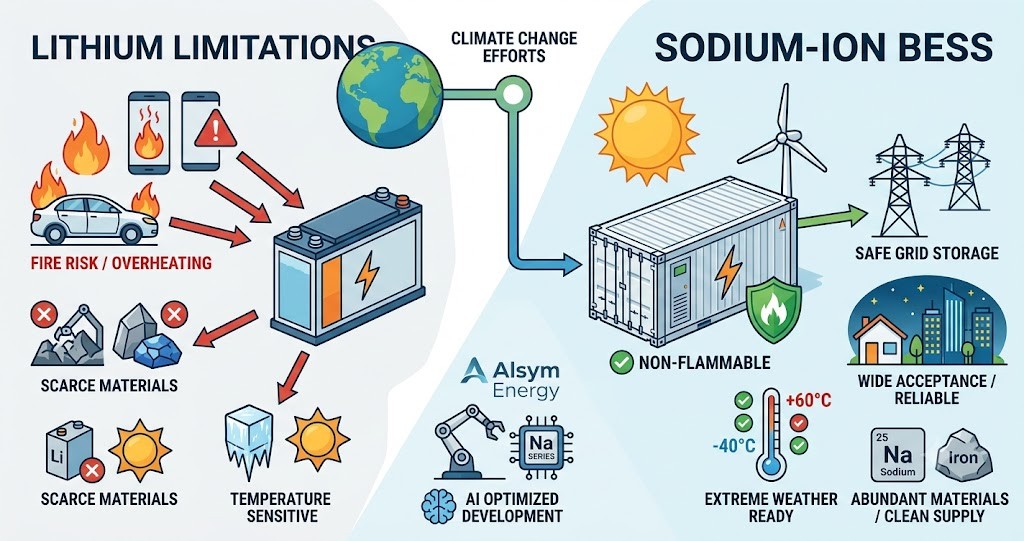
地球規模の気候変動対策が進む中、クリーンエネルギーへの移行において「いかに安全かつ安価に電力を蓄えるか」が大きな課題となっています。現在主流のリチウムイオン電池は、エネルギー密度に優れる一方で、火災(熱暴走)のリスクや、リチウム・コバルトといった特定材料への依存、過酷な温度環境での性能低下といった弱点を抱えています。
こうしたリチウムの限界を打ち破り、世界中のあらゆる地域に安全な電力を届けるため、米国のスタートアップ企業Alsym Energy(アルシム・エナジー)が開発したリチウムフリーの「ナトリウムイオン蓄電池システム(BESS)」が、グリッド(系統)規模の電力貯蔵市場で大きな注目を集めています。
1. アルシム社の革新技術:不燃性「NaシリーズBESS」
アルシム社が開発した「Naシリーズ」は、従来のナトリウムイオン電池の枠を超えた独自の化学構成を持っています。
- 熱暴走ゼロの圧倒的安全性: 不燃性のピロリン酸鉄ナトリウム(NFPP+)と独自の電解質を採用。セルを室温から400℃まで加熱する加速加熱試験や、フル充電状態での釘貫通試験でも、破裂・発火・炎上は一切確認されませんでした。
- 過酷な環境への適応力: 冷却ファンなどの複雑なアクティブ冷却装置を必要とせず、受動冷却(パッシブ冷却)のみで「マイナス40℃から60℃」という極端な温度範囲でも動作します。モハベ砂漠のような酷暑地帯や寒冷地など、リチウムイオン電池が機能しない気候でも展開可能です。
- 高い耐久性と急速充放電: 堅牢なハードカーボンと安定した電極構造、そして溶解問題のないアルミニウム集電体を使用。寿命を縮めることなく最大2C(30分)での高速充放電が可能です。
2. サプライチェーンの変革と国内製造へのこだわり
リチウムイオン電池の多くは中国などの外国懸念企業(FEOC)に依存していますが、アルシム社は安全保障と経済的メリットを両立する国内優先アプローチを採っています。
- 地球に優しいリチウムフリー素材: ナトリウム、鉄、ハードカーボンなど、地球上に豊富に存在する材料を使用。コバルト、ニッケル、マンガン、リチウムは一切不要です。
- Re:Build Manufacturing社との提携: ペンシルベニア州ニューケンジントンにある既存施設を活用し、米国国内での商用規模の電池セル製造能力を確立します。
- インフレ削減法(IRA)の最大活用: 米国国内で製造を行うことで、国家安全保障上のリスク(FEOC)を排除し、2022年インフレ削減法に基づく税制優遇措置(税額控除)や防衛調達規則への完全準拠を達成。インテグレーターや開発者が導入しやすい環境を整えています。
3. 実用化に向けた戦略的パートナーシップ
アルシム社は2026年第3四半期から戦略的パートナーへのセルおよびモジュールの出荷を開始する予定であり、すでに巨額の導入計画が動いています。
- ジュニパー・エナジー(カリフォルニア州): カリフォルニア州全域に「500MWh」のNaシリーズBESSを展開する提携を発表。火災リスクを排除し、均等化発電原価(LCOE)を削減します。高速充電特性を活かし、太陽光発電のシフトから周波数調整まで、1日に複数回の充放電サイクル(マルチサイクル)運用を行う計画です。
- ESS Tech(オレゴン州): 長期エネルギー貯蔵(LDES)の大手メーカーである同社と意向表明書を締結。「8.5GWh」のナトリウムイオン電池およびモジュールを同社のポートフォリオに追加し、短・中期BESS分野への参入を支援します。
4. 追加情報:AI(人工知能)が加速させる電池開発
アルシム社の最大の強みの一つが、物理学に基づいたAIプラットフォームの導入です。通常、新しい電池の化学組成を開発するには、無限に近い組み合わせの中から試行錯誤を繰り返すため膨大な時間がかかります。
- 実験の高速収束: AIがデータと物理法則に基づいて候補を絞り込み、自動化された実験システムと連動してクローズドループ(自動追従型)でテストを繰り返します。
- スケールアップの予測: 分子レベルの診断フィードバックを適用し、ラボでの研究からパイロットライン、そして大規模な商業生産へスケールアップした際の性能やコスト、製造可能性(製造のしやすさ)をエンドツーエンドで最適化しています。
5. まとめ
アルシム社の共同創業者兼CEOであるムケシュ・チャッター氏が「これは10億ドルの問題ではなく、電気を利用できない10億人の人々の問題だ」と語るように、この技術は社会的責任とビジネスを両立させるものです。
リチウムイオン電池の限界を補い、それらが使えない過酷な場所や安全性が最優先されるグリッド(電力網)において、安全・安価・不燃のナトリウムイオン電池は、地球規模のクリーンエネルギーシフトを支える強力なインフラとなるでしょう。
US-Based Alsym Energy Moves to Domestic Manufacturing: The Disruptive Power of Non-Flammable Sodium-Ion BESS Shipping in Q3 2026
As global climate change countermeasures progress, a major challenge in the transition to clean energy is how to store electricity safely and affordably. While currently dominant lithium-ion batteries offer excellent energy density, they suffer from critical weaknesses, including the risk of fire (thermal runaway), reliance on specific materials like lithium and cobalt, and performance degradation in extreme temperature environments.
To break through these limitations of lithium and deliver safe power to all corners of the world, a lithium-free Sodium-Ion Battery Energy Storage System (BESS) developed by US startup Alsym Energy is drawing massive attention in the grid-scale power storage market.
1. Alsym’s Innovative Technology: Non-Flammable “Na Series BESS”
The “Na Series” developed by Alsym Energy features a unique chemical composition that goes beyond standard sodium-ion batteries.
- Absolute Safety with Zero Thermal Runaway: It utilizes non-flammable sodium iron pyrophosphate (NFPP+) and a proprietary electrolyte. In accelerated rate calorimeter tests that heated cells from room temperature to 400C, as well as nail penetration tests conducted on fully charged cells, no ruptures, fires, or flames were observed.
- Adaptability to Extreme Environments: It requires no complex active cooling equipment like cooling fans, maintaining operation across an extreme temperature range of -40C to 60C using passive cooling alone. It can be deployed in climates where lithium-ion batteries fail to function, such as intense heat zones like the Mojave Desert or ultra-cold regions.
- High Durability and Fast Charge/Discharge: Using robust hard carbon, a stable electrode structure, and an aluminum current collector free of dissolution issues, it allows for high-speed charging and discharging up to 2C (30 minutes) without degrading battery lifespan.
2. Revolutionizing the Supply Chain with a Focus on Onshore Manufacturing
While many lithium-ion batteries rely on Foreign Entities of Concern (FEOC) such as China, Alsym Energy adopts a domestic-first approach that balances national security with economic advantages.
- Eco-Friendly, Lithium-Free Materials: The system utilizes earth-abundant materials such as sodium, iron, and hard carbon. Cobalt, nickel, manganese, and lithium are completely unnecessary.
- Partnership with Re:Build Manufacturing: By leveraging an existing facility in New Kensington, Pennsylvania, the company aims to establish commercial-scale battery cell manufacturing capacity within the United States.
- Maximizing the Inflation Reduction Act (IRA): Manufacturing domestically eliminates national security risks (FEOC) and achieves full compliance with tax incentives (tax credits) under the 2022 Inflation Reduction Act and defense procurement regulations. This creates an environment where integrators and developers can easily adopt the technology.
3. Strategic Partnerships Heading Toward Practical Application
Alsym Energy plans to start shipping cells and modules to strategic partners in the third quarter of 2026, and massive deployment plans are already underway.
- Juniper Energy (California): The companies announced a partnership to deploy 500MWh of Na Series BESS across California. This move eliminates fire risks and reduces the Levelized Cost of Storage (LCOS). Capitalizing on its fast-charging characteristics, Juniper plans to utilize the system for multiple daily charge/discharge cycles (multi-cycling), ranging from daily solar shifting to frequency regulation.
- ESS Tech (Oregon): Alsym signed a letter of intent with this leading manufacturer of Long-Duration Energy Storage (LDES) systems. The collaboration supports ESS Tech’s plan to add 8.5GWh of sodium-ion batteries and modules to its portfolio, aiding its entry into the short- and medium-duration BESS sectors.
4. Additional Information: Battery Development Accelerated by AI
One of Alsym Energy’s greatest strengths is the implementation of a physics-backed AI platform. Normally, developing new battery chemistries takes an immense amount of time due to trial-and-error across a near-infinite number of potential combinations.
- Rapid Convergence of Experiments: The AI narrows down candidates based on data and the laws of physics, running tests in a closed-loop automated experimental system.
- Predicting Scale-Up: By applying molecular-level diagnostic feedback, the platform optimizes performance, cost, and manufacturability end-to-end, predicting how the chemistry translates from laboratory research to pilot lines and large-scale commercial production.
5. Conclusion
As Mukesh Chatter, co-founder and CEO of Alsym Energy, notes, “This is not a billion-dollar problem; it is a problem of one billion people who lack access to electricity.” This technology perfectly aligns social responsibility with business.
By compensating for the limitations of lithium-ion batteries, safe, affordable, and non-flammable sodium-ion batteries will serve as a powerful infrastructure supporting the global shift to clean energy in harsh environments and safety-critical power grids.
コメント