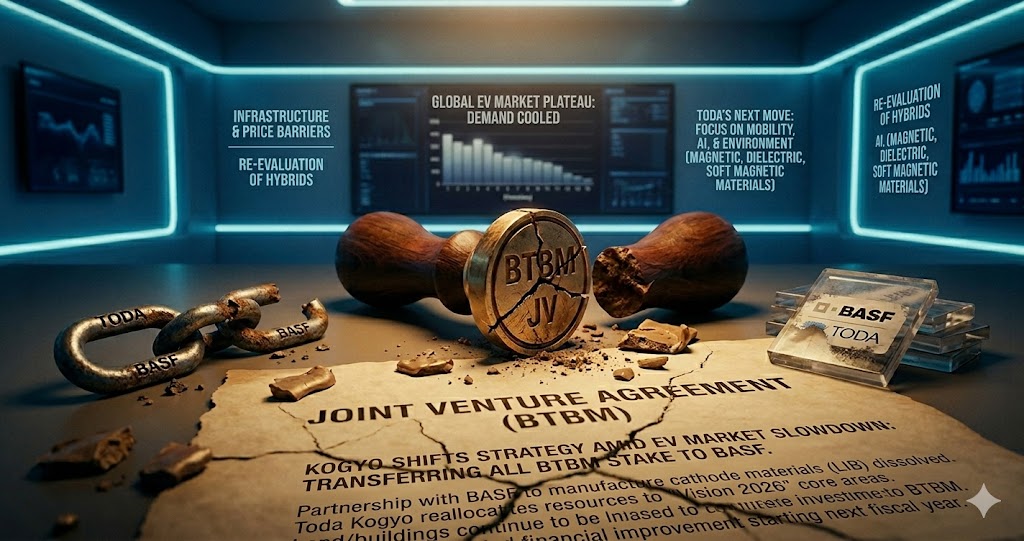
戸田工業は、リチウムイオン電池(LIB)用正極材料を手掛ける合弁会社「BASF戸田バッテリーマテリアルズ(BTBM)」の全持ち分をBASF側に譲渡し、合弁事業を解消することを決定しました。
1. 合弁解消の主な理由
- EV市場の成長鈍化: 2024年以降、電気自動車(EV)市場の伸びが世界的に落ち着き、BTBMの業績も停滞していました。
- 迅速な意思決定の必要性: グローバル競争が激化する中、BASFの単独資本とすることで、投資判断や戦略実行のスピードを速めることが最善と判断されました。
- 経営資源の選択と集中: 戸田工業の中期経営計画「Vision 2026」に基づき、不採算リスクを抑え、自社の強みがある他分野へリソースを再配分します。
2. 今後の両社の関係と影響
- 資産の賃貸は継続: 戸田工業は引き続き、BTBMに対して土地、建物、構築物の貸し出しや役務の提供を行います。
- 財務面の改善: 持ち分譲渡により、来年度以降の戸田工業の連結経常利益は改善する見込みです。
関連情報:背景と業界の動向
今回の決定を深く理解するための補足情報です。
リチウムイオン電池の構造
リチウムイオン電池は主に「正極材」「負極材」「電解液」「セパレータ」の4つの部材で構成されています。
- 正極材の重要性: 電池の容量や電圧を左右する最も重要な部材であり、コストの約3割から4割を占めると言われています。戸田工業がBASFと組んでいたのは、この中心部材の製造です。
「EV踊り場」現象
現在、自動車業界では「EVキャズム(普及の溝)」や「踊り場」と呼ばれる現象が起きています。
- 先行層の需要一巡: 高価格帯のEVを購入する層に行き渡ったこと。
- インフラと価格の壁: 充電インフラの不足や、補助金削減による実質的な価格上昇が消費者のブレーキとなっています。
- ハイブリッド車の再評価: トヨタ自動車をはじめとするハイブリッド車(HEV)やプラグインハイブリッド車(PHEV)の需要が、北米や日本で再び高まっています。
戸田工業の次なる戦略
合弁解消後、戸田工業は以下の「モビリティ・AI・環境」分野に注力する方針です。
- 磁石材料・誘電体材料: モーターや電子部品に不可欠な素材。
- 軟磁性材料: AIサーバーや通信機器の省電力化に寄与する次世代材料。
- 環境関連材料: 脱炭素社会に向けた新素材の開発。
今回の決定は、EV市場の過熱感が冷めた今、メーカーが「規模の拡大」から「収益性とスピード重視」へ戦略を切り替えている象徴的な動きと言えます。
出典:https://response.jp/article/2026/03/02/408065.html
Toda Kogyo Shifts Strategy Amid EV Market Slowdown, Terminating Joint Venture with BASF
Toda Kogyo has decided to transfer its entire stake in BASF TODA Battery Materials (BTBM)—a joint venture specializing in cathode active materials for lithium-ion batteries (LIB)—to BASF, thereby dissolving the partnership.
1. Key Reasons for Dissolving the Joint Venture
- Slowdown in EV Market Growth: Since 2024, the global expansion of the electric vehicle (EV) market has cooled down, leading to stagnant performance for BTBM.
- Need for Rapid Decision-Making: Amid intensifying global competition, it was determined that transitioning to a BASF-only capital structure is the best way to accelerate investment decisions and strategic execution.
- Selection and Concentration of Management Resources: Based on Toda Kogyo’s medium-term management plan, “Vision 2026,” the company aims to minimize unprofitability risks and reallocate resources to other sectors where it holds a competitive advantage.
2. Future Relationship and Impact
- Continuation of Asset Leasing: Toda Kogyo will continue to lease land, buildings, and structures to BTBM, as well as provide ongoing services.
- Financial Improvement: Due to the transfer of shares, Toda Kogyo expects its consolidated ordinary income to improve starting next fiscal year.
Related Information: Background and Industry Trends
Supplementary information to provide a deeper understanding of this decision.
Structure of a Lithium-ion Battery
A lithium-ion battery consists primarily of four components: the cathode, anode, electrolyte, and separator.
- Importance of Cathode Materials: This is the most critical component, determining the battery’s capacity and voltage. It is said to account for approximately 30 percent to 40 percent of the total battery cost. Toda Kogyo’s partnership with BASF focused on manufacturing this core material.
The “EV Plateau” Phenomenon
The automotive industry is currently experiencing a phenomenon often called the “EV Chasm” or “Plateau.”
- Saturation Among Early Adopters: Demand has leveled off now that the initial segment of consumers interested in high-end EVs has already purchased them.
- Infrastructure and Price Barriers: A lack of charging infrastructure and rising effective prices due to the reduction of subsidies are acting as deterrents for consumers.
- Re-evaluation of Hybrid Vehicles: Demand for Hybrid Electric Vehicles (HEV) and Plug-in Hybrid Electric Vehicles (PHEV), led by companies like Toyota, is surging again in markets like North America and Japan.
Toda Kogyo’s Next Strategy
Following the dissolution of the joint venture, Toda Kogyo plans to focus on the following “Mobility, AI, and Environment” sectors:
- Magnetic and Dielectric Materials: Essential materials for motors and electronic components.
- Soft Magnetic Materials: Next-generation materials that contribute to energy saving in AI servers and communication equipment.
- Environment-Related Materials: Development of new materials aimed at achieving a decarbonized society.
This decision is a symbolic move showing how manufacturers are shifting their strategy from “scale expansion” to “profitability and speed” now that the initial hype surrounding the EV market has cooled.
コメント