世界の電気自動車(EV)市場が拡大を続ける中、次世代のバッテリー技術として「半固体電池」の実用化が急速に進んでいます。従来のリチウムイオン電池(液体電解質)と、将来の本命とされる全固体電池(固体電解質)の橋渡しとなるこの技術は、高級乗用車ではなく、まず「物流」や「航空」といったシビアな採算性と性能が求められるビジネスの現場から普及が始まっています。本稿では、中国の電池大手CALB(中創新航科技集団)の最新動向を軸に、半固体電池がもたらす産業勢力図の変化と、その技術的特徴について詳しく解説します。
物流・商用車における半固体電池の導入メリット
先端技術はこれまで高級乗用車から広がる例が多く見られましたが、半固体電池は負荷が大きく、採算性が厳しく問われる商用車分野から導入が進んでいます。小型商用車は乗用車に比べ、積載量や稼働時間、充電待ち時間の影響を大きく受けるためです。
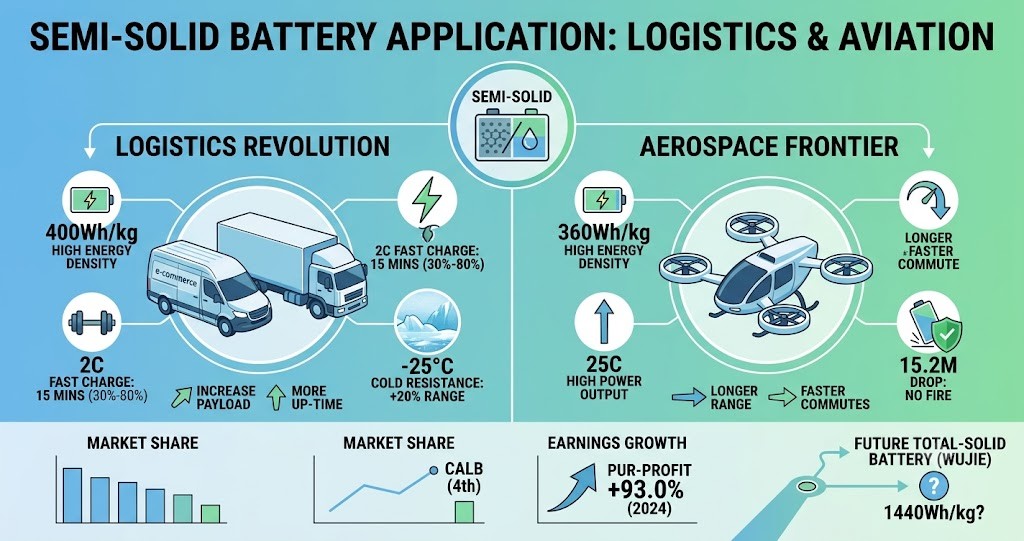
- 高いエネルギー密度と軽量化:CALBが小型トラック向けに投入した固液ハイブリッド電池は、現在の量産技術としては極めて高い400Wh/kgのエネルギー密度を実現しています。テスラの4680セル(約300Wh/kg)や国内メーカー製品(300から360Wh/kg)を上回るこの性能により、バッテリー自体の軽量化が可能となり、商用車の積載量増加や航続距離の延長に直結します。積載量が収益に直結する商用車では、軽量化によって配送効率が高まり、車両運用の幅も広がります。
- 急速充電による稼働率向上:この電池は2Cの急速充電に対応しており、約15分で30%から80%まで充電が可能です。配送車両は1日を通して拠点との往復や荷役作業を繰り返すため、充電による長い待ち時間は稼働率の低下につながっていました。しかし約15分で充電できれば、荷役や休憩の時間に充電を済ませることができ、車両の稼働率を高く保ちやすくなります。
- 寒冷地対応と高い安全性:冬場の配送では、低温による航続距離の低下が運行管理上の大きな課題となってきました。CALBの仕様では、マイナス25度の極低温環境下でも、従来型電池より航続距離が20%向上し、1Cの連続放電にも対応します。また、44項目の厳しい安全試験をクリアしています。
- サプライチェーンの脱炭素化(Scope 3削減):この動きは、荷主企業が進めるサプライチェーン全体の脱炭素化とも深く結び付いています。物流の電動化を取引条件とする動きが広がる中、半固体電池によって充電待ち時間や冬場の性能低下を抑えられれば、輸送品質を維持したままCO2排出量を削減でき、荷主と物流事業者の双方に利益のある事業環境が広がります。
航空分野(eVTOL・空飛ぶクルマ)への展開と低空経済の始動
半固体電池の技術の進歩は陸上物流にとどまらず、次世代の航空輸送にも広がり、モビリティ産業の供給網にも変化をもたらしています。
- 航空級電池「頂流(Dingliu)」の量産:CALBは、小鵬汽車(Xpeng)傘下で空飛ぶクルマを開発するAridge(小鵬匯天)向けに、航空向けの動力電池を成都工場の量産ラインから出荷しました。供給先は、Aridgeが開発するモジュール式空飛ぶクルマ「陸地航母(Land Aircraft Carrier)」であり、2026年内の量産・納入開始を予定しています。
- 大出力と重量制限の克服:滑走路を必要としない新しい航空モビリティ(eVTOL)は、都市部のエアタクシーや災害対応など幅広い用途が期待される一方、従来のリチウムイオン電池では航続距離が100kmから150kmほどにとどまり、大きな課題となっていました。航空用途では自動車以上に重量制限が厳しいため、最大360Wh/kgのエネルギー密度と、25Cという高い最大放電倍率(大出力)を両立させ、機体の飛行時間や積載量の課題を解決しています。
- 最高峰の安全基準:15.2mからの落下試験でも発火や爆発、液漏れを起こさない高い安全性を実証し、自動車の安全基準と航空機の耐空性認証の双方に同時に対応した業界初の製品となっています。量産化が進み、機体価格や運航費が下がれば、空の移動は広く利用される可能性を秘めています。
巨頭回避の非対称な新市場戦略と全固体電池への展望
世界のEV用電池市場では、中国のCATL(寧徳時代新能源科技)とBYD(比亜迪)が圧倒的な存在感を持っており、中国市場では両社が全体の62%以上のシェアを占めています。
その中でCALBは、2024年の世界の電池搭載量で4位(シェア5.3%)、中国国内で6.00%のシェアを維持しています。2024年通期の業績は売上高が前年比2.8%増の277億5152万元となり、純利益は前年比93.0%増の8億4362万元と大きく伸びました。乗用EV向け電池では、強い顧客基盤を持つCATLとBYDに正面から価格競争を挑むことは容易ではないため、CALBは半固体電池を軸に小型商用車や航空向け電池など、新しい用途を先行して開拓する道(非対称な市場戦略)を選んでいます。
その先には、次世代電池として開発を進める全固体電池「無界(WUJIE)」があります。全固体電池は燃えにくい無機固体電解質を使うことで高い安全性を確保し、理論上は従来の約4倍となる最大1440Wh/kgのエネルギー密度を実現できる可能性があります。業界全体では2026年から2028年ごろの量産開始を目標としており、CALBも430Wh/kgのエネルギー密度と50Ahを超える容量を持つセルの開発を進め、2027年に実車への小規模な搭載を始め、その後に量産へ移る予定です。この計画では、先行する半固体電池の事業化によって収益を確保しながら運用データを蓄積し、その成果を全固体電池の製造にも生かす考えです。
補足:半固体電池の技術的特徴と早期実用化の理由
電池技術の流れを見ると、次世代への移行は一気に全固体電池へ切り替わるわけではありません。なぜ半固体電池がこれほど注目され、素早く市場に投入できているのか、その技術的背景を解説します。
- 半固体電池の構造と定義: 半固体電池(Semi-solid-state battery または 準固体電池)は、電解質に「液体」と「固体」の両方を組み合わせた固液混合型や、電解質・電極材料をゲル状や粘土(クレイ)状にしたものを指します。完全に液体を排除した「全固体電池」とは異なり、5%から10%未満のわずかな液体成分を残しているのが特徴です。
- なぜ全固体電池より早く実用化できるのか: 全固体電池は、固体の界面(接触面)におけるイオンの移動抵抗が高く、量産製造時のコストや耐久性に多くの課題を抱えています。一方、半固体電池はわずかに含まれる液体やゲルがイオンの移動をスムーズに保つため、従来のリチウムイオン電池の生産設備や製造ラインの多くをそのまま、あるいは一部の改良だけで活用できます。そのため、巨額の新規設備投資を抑えながら、素早く大量生産へと移行できる最大のメリットがあります。
- 安全性の飛躍的な向上: 従来のリチウムイオン電池で最大の懸念だった「可燃性液体電解質の液漏れ」や、内部短絡による「熱暴走(発火・爆発)」のリスクが、電解質のゲル化・半固体化によって極限まで低減されています。釘を刺したり衝撃を与えたりしても燃えにくい特性を持つため、乗客の安全が第一とされる航空モビリティ(eVTOL)や、物流現場での信頼性を担保する技術として非常に適しています。
結び
小型トラックと空飛ぶクルマという、異なる移動手段で同じ電池技術の採用が進んでいることは、モビリティの電動化が乗用車中心の段階から広がり、2030年代に向けて空の移動も含めた広大な市場へ拡大しつつあることを示しています。半固体電池は遠い将来の技術ではなく、次の全固体電池という段階へ向かう中で、性能の違いが稼働効率や安全性に直結するビジネス分野から実用化が進んでいる、極めて現実的かつ強力な技術なのです。
出典:https://carview.yahoo.co.jp/news/detail/52505419d7a382ae2e2225bb9dee5d9e7573da97/
“Semi-Solid-State Batteries” Arrive Ahead of All-Solid-State: Why Next-Gen Tech is Spreading from “Logistics” and “Aviation” Rather Than Luxury Cars
As the global electric vehicle (EV) market continues to expand, the commercialization of “semi-solid-state batteries” is accelerating as a next-generation battery technology. Serving as a bridge between conventional lithium-ion batteries (liquid electrolyte) and all-solid-state batteries (solid electrolyte)—the ultimate future goal—this technology is gaining traction first in demanding business environments like logistics and aviation where strict profitability and performance are required, rather than in luxury passenger cars. Focusing on the latest moves by Chinese battery giant CALB (China Aviation Lithium Battery), this article provides a detailed analysis of how semi-solid-state batteries are reshaping the industrial competitive landscape and outlines their key technical characteristics.
Benefits of Introducing Semi-Solid-State Batteries in Logistics and Commercial Vehicles
While advanced technologies have traditionally debuted in luxury passenger cars, semi-solid-state batteries are being deployed first in the commercial vehicle sector, where workloads are heavy and profitability is strictly scrutinized. This is because light commercial vehicles are far more sensitive to cargo capacity, operating hours, and charging wait times compared to passenger cars.
- High Energy Density and Lightweight Design: The solid-liquid hybrid battery that CALB introduced for light trucks achieves an energy density of 400 Wh/kg, an exceptionally high level for current mass-production technology. Outperforming Tesla’s 4680 cells (approx. 300 Wh/kg) and products from Japanese domestic manufacturers (300 to 360 Wh/kg), this performance enables a lighter battery pack. This directly translates into increased cargo capacity and extended driving range for commercial vehicles. In an industry where load capacity directly impacts revenue, reduced weight improves delivery efficiency and expands operational flexibility.
- Maximizing Operating Efficiency via Fast Charging: This battery supports 2C fast charging, allowing it to charge from 30% to 80% in about 15 minutes. Delivery vehicles frequently travel between hubs and perform loading operations throughout the day, meaning long charging wait times previously caused lower operational efficiency. A 15-minute charge allows operators to plug in during loading or driver breaks, keeping vehicle uptime high.
- Cold-Weather Performance and High Safety: Reduced driving range due to low temperatures has long been a major challenge for winter fleet management. CALB’s specifications show that even in extreme cold at minus 25 degrees Celsius, the driving range improves by 20% compared to conventional batteries, while still supporting 1C continuous discharge. Furthermore, it has successfully cleared 44 rigorous safety tests.
- Supply Chain Decarbonization (Scope 3 Reduction): This shift is deeply linked to shippers’ efforts to decarbonize their entire supply chains. As electric logistics become a strict condition for business contracts, semi-solid-state batteries mitigate shipper concerns over delivery delays and high costs by minimizing charging downtime and winter performance drops. This creates a profitable business environment for both shippers and logistics providers while maintaining transport quality and cutting carbon emissions.
Expansion into Aviation (eVTOL / Flying Cars) and the Launch of the Low-Altitude Economy
The progress of semi-solid-state battery technology extends beyond land logistics, reaching next-generation air transport and reshaping the mobility supply chain.
- Mass Production of Aviation-Grade “Dingliu” Batteries: CALB has begun shipping its aviation-grade power batteries from its Chengdu plant’s mass-production line to Aridge (XPENG AEROHT), a flying car developer under XPENG. The destination for these batteries is the “Land Aircraft Carrier,” a modular flying car currently developed under the project code X3-F, with mass production and deliveries scheduled to begin within 2026.
- Overcoming Weight Limits with High Power: New electric vertical takeoff and landing (eVTOL) aircraft offer broad potential for urban air taxis and disaster response without needing runways. However, conventional lithium-ion batteries limited their range to about 100 km to 150 km, posing a massive barrier to adoption. Because aviation faces far stricter weight constraints than automobiles, CALB’s battery combines a maximum energy density of 360 Wh/kg with a high maximum discharge rate of 25C (high power output) to solve flight time and payload limitations.
- The Highest Safety Standards: Demonstrating extreme reliability, the aviation-grade battery showed no ignition, explosion, or leakage during a 15.2-meter drop test. It is the industry’s first product to simultaneously satisfy both automotive safety standards and aircraft airworthiness certifications. As mass production drives down aircraft and operational costs, air mobility could become widely accessible.
An Asymmetric Market Strategy to Avoid Giants and the Outlook for All-Solid-State Batteries
In the global EV battery market, China’s CATL and BYD hold a dominant presence, commanding over 62% of the domestic Chinese market share.
In this landscape, CALB ranked fourth globally in battery installations in 2024 (5.3% share) and maintained a 6.00% domestic share as of February 2026. For the full year of 2024, its revenue grew 2.8% year-on-year to 27.75 billion yuan, and net profit surged 93.0% to 843.62 million yuan. Competing directly on price for passenger EV batteries against giants with strong customer bases like CATL and BYD is difficult. Therefore, CALB has chosen an asymmetric market strategy, using semi-solid-state batteries to pioneer new applications like light commercial vehicles and aviation ahead of the competition.
Looking ahead, CALB is developing its next-generation all-solid-state battery, “WUJIE.” By utilizing non-flammable inorganic solid electrolytes, all-solid-state batteries ensure high safety and theoretically offer a maximum energy density of up to 1440 Wh/kg—roughly four times that of conventional batteries. The industry targets the launch of mass production for third-generation all-solid-state batteries between 2026 and 2028. CALB is currently developing cells with an energy density of 430 Wh/kg and capacities exceeding 50 Ah, aiming for small-scale vehicle deployment in 2027 before moving to full mass production. This roadmap uses commercial revenues and operational data from semi-solid-state batteries to refine all-solid-state manufacturing.
Technical Characteristics of Semi-Solid-State Batteries and Reasons for Early Adoption
Looking at the trajectory of battery technology, the transition to the next generation will not happen overnight. The following technical factors explain why semi-solid-state batteries are receiving intense focus and entering the market so rapidly:
- Structure and Definition: Semi-solid-state batteries (or quasi-solid-state batteries) refer to solid-liquid hybrid designs that combine both liquid and solid electrolytes, or utilize gel-like or clay-like (clay-type) electrolyte and electrode materials. Unlike all-solid-state batteries that eliminate liquids entirely, semi-solid-state batteries retain a small liquid or gel component of roughly 5% to less than 10%.
- Why They Can Be Commercialized Faster Than All-Solid-State: All-Solid-state batteries suffer from high ion transport resistance at the solid-to-solid interfaces (contact surfaces), presenting major hurdles in mass-production costs and durability. Conversely, the minor liquid or gel content in semi-solid-state batteries keeps ion movement smooth. This allows manufacturers to utilize most of their existing lithium-ion production machinery and lines with only minor modifications, enabling rapid scaling to mass production without massive new capital investments.
- A Leap Forward in Safety: The greatest vulnerability of conventional lithium-ion batteries—volatile liquid electrolyte leakage leading to internal short circuits and thermal runaway (fire/explosion)—is minimized through gelation and semi-solidification. Because these batteries resist catching fire even under severe impact or nail-penetration tests, they are ideal for ensuring passenger safety in air mobility (eVTOL) and operational reliability in logistics.
Conclusion
The fact that the same battery technology is being adopted across two vastly different modes of transport—light trucks and flying cars—shows that mobility electrification is expanding beyond passenger cars. It is moving toward a vast market that will include air transport by the 2030s. Semi-solid-state batteries are not a far-off technology; they are a highly practical, powerful solution rolling out right now in business sectors where performance differences directly impact operational efficiency and safety, paving the way toward the ultimate goal of all-solid-state power.
コメント