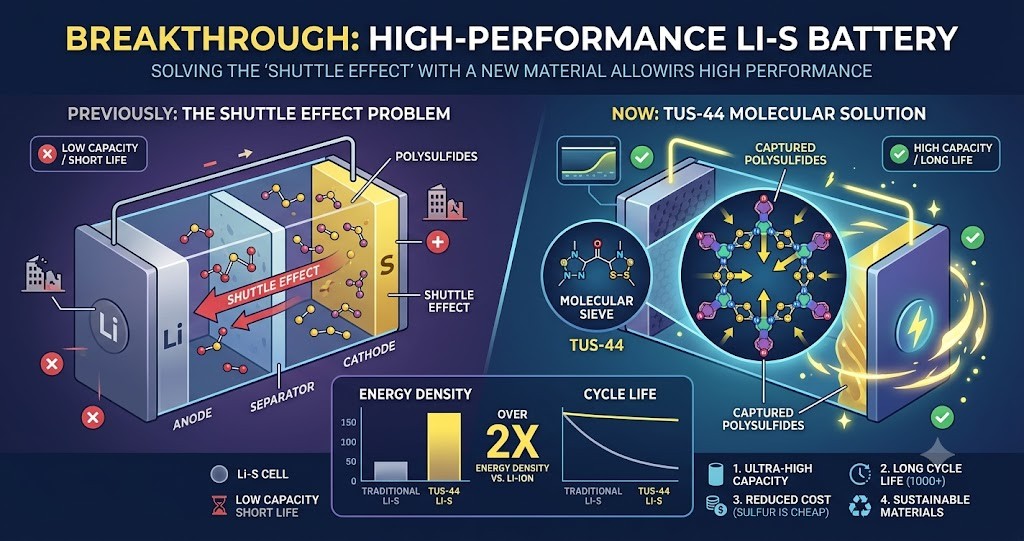
次世代のクリーンモビリティやグリッドストレージの鍵を握る技術として、「リチウム硫黄(Li-S)電池」が世界中で激しい開発競争の的となっています。現行のリチウムイオン電池の数倍に達する理論エネルギー密度を持ち、かつ資源リスクの低い硫黄を正極に用いるこの技術は、長年「シャトル効果」と呼ばれる特有の寿命劣化メカニズムに阻まれてきました。
本稿では、東北大学の根岸雄一教授らの国際共同研究グループが発表した、このジレンマを根本から打破する新材料「TUS-44」に関する最新成果をベースに、リチウム硫黄電池の基本原理や他技術との比較などの関連情報を補足・整理して解説します。
- 1. リチウム硫黄電池のポテンシャルと「シャトル効果」の壁
- 2. 東北大が開発した新材料「TUS-44」の分子設計
- 3. 実証された圧倒的な電池性能
- 4. 【関連情報補足】次世代電池マップにおけるリチウム硫黄電池の位置づけ
- 1. The Potential of Li-S Batteries and the Barrier of the “Shuttle Effect”
- 2. Molecular Design of the New Material “TUS-44” Developed by Tohoku University
- 3. Demonstrated Performance Breakthroughs
- 4. Supplementary Context: Li-S Batteries in the Next-Gen Battery Landscape
1. リチウム硫黄電池のポテンシャルと「シャトル効果」の壁
リチウム硫黄(Li-S)電池は、正極に「硫黄(S)」、負極に「リチウム金属(Li)」を用いる蓄電システムです。
なぜ「硫黄」なのか?
- 圧倒的な理論容量: 硫黄の理論容量は 1,672 mAh/g であり、リチウムイオン電池の正極材料(コバルト酸リチウムなど:約270 mAh/g)を圧倒します。
- 高い経済性と持続可能性: 硫黄は石油精製の副産物として大量に産出されるため極めて安価です。コバルトやニッケルのような地政学的リスクや環境負荷を伴うレアメタルに依存しません。
実用化を阻む「シャトル効果(Shuttle Effect)」
Li-S電池の放電プロセスでは、硫黄が段階的にリチウムと反応し、中間生成物である多硫化リチウム(リチウムポリスルフィド:Li2Sx, 4 < x < 8)が生成されます。
【シャトル効果のメカニズム】
- 放電時に生成した長鎖のポリスルフィド(Li2S8 や Li2S4)が、液体の有機電解液に容易に溶解する。
- 溶解したポリスルフィドがセパレーターを透過し、負極(リチウム金属)側へ拡散する。
- 負極表面で直接還元され、不溶性の Li2S2 や Li2S となって沈着し、活物質(硫黄)が永久に失われる。
- この往復運動(シャトル)により、わずか数十サイクルの充放電で容量が激減する。
これまで「多孔質炭素などでポリスルフィドを物理的に閉じ込める」アプローチが試みられてきましたが、硫黄そのものが絶縁体であるため、強固に閉じ込めようとすると電子の移動(導電性)が犠牲になり、充放電の反応速度(出力特性)が著しく低下するというトレードオフに悩まされていました。
2. 東北大が開発した新材料「TUS-44」の分子設計
東北大学の研究チームは、この「漏出阻止」と「反応高速化」の両立を目指し、共有結合性有機構造体(COF: Covalent Organic Framework)を用いた「反応性界面」を新たに構築しました。開発された材料の名前は「TUS-44」です。
2つの「傑作分子」の融合
TUS-44は、精密に設計された2次元の網目状(二重六の字トポロジー)結晶構造を持ち、ポリスルフィドのサイズ(約0.9 nm〜1.2 nm)に最適化された均一な微細孔を備えています。骨格には以下の2つの主要ユニットが組み込まれています。
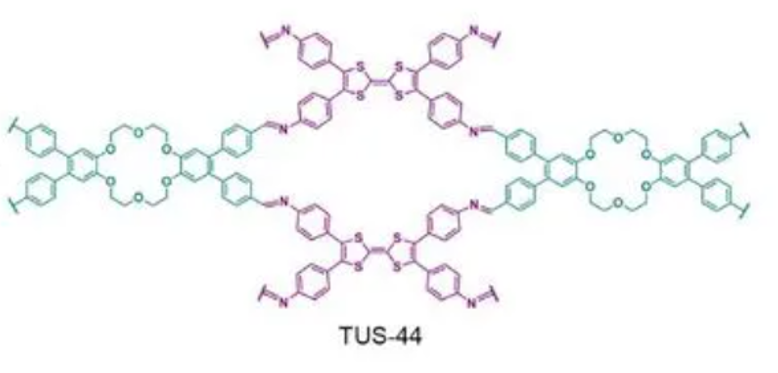
- テトラチアフルバレン(TTF)骨格: 豊かな電子を持ち、優れた有機導電性を示す。
- ベンゾ[18]クラウン-6骨格: 特定の金属イオン(リチウムイオンなど)を包み込んで捕捉する能力を持つ。
3つのヘテロ原子による「分子レベルの完全分業」
密度汎関数理論(DFT)計算とX線光電子分光法(XPS)により、TUS-44内の3つの原子がベルトコンベア式に役割を分担していることが証明されました。
- イミン窒素(N)【捕獲】:リチウムイオンと強く相互作用し、溶け出したポリスルフィドを強力に吸着(吸着エネルギー:-1.18 eV)。シャトル効果を根底から食い止めます。
- クラウンエーテル酸素(O)【誘導】:リチウムイオンのスムーズな移動経路を確保し、イオン伝導性をサポートします。
- TTF由来の硫黄(S)【反応促進】:複合化したグラフェンと連携して電子の受け渡しを媒介し、ポリスルフィドの酸化還元(レドックス)反応のスピードを劇的に加速させます。
3. 実証された圧倒的な電池性能
TUS-44をグラフェンと複合化(TUS-44@G)し、セパレーター上に極薄膜としてコーティングしたセルの性能は、従来の限界を大きく塗り替えました。
従来技術との電気化学的特性比較
| 評価指標 | 従来型セパレーター (Celgard) | グラフェン塗布セパレーター | TUS-44@G塗布セパレーター(本研究) |
| 高負荷時の容量 (10 A/gの大電流時) | 約 161 mAh/g | 約 81.2 mAh/g | 773 mAh/g (圧倒的なレート特性) |
| 電荷移動抵抗 (Rct) | 91.56Ω | 36.48Ω | 44.24Ω(導電性と吸着の最適バランス) |
| 5 A/g での長期耐久性 | 早期に劣化、測定不能 | 容量低下が顕著 | 1,000回後も 604 mAh/gを維持 (1サイクルあたり僅か $0.034\%$ の低下) |
| 過電圧(ロス) | 高い | やや高い | 71.8 mV に抑制 |
| 負極(Li金属)の表面 | デンドライト(樹枝状結晶)が発生 | デンドライトが発生 | 鏡のように滑らかな表面を維持 |
実用化へ向けたマイルストーン:パウチセルでの実証
研究室レベルのコインセル(電解液を過剰に入れられるため、シャトル効果が隠れやすい)にとどまらず、より実用形態に近いパウチセル(電極面積 24.08 cm2、硫黄量 44.558 mg)での試験を実施しました。
電解液の量を極限まで絞った厳しい条件下(電解液/硫黄比:2.69 mL/g)において、初期エネルギー密度 674 Wh/kg を達成。これは現在の一般的な商用リチウムイオン電池(250 ~ 300 Wh/kg)の2倍以上に相当する破壊的な数値です。
4. 【関連情報補足】次世代電池マップにおけるリチウム硫黄電池の位置づけ
現在、ポスト・リチウムイオン電池の座を巡っては、複数の技術が並行して開発されています。それぞれの特徴と今回の成果による影響を整理します。
- 全固体電池(硫化物系・酸化物系など):
- 特徴: 電解液を固体に置き換えるため安全性が極めて高く、高出力。
- 課題: 固固界面の接合維持が難しく、製造プロセスが複雑で高コスト。
- リチウム金属電池(次世代リチウムイオン等):
- 特徴: 負極にリチウム金属を使い容量を上げるが、正極は既存のニッケル・コバルト系。
- 課題: レアメタル依存から脱却できない。
- リチウム硫黄電池(本技術):
- 特徴: 圧倒的な軽量・高エネルギー密度、かつ抜群の低コスト(硫黄ベース)。
- 今回の革新: 弱点だった「短寿命(シャトル効果)」を液系電解液のままで克服。既存のリチウムイオン電池の製造ライン(液系用)を大幅に改修することなく流用できる可能性が高く、全固体電池に対して「社会実装スピード」と「コスト」の面で強力な優位性を持ちます。
今後の課題
社会実装への最終ステップとしては、さらに電解液を減らした「極限のリーンエレクトロライト環境」での動作安定性の検証や、幅広い温度域(特に冬場の低温環境など)での長寿命化の証明が挙げられます。しかし、TUS-44が示した「分子レベルでの役割分担設計」は、ナトリウム硫黄電池や金属空気電池といった他の次世代蓄電デバイスへの応用も期待される、極めて汎用性の高いプラットフォーム技術と言えます。
出典:https://xenospectrum.com/tus-44-cof-lithium-sulfur-battery-breakthrough/#google_vignette
Achieving an Energy Density of 674 Wh/kg! Tohoku University Overcomes the Shuttle Effect in Lithium-Sulfur Batteries via Molecular Design
Lithium-sulfur (Li-S) batteries have become the focus of intense global development competition as a key technology for next-generation clean mobility and grid storage. Despite possessing a theoretical energy density several times higher than current lithium-ion batteries and utilizing low-resource-risk sulfur for the cathode, this technology has long been hindered by a unique degradation mechanism known as the “shuttle effect.”
Based on the latest breakthrough regarding the novel material “TUS-44”—which fundamentally resolves this dilemma and was recently announced by an international joint research group led by Professor Yuichi Negishi and his colleagues at Tohoku University—this article provides a structured overview of the underlying principles of Li-S batteries, contextualized with supplementary comparisons to alternative next-generation technologies.
1. The Potential of Li-S Batteries and the Barrier of the “Shuttle Effect”
A lithium-sulfur (Li-S) battery is an energy storage system that utilizes sulfur (S) as the cathode and lithium metal (Li) as the anode.
Why Sulfur?
- Overwhelming Theoretical Capacity: The theoretical capacity of sulfur is 1,672 mAh/g, which dwarfs that of conventional lithium-ion battery cathode materials like lithium cobalt oxide (approx. 270 mAh/g).
- High Cost-Effectiveness and Sustainability: Sulfur is highly abundant and extremely inexpensive because it is produced in large quantities as a byproduct of petroleum refining. It eliminates dependency on rare metals like cobalt and nickel, which carry geopolitical supply risks and heavy environmental burdens.
The Major Obstacle: The “Shuttle Effect”
During the discharge process of a Li-S battery, sulfur reacts with lithium in a stepwise manner, generating intermediate lithium polysulfides ($\text{Li}_2\text{S}_x$, where $4 \le x \le 8$).
【Mechanism of the Shuttle Effect】
- Long-chain polysulfides ($\text{Li}_2\text{S}_8$ and $\text{Li}_2\text{S}_4$) generated during discharge readily dissolve into the liquid organic electrolyte.
- These dissolved polysulfides migrate through the separator and diffuse toward the negative electrode (lithium metal anode).
- They are directly reduced on the anode surface, precipitating as insoluble $\text{Li}_2\text{S}_2$ or $\text{Li}_2\text{S}$, which permanently depletes the active material (sulfur).
- This continuous back-and-forth migration (shuttling) causes a catastrophic drop in capacity within just a few dozen cycles.
Past approaches have attempted to physically confine polysulfides using porous carbon or similar materials. However, because sulfur is an inherent insulator, tight physical confinement severely compromises electron transport (electrical conductivity). This leaves researchers trapped in a painful trade-off where the redox reaction rate (power output characteristics) drops significantly.
2. Molecular Design of the New Material “TUS-44” Developed by Tohoku University
To simultaneously achieve “leakage prevention” and “accelerated reaction kinetics,” the Tohoku University research team constructed a novel “reactive interface” utilizing a Covalent Organic Framework (COF)—a crystalline porous polymer. The newly developed material is named “TUS-44.”
Fusion of Two “Masterpiece Molecules”
TUS-44 features a precisely engineered 2D layered network with a double six-fold (bex) topology, providing uniform micropores (approx. 0.9 nm to 1.2 nm) that perfectly match the molecular dimensions of polysulfides. The framework integrates two masterfully selected core units:
- Tetrathiafulvalene (TTF) Framework: Rich in electrons, serving as a historic staple in organic conductors to provide excellent electrical pathways.
- Benzo[18]crown-6 Framework: A crown ether variant capable of encapsulating and trapping specific metal ions (such as lithium ions).
“Complete Division of Labor” at the Molecular Level
Density Functional Theory (DFT) calculations and X-ray Photoelectron Spectroscopy (XPS) confirmed that three specific heteroatoms within TUS-44 distribute tasks in an assembly-line fashion:
- Imine Nitrogen (N) 【Capture】: Interacts exceptionally strongly with lithium ions to firmly anchor dissolved polysulfides (binding energy: $-1.18\text{ eV}$), tackling the shuttle effect at its root.
- Crown Ether Oxygen (O) 【Guidance】: Secures smooth pathways for lithium-ion migration, drastically supporting overall ionic conductivity.
- TTF-Derived Sulfur (S) 【Reaction Acceleration】: Cooperates with the composited graphene to mediate electron transfer, rapidly accelerating the typically sluggish polysulfide redox conversion.
3. Demonstrated Performance Breakthroughs
By compositing TUS-44 with highly conductive graphene ($\text{TUS-44@G}$) and coating it as an ultra-thin membrane onto a standard polypropylene separator, the cell performance shattered historical limitations.
Electrochemical Property Comparison with Conventional Technologies
| Performance Metrics | Conventional Separator (Celgard) | Graphene-Coated Separator | TUS-44@G-Coated Separator (This Study) |
| High-Load Capacity (At a high current of $10\text{ A/g}$) | Approx. $161\text{ mAh/g}$ | Approx. $81.2\text{ mAh/g}$ | $773\text{ mAh/g}$ (Exceptional rate capability) |
| Charge-Transfer Resistance ($R_{ct}$) | $91.56\ \Omega$ | $36.48\ \Omega$ | $44.24\ \Omega$ (Optimally balanced conductivity & adsorption) |
| Long-Term Durability at $5\text{ A/g}$ | Degrades early; unmeasurable | Pronounced capacity decay | Maintains $604\text{ mAh/g}$ after 1,000 cycles (Decay rate of just $0.034\%$ per cycle) |
| Overpotential (Energy Loss) | High | Moderately High | Suppressed to $71.8\text{ mV}$ |
| Anode (Li Metal) Surface | Severe dendrite growth | Severe dendrite growth | Maintains a mirror-smooth surface |
Commercialization Milestone: Pouch Cell Verification
Moving beyond lab-scale coin cells—where excessive electrolyte volumes often mask the true severity of the shuttle effect—the team tested the material in a commercial-style pouch cell (electrode area: $24.08\text{ cm}^2$, sulfur loading: $44.558\text{ mg}$).
Even under strictly constrained “lean electrolyte” conditions (electrolyte-to-sulfur ratio: $2.69\text{ mL/g}$), the pouch cell delivered an initial energy density of 674 Wh/kg. This disruptive figure is more than double that of conventional commercial lithium-ion batteries ($250 \sim 300\text{ Wh/kg}$).
4. Supplementary Context: Li-S Batteries in the Next-Gen Battery Landscape
Several technologies are currently competing to claim the throne of post-lithium-ion energy storage. Their distinct profiles and the impact of this breakthrough are categorized below:
- All-Solid-State Batteries (Sulfidic, Oxidic, etc.):
- Features: Exceptional safety and high power output achieved by replacing liquid electrolytes with solid alternatives.
- Challenges: High manufacturing costs and complexity; difficulty maintaining solid-to-solid interfacial contact over time.
- Features: Replaces standard graphite anodes with lithium metal to boost capacity, but relies on existing nickel/cobalt-based chemistry for the cathode.
- Challenges: Fails to break the dependency on volatile, expensive rare metals.
- Lithium-Sulfur Batteries (This Technology):
- Features: Unmatched lightweight properties, extreme energy density, and unparalleled cost advantages due to the abundance of sulfur.
- The Innovation: Overcomes the traditional fatal flaw—short cycle life caused by the shuttle effect—while retaining a liquid electrolyte system. Because it can seamlessly fit into existing liquid-electrolyte production lines without requiring complete factory overhauls, it holds a massive advantage over all-solid-state options in terms of rollout speed and scalability.
Future Engineering Challenges
The final hurdles toward commercial scaling include verifying long-term operational stability under even lower electrolyte thresholds (“ultimate lean electrolyte conditions”) and proving lifecycle durability across extreme temperature ranges (such as freezing winter conditions).
Nevertheless, the molecular-level “division of labor” platform demonstrated by TUS-44 serves as a highly versatile framework. It holds immense promise for cross-application into other next-generation devices, including sodium-sulfur batteries, metal-air batteries, and high-efficiency electrocatalysts.

コメント