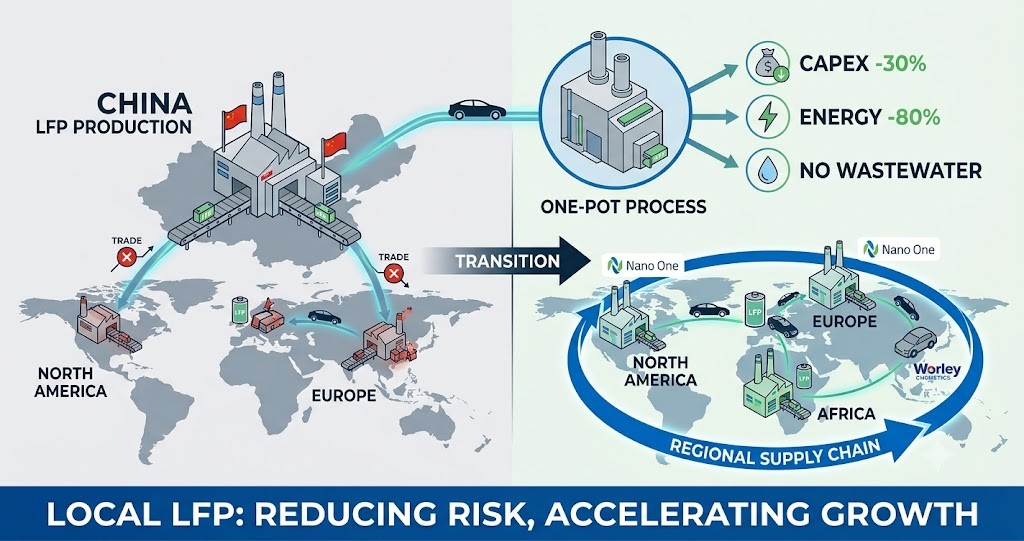
現在、世界のEV用バッテリー市場で主流となりつつある「リン酸鉄リチウム(LFP)」バッテリーですが、その正極材(CAM)生産の98%以上が中国に集中しているというサプライチェーンの偏りが国際的な課題となっています。中国政府による輸出規制の強化や、地政学的リスクへの懸念が高まる中、北米や欧州といった主要先進国では「重要鉱物やバッテリー材料の地域内調達(ローカルサプライチェーンの構築)」が経済安全保障上の最優先事項となっています。このような背景のもと、カナダの技術企業Nano One社が発表した新たな製造パッケージは、脱中国依存を加速させる画期的な一手として注目を集めています。
1. 発表の概要
リチウムイオン電池正極活物質(CAM)の革新的なプロセス技術を持つNano One Materials社は、提携パートナーであるWorley Chemetics社とともに、「One-Pot(ワンポット)LFP CAMパッケージ」の設計・開発を完了し、商業販売を開始しました。これにより、2026年上半期の主要目標を達成しました。
2. One-Pot LFP CAMパッケージとは
このパッケージは、原材料をLFP正極材に変換するコアプロセス機器(ISBL範囲)の設計、建物のレイアウト、機器仕様、コスト見積もり、そして技術ライセンスを一つにまとめたオールインワンのソリューションです。
- 調達の地域化: 北米、欧州、南アフリカの認定機器ベンダー(販売業者)のみで構成されており、中国に依存しないサプライチェーン構築が可能です。
- 顧客へのメリット: 技術やコストの不確実性(リスク)を低減し、工場建設や市場投入までの期間を大幅に短縮できます。
3. ワンポットプロセスの圧倒的なコスト・環境優位性(関連情報)
従来のLFP製造方法と比較して、Nano One独自のワンポットプロセスは以下の劇的な削減効果をもたらします。
- 設備投資額(設備投資コスト): 少なくとも30%削減
- 運用コスト: 最大30%削減
- エネルギー消費量: 最大80%削減
- 環境負荷: 廃水や副産物を排除し、工程数を減らすことで環境への影響を最小限に抑えます。
4. 柔軟性を高める「ハイブリッド構成」の開発(2026年下半期予定)
中国製機器の使用が許可されている地域や、より柔軟な調達を求める顧客向けに、中国のベンダーからの調達も選択肢に含めた「ハイブリッド構成」も現在開発中(2026年下半期に完成予定)です。ただし、特許や知的財産権(IP)に関わるコア装置(ワンポット反応器など)については、どちらの構成であっても欧米のパートナーによって製造され、技術流出を防ぐ設計となっています。
5. 背景にある市場需要と地政学的要因(関連情報)
- 市場の急成長: LFPは、2020年には世界市場の10%未満でしたが、現在ではEV市場のほぼ半分を占め、電力網向けのエネルギー貯蔵システム(ESS)でも標準的な化学物質となっています。
- 高まる規制と政策: 中国によるLFP材料・生産設備の輸出規制強化(2025-2026年)に対抗し、2026年6月にはG7首脳が「重要鉱物のサプライチェーン確保に関する宣言」を発表。中流・下流産業の地域価値創造と経済安全保障の強化を掲げており、Nano Oneの地域密着型生産パッケージはまさにこの国策に合致しています。
関連解説:Nano One社の「設計・製造・大量展開」戦略
Nano One自身がすべての工場を所有して大量生産するのではなく、長年の化学処理装置の設計実績を持つWorley Chemetics社と組み、完成された技術パッケージを世界中のCAMメーカーへ「ライセンス供与(技術提供)」する戦略をとっています。 この取り組みは、Next Generation Manufacturing Canadaからの280万カナダドルの資金援助をはじめ、米・仏・加などの各国政府の支援を受けており、グローバルな戦略的パートナー(住友金属鉱山、リオ・ティントなど)とともに、次世代バッテリー材料の分散型・地域密着型生産を世界規模で急速に拡大することを目指しています。
- Nano One and Worley Chemetics Complete “One-Pot LFP Cathode Package” for Market Launch
- 1. Overview of the Announcement
- 2. What Is the One-Pot LFP CAM Package?
- 3. Overwhelming Cost and Environmental Advantages of the One-Pot Process (Related Information)
- 4. Development of a “Hybrid Configuration” for Enhanced Flexibility (Planned for H2 2026)
- 5. Market Demand and Geopolitical Factors in the Background (Related Information)
- Related Commentary: Nano One’s “Design, Manufacture, and Scaled Deployment” Strategy
Nano One and Worley Chemetics Complete “One-Pot LFP Cathode Package” for Market Launch
While Lithium Iron Phosphate (LFP) batteries are becoming mainstream in the global electric vehicle (EV) battery market today, the fact that over 98% of Cathode Active Material (CAM) production is concentrated in China represents a supply chain imbalance that has become an international challenge. Amid tightening export controls by the Chinese government and rising concerns over geopolitical risks, securing local procurement of critical minerals and battery materials (building local supply chains) has become a top priority for economic national security in major developed regions like North America and Europe. Against this backdrop, the new manufacturing package announced by Canadian technology firm Nano One is drawing significant attention as a breakthrough move to accelerate decoupling from reliance on China.
1. Overview of the Announcement
Nano One Materials, a process technology company with innovative technology for lithium-ion battery cathode active materials (CAM), together with its alliance partner Worley Chemetics, has completed the design and development of the “One-Pot LFP CAM Package” and commenced commercial sales. With this achievement, the company has fulfilled its key goal for the first half of 2026.
2. What Is the One-Pot LFP CAM Package?
This package is an all-in-one solution that integrates the design of core process equipment (Inside Battery Limits, or ISBL scope) to convert raw materials into LFP cathode material, building layouts, equipment specifications, cost estimates, and technology licensing.
- Localization of Procurement: It is comprised exclusively of qualified equipment vendors from North America, Europe, and South Africa, enabling the construction of a supply chain that does not rely on China.
- Benefits to Customers: It reduces technical and financial uncertainty (risk) and significantly shortens the timeline for plant construction and time-to-market.
3. Overwhelming Cost and Environmental Advantages of the One-Pot Process (Related Information)
Compared to conventional LFP manufacturing methods, Nano One’s proprietary One-Pot process delivers the following dramatic reductions:
- Capital Expenditure (CapEx Cost): Reduced by at least 30%
- Operating Cost (OpEx): Reduced by up to 30%
- Energy Consumption: Reduced by up to 80%
- Environmental Footprint: Minimizes environmental impact by eliminating wastewater and by-products and reducing the number of process steps.
4. Development of a “Hybrid Configuration” for Enhanced Flexibility (Planned for H2 2026)
For regions where the use of Chinese equipment is permitted, or for customers seeking more flexible sourcing, a “Hybrid Configuration” that includes procurement options from Chinese vendors is currently under development (scheduled for completion in the second half of 2026). However, regarding core equipment involving patents and intellectual property (IP), such as the One-Pot reactor, it will be manufactured by Western partners under either configuration to prevent technology leakage.
5. Market Demand and Geopolitical Factors in the Background (Related Information)
- Rapid Market Growth: LFP supplied less than 10% of the global market in 2020, but it now powers nearly half of the EV market and has increasingly become the chemistry of choice for grid-scale energy storage systems (ESS).
- Rising Regulations and Policies: In response to China’s expanding export controls on LFP materials and production equipment (2025-2026), G7 leaders issued the “Declaration on Securing Supply Chains for Critical Minerals” in June 2026. This declaration commits to strengthening midstream and downstream industrial competitiveness and regional value creation alongside economic security, a national policy direction that perfectly aligns with Nano One’s regionalized production package.
Related Commentary: Nano One’s “Design, Manufacture, and Scaled Deployment” Strategy
Rather than owning all the factories and mass-producing materials itself, Nano One is pursuing a strategy to license its completed technology packages to CAM manufacturers worldwide by teaming up with Worley Chemetics, which has decades of experience in chemical processing equipment design.
This initiative is backed by 2.8 million Canadian dollars in non-dilutive funding from Next Generation Manufacturing Canada, alongside support from various governments including Canada, the US, and France. Together with global strategic partners such as Sumitomo Metal Mining and Rio Tinto, the company aims to rapidly scale the decentralized, regionalized production of next-generation battery materials on a global scale.
コメント