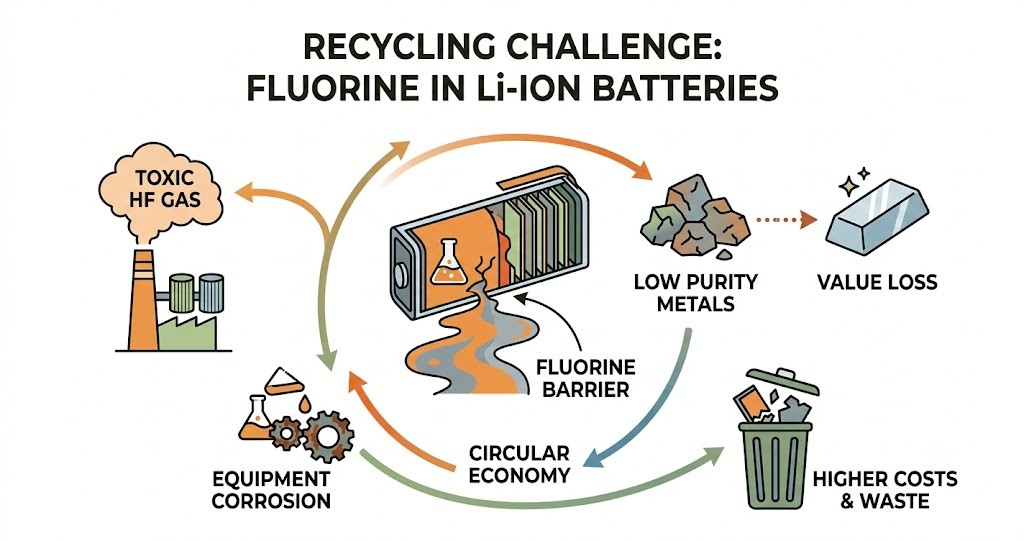
バーミンガム大学の研究チーム(リジー・ドリスコル博士ら)は、リチウムイオン電池(LiB)に広く使用されているフッ素含有材料が、レアメタルの回収効率を下げ、環境負荷やコストを増大させる大きな障害になっていると警告しました。
1. バッテリーに含まれるフッ素化合物とその役割
フッ素は現在のリチウムイオン電池の性能を維持するために不可欠な要素であり、主に以下の部材に含まれています。
- LiPF6(六フッ化リン酸リチウム): 主流の電解質塩として広く使用。
- PVDF(ポリフッ化ビニリデン): 電極材料を固定するバインダー(接着剤)として使用。
2. 主要なリサイクル手法(乾式・湿式)におけるフッ素の弊害
現在工業化されている2大リサイクルルートにおいて、フッ素はそれぞれ深刻な問題を引き起こします。
- 乾式製錬(高温処理)の課題: バッテリーを高温で溶融する際、PVDFやLiPF6が分解し、極めて毒性と腐食性が高い「フッ化水素(HF)ガス」が発生します。これを安全に処理するために、高額な排ガス除去設備が必要となり、コストを押し上げます。
- 湿式製錬(化学溶液処理)の課題: 解体や前処理の段階で水分があると、LiPF6が加水分解を起こしてHFを生成します。溶液中に溶け出したフッ化物イオンは、リチウム、コバルト、ニッケルなどの重要鉱物を沈殿・回収するプロセスを妨害し、回収品の純度を低下させます。また、PVDFは一般的な溶媒に溶けにくいため、電極からの剥離を難しくします。
3. 【関連情報】欧州のバッテリー規制とフッ素対策の重要性
本研究が欧州で注目される背景には、世界で最も厳しいとされる環境規制の存在があります。
- 欧州バッテリー規則(欧州電池法)の影響: 欧州連合(EU)では、2020年代後半から段階的に、リサイクルによって回収されたコバルト、リチウム、ニッケルの最低使用割合(再利用義務)が法制化されています。フッ素による汚染や回収率の低下は、自動車メーカーやリサイクル業者がこの法的な目標を達成する上での致命的なリスクとなります。
- PFAS規制との連動: PVDFなどのフッ素系バインダーは、環境中に長く残留する「PFAS(有機フッ素化合物)」の一種として分類される傾向にあります。欧州では将来的なPFASの使用制限も議論されており、リサイクル時だけでなく、製造段階からフッ素を使わない材料開発(水系バインダーなど)への移行が急務となっています。
- 直接リサイクル(Direct Recycling)への期待: 論文でも触れられている「直接リサイクル」は、材料を元素レベルまでバラバラに破壊せず、正極材の結晶構造を維持したままリチウムを再補填して復活させる新しい技術です。これが実用化されれば、フッ素の悪影響を回避しつつ、より低エネルギーで高価値な材料再生が可能になると期待されています。
まとめ:持続可能な「クローズドループ」実現への鍵
バッテリーリサイクルの現場では、これまで「いかに多くの重要鉱物を回収するか」に焦点が当てられてきましたが、今後は「フッ素のような有害・妨害物質をいかに安全かつ効率的に制御・排除するか」という化学的理解と管理が、持続可能な循環型社会(クローズドループ)を成立させるための最大の鍵となります。
出典:https://www.bestmag.co.uk/iom3-fluorine-challenge-battery-recycling/
The Price of High Performance? The “Severe Double Whammy” Triggered by Fluorine Compounds in Lithium-Ion Battery Recycling
A research team at the University of Birmingham, led by Dr. Lizzie Driscoll, has warned that fluorine-containing materials widely used in lithium-ion batteries (LiBs) pose a major obstacle. These materials lower the recovery efficiency of rare metals while increasing environmental burdens and processing costs.
- 1. バッテリーに含まれるフッ素化合物とその役割
- 2. 主要なリサイクル手法(乾式・湿式)におけるフッ素の弊害
- 3. 【関連情報】欧州のバッテリー規制とフッ素対策の重要性
- まとめ:持続可能な「クローズドループ」実現への鍵
- 1. Fluorine Compounds in Batteries and Their Roles
- 2. Harmful Effects of Fluorine in Major Recycling Methods (Pyrometallurgy and Hydrometallurgy)
- 3. Related Information: European Battery Regulations and the Importance of Fluorine Countermeasures
- Summary: The Key to Realizing a Sustainable “Closed Loop”
1. Fluorine Compounds in Batteries and Their Roles
Fluorine is an indispensable element for maintaining the performance of current lithium-ion batteries and is mainly found in the following components:
- LiPF6 (Lithium Hexafluorophosphate): Widely used as the mainstream electrolyte salt.
- PVDF (Polyvinylidene Fluoride): Used as a binder (adhesive) to fix electrode materials in place.
2. Harmful Effects of Fluorine in Major Recycling Methods (Pyrometallurgy and Hydrometallurgy)
In the two main recycling routes currently commercialized in the industry, fluorine causes severe problems in each process.
- Challenges in Pyrometallurgy (High-Temperature Processing): When batteries are melted at high temperatures, PVDF and LiPF6 decompose to generate hydrogen fluoride (HF) gas, which is highly toxic and corrosive. Safely treating this gas requires expensive exhaust gas scrubbing systems, driving up operational costs.
- Challenges in Hydrometallurgy (Chemical Solution Processing): If moisture is present during the dismantling or pre-treatment stages, LiPF6 undergoes hydrolysis to produce HF. Fluoride ions dissolved in the solution interfere with the precipitation and recovery processes of critical minerals such as lithium, cobalt, and nickel, reducing the purity of the recovered products. Furthermore, because PVDF is insoluble in common solvents, it makes separating active materials from the electrodes difficult.
3. Related Information: European Battery Regulations and the Importance of Fluorine Countermeasures
The reason this study is drawing significant attention in Europe is the existence of environmental regulations considered the strictest in the world.
- Impact of the European Battery Regulation: In the European Union (EU), minimum recycled content mandates for cobalt, lithium, and nickel are being phased in starting in the late 2020s. Contamination and reduced recovery rates caused by fluorine pose a fatal risk for automakers and recyclers trying to meet these legal targets.
- Link with PFAS Regulations: Fluorinated binders such as PVDF tend to be classified as a type of PFAS (per- and polyfluoroalkyl substances), which persist in the environment for long periods. With future restrictions on PFAS usage being debated in Europe, there is an urgent need to shift toward fluorine-free material development (such as water-based binders) from the manufacturing stage, not just during recycling.
- Expectations for Direct Recycling: “Direct recycling,” which is also discussed in the paper, is an emerging technology that restores the battery by replenishing lithium while maintaining the crystal structure of the cathode material, rather than breaking the materials down into their elemental components. If commercialized, this method is expected to enable lower-energy, higher-value material regeneration while avoiding the negative impacts of fluorine.
Summary: The Key to Realizing a Sustainable “Closed Loop”
While battery recycling efforts have previously focused primarily on “how many critical minerals can be recovered,” the future key to establishing a sustainable circular economy (closed loop) will be the chemical understanding and management of “how to safely and efficiently control and eliminate hazardous and interfering substances like fluorine.”

コメント