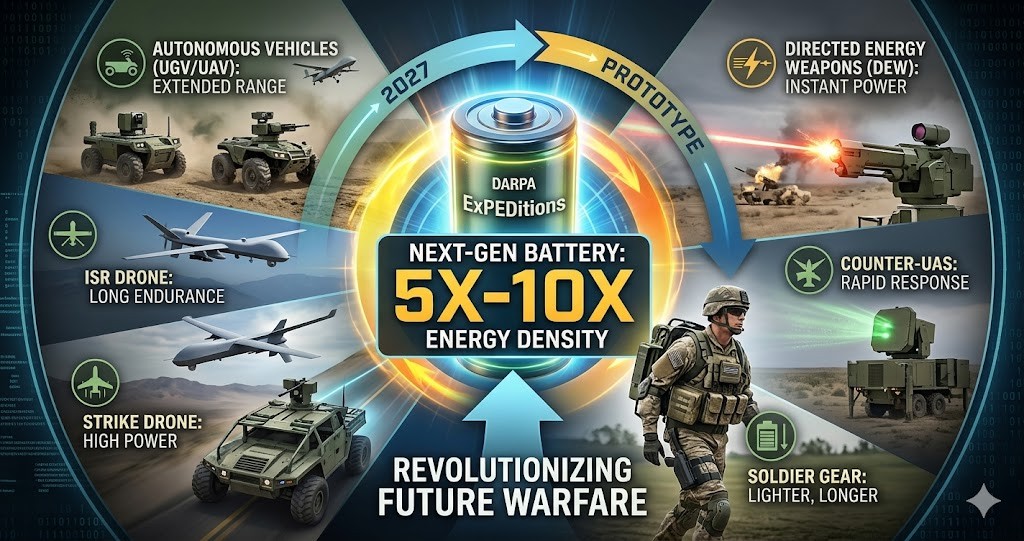
米国防高等研究計画局(DARPA)は、将来の戦場システムや自律型兵器の運用能力を飛躍的に高めるため、現行システムの5倍から10倍という圧倒的なエネルギー密度を持つ次世代充電式バッテリーの開発プログラム「ExPEDitions」を開始しました。
1. プログラムの概要とタイムライン
本取り組みは「遠征型電力・エネルギー密度実装プログラム(ExPEDitions)」の一環として、公募(DARPA-PS-26-118)が開始されました。
- 開発内容: 開発者には、基礎的な電池化学、新材料、および電池アーキテクチャの根本的な進歩が求められます。
- スケジュール: 2026年6月中に概要提出、8月に正式な提案書提出締め切りを経て、2027年1月からプロジェクトが開始される予定です。18ヶ月ずつの2フェーズ(計36ヶ月)で構成され、複数のプロトタイプ開発が進められます。
2. 軍事システムが直面する「エネルギーと電力の不均衡」の解消
現在のバッテリー技術は、蓄えられる総エネルギー量(エネルギー密度:持続力)と、それを引き出す速度(電力密度:瞬発力)の間にトレードオフ(二者択一)の関係があり、軍用システムの運用を制約しています。
- 課題の具体例:
- 監視ドローン: 標的上空で長時間活動するため、高い「エネルギー密度(持続力)」が必要。
- 攻撃ドローン・迎撃システム: 攻撃的な機動や高出力な作動のために、迅速にエネルギーを放出する「電力密度(瞬発力)」が必要。
- DARPAの狙い: この長年の課題を解決し、「長時間のエネルギー貯蔵」と「高速な電力出力」を同一のバッテリーで両立させることを目指します。
3. 【関連情報】次世代軍用バッテリーが求められる背景と技術的展望
DARPAがエネルギー効率10倍という極めて高い目標を掲げる背景には、近代戦における兵器の劇的な変化があります。
- ドローン(UGV/UAV)の多用と自律化: 偵察・攻撃ドローンだけでなく、ニュース内でも触れられているHarbinger社の350kWハイブリッドUGV(無人地上車両)のような大型の無人システムが戦場に投入されつつあります。これらを長期間、前線で稼働させるには超高効率な電源が不可欠です。
- 指向性エネルギー兵器(DEW)の普及: レーザー兵器や対ドローン用高出力マイクロ波(HPM)システムは、作動時に一瞬で膨大な電力を消費します。現行のバッテリーや発電機では重量やサイズの面で前線への展開に限界があり、軽量かつ超高出力な次世代バッテリーの登場が待たれています。
- 兵士の装備軽量化: 現代の歩兵は、暗視装置、無線機、ウェアラブル端末など多くの電子機器を身につけており、そのバッテリー重量が大きな負担となっています。エネルギー密度が5〜10倍になれば、持ち運ぶバッテリーの重さを劇的に減らし、作動時間を大幅に伸ばすことができます。
まとめ:戦場のロジスティクス(兵站)を激変させる可能性
DARPAの「ExPEDitions」プログラムが目指す次世代バッテリーは、単に個々の兵器の性能を上げるだけでなく、前線への燃料補給や充電の手間を大幅に減らし、軍の「遠征能力(Expeditionary capability)」そのものを引き上げる可能性を秘めています。2027年からのプロトタイプ開発とその成果は、軍事のみならず将来の民間産業(空飛ぶクルマや高性能ロボット)へも波及する重要プロジェクトとして注目されます。
出典:https://nextgendefense.com/darpa-military-battery-program/
Balancing Endurance and Rapid Output: US Military’s Ultra-High-Density Battery Development Set to Change the Rules for Drones and Laser Weapons
The US Defense Advanced Research Projects Agency (DARPA) has launched the “ExPEDitions” program, a development initiative for next-generation rechargeable batteries. To dramatically enhance the operational capabilities of future battlefield systems and autonomous weapons, the program targets an overwhelming energy density 5 to 10 times higher than that of current systems.
- 1. プログラムの概要とタイムライン
- 2. 軍事システムが直面する「エネルギーと電力の不均衡」の解消
- 3. 【関連情報】次世代軍用バッテリーが求められる背景と技術的展望
- まとめ:戦場のロジスティクス(兵站)を激変させる可能性
- 1. Program Overview and Timeline
- 2. Resolving the “Energy and Power Imbalance” Faced by Military Systems
- 3. Related Information: Background and Technological Outlook of Next-Generation Military Batteries
- Summary: Potential to Revolutionize Battlefield Logistics
1. Program Overview and Timeline
This initiative has been launched under a program solicitation (DARPA-PS-26-118) as part of the Expeditionary Power and Energy Density Implementations (ExPEDitions) program.
- Development Focus: Developers are required to achieve fundamental advancements in basic battery chemistry, new materials, and cell architectures.
- Schedule: Following the submission of abstracts in June 2026 and the deadline for formal proposals in August, the project is scheduled to begin in January 2027. It will run for a total of 36 months, divided into two 18-month phases, with multiple prototype development contracts expected to be awarded.
2. Resolving the “Energy and Power Imbalance” Faced by Military Systems
Current battery technology is limited by a long-standing trade-off between the total amount of energy that can be stored (energy density: endurance) and the speed at which it can be delivered (power density: rapid output), which constrains the operation of military systems.
- Specific Examples of the Challenge:
- Surveillance Drones: Require high “energy density (endurance)” to operate over target areas for extended periods.
- Attack Drones and Interception Systems: Require high “power density (rapid output)” to discharge energy quickly for aggressive maneuvers and high-output operations.
- DARPA’s Goal: To eliminate this imbalance by developing a single rechargeable battery capable of providing both long-duration energy storage and high-speed power output.
3. Related Information: Background and Technological Outlook of Next-Generation Military Batteries
DARPA’s highly ambitious goal of achieving up to a 10-fold increase in energy efficiency is driven by the dramatic transformation of weaponry in modern warfare.
- Widespread Use and Autonomy of Drones (UGVs/UAVs): In addition to reconnaissance and attack drones, larger unmanned systems—such as Harbinger’s 350 kW hybrid UGV (Unmanned Ground Vehicle) mentioned in the news—are increasingly being deployed to the battlefield. Ultra-efficient power sources are essential to keep these systems operational on the front lines for long periods.
- Proliferation of Directed Energy Weapons (DEWs): Laser weapons and high-power microwave (HPM) counter-drone systems consume massive amounts of power in an instant when activated. Current batteries and generators face deployment limitations due to their weight and size, making the arrival of lightweight, ultra-high-output next-generation batteries highly anticipated.
- Lightening the Load for Soldiers: Modern infantry soldiers carry numerous electronic devices, such as night-vision goggles, radios, and wearable electronics, making battery weight a major physical burden. Increasing energy density by 5 to 10 times would drastically reduce the weight of the batteries they carry while significantly extending operational times.
Summary: Potential to Revolutionize Battlefield Logistics
The next-generation batteries envisioned by DARPA’s “ExPEDitions” program will do more than just boost the performance of individual weapons. By significantly reducing the need for refueling and recharging on the front lines, they hold the potential to fundamentally enhance the military’s “expeditionary capability.” The prototype development starting in 2027 and its outcomes will be watched closely as a vital project whose impacts could spill over from the military into future civilian industries, such as flying cars and high-performance robotics.
コメント