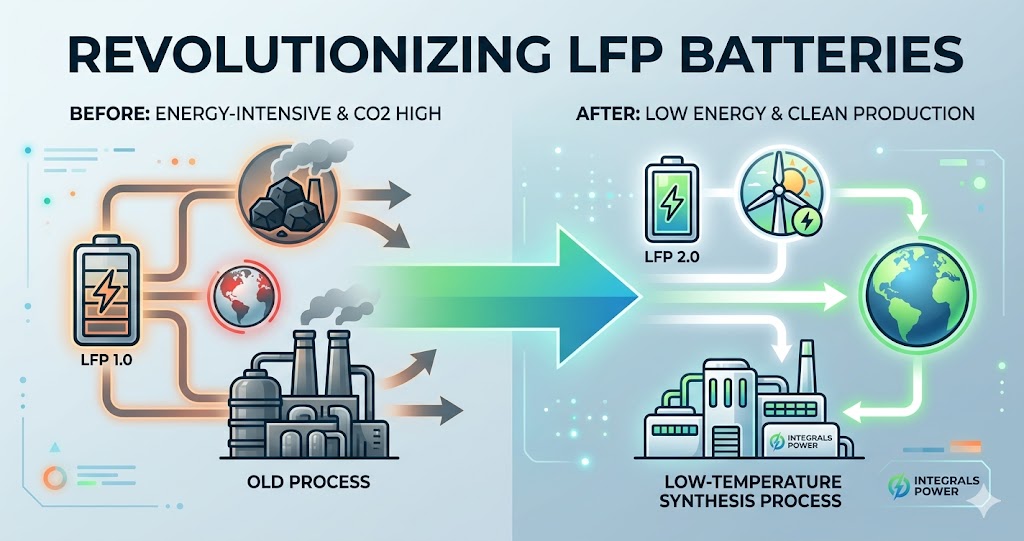
世界的な電気自動車(EV)シフトとエネルギー貯蔵システム(ESS)の需要拡大を背景に、電池材料のサプライチェーン再編が急務となっている。現在、安価で安全性の高いリン酸鉄リチウム(LFP)電池の供給網はその大部分を中国が占めているが、欧米諸国では経済安全保障の観点から「脱・中国」を掲げた国産化の動きが加速している。こうした中、英国の電池材料スタートアップが、環境負荷を抑えつつ高品質な材料を域内で生産できる画期的な技術を発表し、大きな注目を集めている。
英国ミルトン・キーンズから発信される革新技術
英国の電池材料開発企業インテグラルズ・パワー(Integrals Power)は、LFP正極材料の主要な前駆体である「リン酸鉄」の新たな製造プロセスを、ミルトン・キーンズの自社施設で開発したと発表した。
同社が開発した新プロセスは「低温合成法」を採用しているのが最大の特徴だ。従来の製造技術と比較して大幅にエネルギー消費量を抑制し、製造工程に伴う炭素排出量(CO2フットプリント)を削減するよう設計されている。また、この手法は鉄鋼産業など他の産業部門からの副産物に依存せず、独自のルートで粒子特性を厳密に制御した高純度のリン酸鉄を製造することを目的としている。
中国依存からの脱却と性能の実証
現在、LFPおよびその前駆体の世界的な供給シェアは中国が圧倒的だが、インテグラルズ・パワー社は新製法を用いることで、英国、欧州、北米などの地域サプライチェーンから調達した原材料のみでリン酸鉄を生産できる可能性を示した。
同社によれば、開発された材料は英国の大学と共同でセルレベルの試験が実施されており、中国の主要サプライヤーから入手したベンチマークサンプルと同等、あるいはそれ以上の性能を示したという。これは、地域調達の材料であっても、コスト競争力($/kWhベース)と高品質を両立できることを証明するものだ。
迫り来る2027年規則と市場の要請
国際エネルギー機関(IEA)のデータによると、欧州のEV用電池市場におけるLFPの占有率は2024年に10%を超え、前年比約90%という驚異的な成長を遂げている。しかし、その供給のほぼすべてが現状では中国に依存しており、欧州の自動車メーカーにとって潜在的なサプライチェーンリスクとなっている。
さらに、EUと英国では2027年から電気自動車の取引に関する原産地規則が厳格化される。関税を回避するためには、EVの総価値の少なくとも55%、およびバッテリーセルやパックの一定割合が域内産(EUまたは英国産)でなければならない。各国政府が国内バッテリー産業の強化を急ぐ中、今回のインテグラルズ・パワー社の技術は、これらの規制をクリアするための重要なミッシングピースとなる可能性がある。
今後の展望:サンプル供給と商業生産へ
インテグラルズ・パワー社は今後数ヶ月にわたり、自動車メーカーや電池メーカー、その他の戦略的パートナーに対して、リン酸鉄およびLFP正極材のサンプル供給を開始する。これにより、さまざまな用途における性能評価(ベンチランキング)を進める。
同社の創業者兼CEOであるベナム・ホルモジ氏は、「化学反応を根本から見直すことで、よりクリーンでエネルギー効率が高く、かつ優れた材料を生み出すプロセスを開発した。これは、持続可能な西側諸国のLFPサプライチェーンを構築するための基盤となる画期的な成果だ」と述べている。
同社は、顧客による評価が完了次第、英国、欧州、北米での商業生産および長期供給契約に向けた生産能力の拡大を計画しており、EV、電力網、そしてAIを支えるデータセンター向け蓄電池市場での存在感を高めていく方針だ。
UK-based Integrals Power Develops New Manufacturing Process for LFP Battery Materials – Reducing CO2 via Low-Temperature Synthesis
Against the backdrop of the global shift toward electric vehicles (EVs) and the expanding demand for energy storage systems (ESS), restructuring the battery material supply chain has become an urgent priority. Currently, the supply chain for lithium iron phosphate (LFP) batteries, known for their affordability and safety, is largely dominated by China. However, Western nations are accelerating efforts toward localization and “de-risking” from China from the perspective of economic security. In this context, a UK-based battery material startup has attracted significant attention by announcing a breakthrough technology that enables the production of high-quality materials within the region while minimizing environmental impact.
Innovative Technology from Milton Keynes, UK
Integrals Power, a UK-based battery material development company, announced that it has developed a new manufacturing process for iron phosphate, the primary precursor for LFP cathode materials, at its dedicated facility in Milton Keynes.
The most distinctive feature of the new process is the adoption of a “low-temperature synthesis method.” It is designed to significantly suppress energy consumption compared to conventional manufacturing technologies, thereby reducing the carbon footprint (CO2 emissions) associated with the production process. Furthermore, this method does not rely on by-products from other industrial sectors, such as the steel industry, and aims to produce high-purity iron phosphate with strictly controlled particle characteristics through an original route.
Breaking Dependency on China and Demonstrating Performance
While China currently holds an overwhelming global supply share of LFP and its precursors, Integrals Power has demonstrated the potential to produce iron phosphate using only raw materials sourced from regional supply chains in the UK, Europe, and North America.
According to the company, the developed materials have undergone cell-level testing in collaboration with a UK university. The results showed performance equal to or exceeding benchmark samples obtained from major Chinese suppliers. This proves that high quality and cost-competitiveness (on a $/kWh basis) can be achieved even with regionally sourced materials.
The Approaching 2027 Regulations and Market Demands
According to data from the International Energy Agency (IEA), the share of LFP in the European EV battery market exceeded 10% in 2024, achieving a staggering growth of approximately 90% year-on-year. However, almost all of that supply currently depends on China, posing a potential supply chain risk for European automakers.
Furthermore, the “Rules of Origin” governing the trade of electric vehicles in the EU and the UK will become stricter starting in 2027. To avoid tariffs, at least 55% of the total value of an EV, as well as a certain percentage of the battery cells and packs, must be of regional origin (produced in the EU or UK). As governments rush to strengthen their domestic battery industries, Integrals Power’s technology could be a vital “missing piece” to meet these regulations.
Future Outlook: Toward Sample Supply and Commercial Production
Over the coming months, Integrals Power will begin supplying samples of iron phosphate and LFP cathode materials to automakers, battery manufacturers, and other strategic partners as part of a validation program. This will facilitate performance evaluation (benchmarking) for various applications.
Behnam Hormozi, founder and CEO of Integrals Power, stated: “By fundamentally rethinking the chemistry, we have developed a manufacturing process for iron phosphate precursors that is cleaner, more energy-efficient, and, as test results show, creates superior materials. This is a landmark achievement that provides the foundation for building a sustainable Western LFP supply chain.”
The company plans to expand its production capacity for precursors and cathodes to support commercial production and potential long-term supply agreements in the UK, Europe, and North America once customer evaluations are complete. They aim to increase their presence in the battery markets for EVs, power grids, and the data centers supporting AI.

コメント