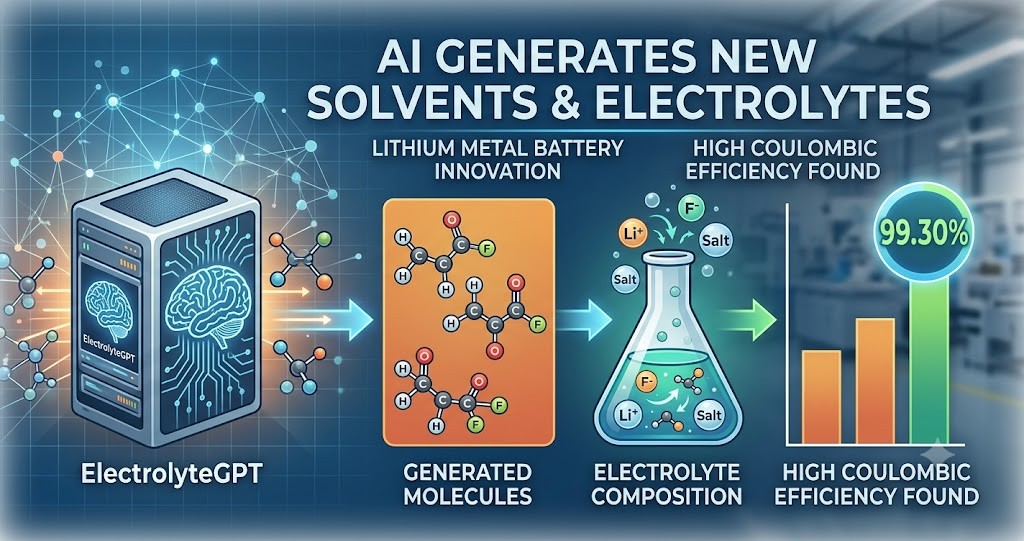
次世代のエネルギー貯蔵技術として期待される「リチウム金属電池(LMB)」。その性能や安全性を大きく左右するのが「電解質」の組成ですが、組み合わせの数が10の60乗規模と無限に存在するため、最適な配合を見つけ出すことは材料科学における最大のボトルネックでした。
本稿では、アメリカ化学会(ACS)の学術誌「JACS Au」に掲載された最新論文をもとに、トランスフォーマーベースの生成型AI「ElectrolyteGPT」が創り出した革新的な溶媒の具体的な化学構造と、高いクーロン効率を叩き出した電解液配合の具体例を交え、その革新性を解説します。
1. 背景知識とリチウム金属電池の課題
電解質の本質
電解質は、正極と負極の間でリチウムイオンを輸送する媒介です。通常、ベースとなる「溶媒」、イオンを供給する「塩」、界面を保護する「添加剤」が複雑な比率でブレンドされた分子混合物です。
リチウム金属電池(LMB)の2大ボトルネック
現在主流のリチウムイオン電池よりも劇的にエネルギー密度を高められますが、以下の課題から実用化が阻まれてきました。
- デンドライト(樹枝状結晶)の成長: 充放電の繰り返しでリチウムがトゲのように結晶化し、内部ショートや発火を引き起こす。
- 低いクーロン効率(CE): 充放電時にリチウムが副反応で失われやすく、電池寿命が極端に短くなる。
AIによる「逆設計(ジェネレーティブ・アプローチ)」
従来の「特性を予測する」AIとは異なり、ElectrolyteGPTは「イオン伝導率 1 mS/cm以上、酸化安定性 5 V以上、クーロン効率 99%以上」という目標特性を入力するだけで、それを満たす未知の分子構造や配合レシピを自らデザイン(条件付き生成)できます。
2. ElectrolyteGPTが創出した主要溶媒の化学構造
論文内で実際に合成・検証された、AI生成溶媒の具体的な構造と特徴は以下の通りです。これらは電池反応を阻害する反応性基を持たず、電気化学的安定性を高めるフッ素(F)やエーテル結合、炭酸エステル骨格が巧みに配置されています。
| 略号 | IUPAC化学名 / 構造の特徴 | 実験での主な知見・メリット |
| MPFPE | 1,1,1,2,2-pentafluoro-3-(2-methoxyethoxy)propane (フッ素化鎖とグリコールエーテル骨格の結合) | 本研究のトップランナー。 リチウム金属のクーロン効率(CE)で**99.30%**という最先端の数値を叩き出し、フルセル試験でも優れた長寿命化を達成。 |
| MPFPenE | 1,1,1,2,2-pentafluoro-5-(2-methoxyethoxy)pentane (PubChem等のデータベースに未登録の完全新規物質) | フッ素鎖とエーテル部位の間にアルキルスペーサー(-CH2-CH2-)を導入した構造。フッ素による塩の溶解度低下を防ぎ、MPFPEを上回る高いイオン伝導率を発揮。 |
| MTFEmP | 1,1,1-trifluoro-2-(3-methoxy-3-methylethoxy)ethane (PubChem等に未登録の完全新規物質) | チームが実験室で初めて合成に成功した完全な新規分子。AIが既存の化学の常識に囚われずに有用な構造をデザインできる証明となった。 |
| MHFBE | 1,1,1,2,2,3,3-heptafluoro-4-(2-methoxyethoxy)butane | MPFPEのフッ素鎖をさらに長くしたもの(人間による微調整)。フッ素化度を高めることで酸化安定性は向上するが、イオン伝導率はやや低下するトレードオフを確認。 |
| BuTFEC | butyl 2,2,2-trifluoroethyl carbonate | エーテル系ではなく、高電圧耐性に優れる「フッ素化炭酸エステル」骨格を持つAI生成溶媒。 |
| 2MoTHP | 2-methoxytetrahydropyran | フッ素を持たない環状エーテル溶媒。5 V以上の高電圧では酸化分解しやすい特性を持ち、フッ素化の重要性を裏付ける対照データとなった。 |
3. 性能が良かった電解液組成(配合レシピ)の具体例
研究チームは、溶媒単体だけでなく「塩の種類・濃度・溶媒比率」を包括した配合そのものをAIに生成させるため、新しい線表記法「fLine」を開発しました。
実験検証において、従来の市販電解液を凌駕し、最先端の文献値に匹敵する優れた性能を示したトップクラスの電解液組成の具体例は以下の通りです。
① AI生成ベース + 人間による最適化配合(最高成績:f3-m2)
- 組成: 2 M LiFSA in エチレングリコールエチルメチルエーテル / 1,1,2,2-テトラフルオロエチル 2,2,3,3-テトラフルオロプロピルエーテル(TTE)
- 実績・特徴: AIが提示したエーテル混合系ベースに、人間の知見(塩濃度を2 Mに高めて導電率を上げ、塩をLiTFSIからSEI形成能に優れるLiFSAに変更)を融合させた配合。リチウム金属のクーロン効率で99.40%を達成。アノードフリーのCu||LFPフルセル試験において、市販の電解液(1 M LiPF6 in EC/DMC)を大幅に上回る圧倒的な容量保持率とサイクル長寿命化を実証しました。
② 高電圧対応・フッ素化濃縮配合(f1)
- 組成: 1 M LiDFOB + 1 M LiFSA in ビス(2,2,2-トリフルオロエチル)エーテル(BTFE)
- 実績・特徴: 2種類の塩(LiDFOBとLiFSA)を組み合わせ、溶媒にフッ素化エーテル(BTFE)を用いた高濃度・ローカルコンセントレーティッド(LHCE)に近いアプローチ。5 V以上の高い酸化安定性を維持しながら、98.16%の高いクーロン効率を両立させました。
結論
本研究は、膨大な化学空間から手作業や直感で電解質材料を探し出すという従来の非効率な手法を覆し、生成AIによって「MPFPE」のような高性能な未知の溶媒分子や、「f3-m2」のような優れた配合レシピをピンポイントで逆設計(デザイン)できることを実証しました。
このデータ駆動型アプローチは、リチウム金属電池の早期実用化(EVの航続距離劇的向上や軽量化)に直結するだけでなく、全固体電池や、配合技術が不可欠な医薬品・化粧品・化学プロセス全般における素材開発を劇的に加速させる可能性を秘めています。
出典:https://pubs.acs.org/doi/10.1021/jacsau.5c01628
Entering the Era of AI-Designed Molecules: A Concrete Look at High-Performance Battery Electrolytes Derived by ElectrolyteGPT
Lithium metal batteries (LMBs) are highly anticipated as a next-generation energy storage technology. While the composition of the electrolyte heavily dictates their performance and safety, finding the optimal formulation has been the single greatest bottleneck in materials science due to an virtually infinite chemical space containing an estimated 10 to the power of 60 possible combinations.
Based on a recent paper published in “JACS Au,” a journal of the American Chemical Society (ACS), this article highlights the innovation of “ElectrolyteGPT”—a transformer-based generative AI. We will explore the specific chemical structures of the revolutionary solvents it created, alongside concrete examples of electrolyte formulations that achieved exceptionally high Coulombic efficiency.
1. Basic Knowledge and Challenges of Lithium Metal Batteries
The Essence of an Electrolyte
An electrolyte serves as the medium that transports lithium ions between the positive electrode (cathode) and the negative electrode (anode). It is a complex molecular mixture typically consisting of a baseline “solvent,” an ion-providing “salt,” and “additives” that protect interfaces, all blended in precise ratios.
Two Major Bottlenecks of Lithium Metal Batteries (LMBs)
While LMBs can dramatically increase energy density compared to currently mainstream lithium-ion batteries, their commercialization has been hindered by the following two critical challenges:
- Lithium Dendrite Growth: Repeated charge and discharge cycles cause lithium to crystallize into needle-like structures, which can pierce the separator, causing internal short circuits and thermal runaway or fires.
- Low Coulombic Efficiency (CE): Lithium is easily lost to side reactions during cycling, leading to an extremely short battery lifespan.
“Inverse Design” (Generative Approach) via AI
Unlike conventional AI that merely predicts properties in a forward manner, ElectrolyteGPT can independently design unknown molecular structures and formulation recipes from scratch (conditional generation). This is done simply by entering target properties, such as “ionic conductivity of 1 mS/cm or higher, oxidation stability of 5 V or higher, and a Coulombic efficiency of 99% or higher.”
2. Chemical Structures of Key Solvents Created by ElectrolyteGPT
The specific structures and characteristics of the AI-generated solvents that were actually synthesized and verified in the study are detailed below. These molecules intentionally exclude reactive groups that would inhibit battery reactions, and instead strategically position fluorine (F) atoms, ether linkages, and carbonate ester backbones to enhance electrochemical stability.
| Abbreviation | IUPAC Chemical Name / Structural Characteristics | Key Experimental Insights & Advantages |
| MPFPE | 1,1,1,2,2-pentafluoro-3-(2-methoxyethoxy)propane (Combines a fluorinated chain with a glycol ether backbone) | The top runner of this study. It achieved a cutting-edge Coulombic efficiency (CE) of 99.30% on lithium metal and demonstrated outstanding lifespan extension in full-cell tests. |
| MPFPenE | 1,1,1,2,2-pentafluoro-5-(2-methoxyethoxy)pentane (A completely novel substance unregistered in databases like PubChem) | Features an alkyl spacer (-CH2-CH2-) introduced between the fluorine chain and the ether segment. This layout prevents the fluorine from lowering salt solubility, yielding an ionic conductivity even higher than MPFPE. |
| MTFEmP | 1,1,1-trifluoro-2-(3-methoxy-3-methylethoxy)ethane (A completely novel substance unregistered in databases like PubChem) | A brand-new molecule successfully synthesized in the lab for the first time. It serves as definitive proof that AI can design highly effective structures without being bound by conventional chemical dogmas. |
| MHFBE | 1,1,1,2,2,3,3-heptafluoro-4-(2-methoxyethoxy)butane | An engineered variant extending the fluorine chain of MPFPE (human-guided fine-tuning). Testing confirmed a trade-off: higher fluorination improves oxidation stability but slightly reduces ionic conductivity. |
| BuTFEC | butyl 2,2,2-trifluoroethyl carbonate | An AI-generated solvent featuring a “fluorinated carbonate” backbone optimized for high-voltage tolerance rather than an ether-based system. |
| 2MoTHP | 2-methoxytetrahydropyran | A non-fluorinated cyclic ether solvent. It exhibited a tendency to undergo rapid oxidative decomposition at high voltages of 5 V or more, serving as a vital control data point that underscores the necessity of fluorination. |
3. Concrete Examples of High-Performance Electrolyte Formulations (Recipes)
To allow the AI to generate complete formulations—encompassing the types of salts, their concentrations, and solvent ratios rather than just isolated solvents—the research team developed a new line notation system called “fLine.”
Below are the premier electrolyte compositions identified during experimental validation that outperformed standard commercial alternatives and matched state-of-the-art literature values.
Formulation 1: AI-Generated Base + Human-Optimized Blend (Top Performer: f3-m2)
- Composition: 2 M LiFSA in ethylene glycol ethyl methyl ether / 1,1,2,2-tetrafluoroethyl 2,2,3,3-tetrafluoropropyl ether (TTE)
- Performance & Characteristics: This formulation fused human expertise with an AI-proposed mixed-ether baseline. The human adjustments involved increasing the salt concentration to 2 M to boost conductivity and switching the salt from LiTFSI to LiFSA, which is widely recognized for its superior solid electrolyte interphase (SEI) forming capabilities. It achieved a lithium metal Coulombic efficiency of 99.40%. In anode-free Cu||LFP full-cell tests, it demonstrated overwhelming capacity retention and cycle longevity, vastly outperforming standard commercial electrolyte solutions (1 M LiPF6 in EC/DMC).
Formulation 2: High-Voltage Tolerant, Fluorinated Concentrated Blend (f1)
- Composition: 1 M LiDFOB + 1 M LiFSA in bis(2,2,2-trifluoroethyl) ether (BTFE)
- Performance & Characteristics: This setup combines two distinct salts (LiDFOB and LiFSA) within a fluorinated ether solvent (BTFE), mimicking a high-concentration or localized high-concentration electrolyte (LHCE) approach. It successfully achieved a high Coulombic efficiency of 98.16% while maintaining robust oxidation stability above 5 V.
Conclusion
This study successfully overturns the traditionally inefficient, trial-and-error methodology of discovering electrolyte materials through manual experimentation and intuition. It demonstrates that generative AI can successfully perform inverse design to pinpoint high-performance, unknown solvent molecules like “MPFPE” and elite formulation recipes like “f3-m2.”
This data-driven paradigm is poised to directly accelerate the practical deployment of lithium metal batteries—leading to dramatic range extensions and weight reductions for electric vehicles. Furthermore, the implications of this methodology extend far beyond batteries, offering a framework to radically streamline material development in all-solid-state batteries, pharmaceuticals, cosmetics, and broader chemical engineering processes where complex molecular formulation is essential.


コメント