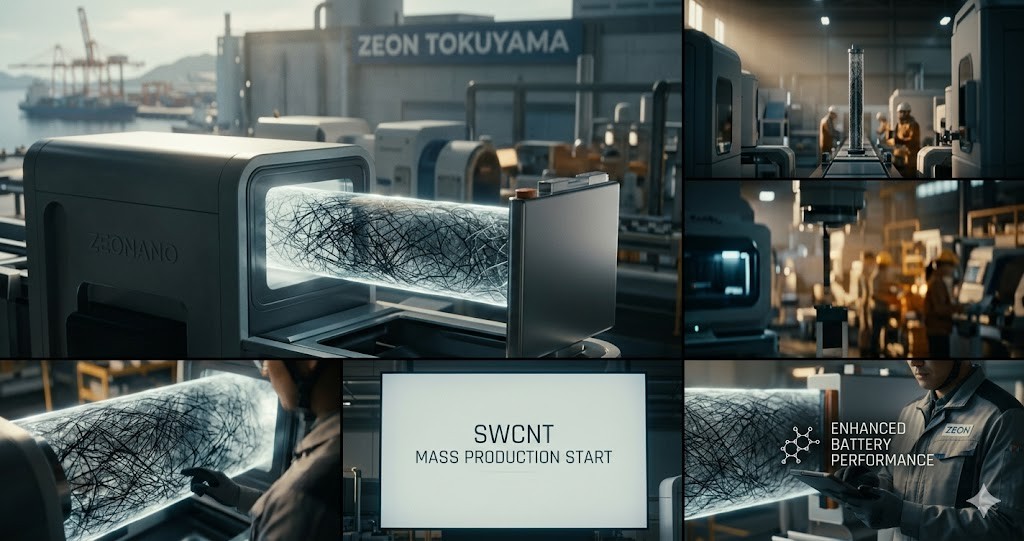
次世代の産業を支える「夢の新材料」として期待されてきたカーボンナノチューブが、いよいよ本格的な量産フェーズへと突入します。日本ゼオンは、電気自動車(EV)やAIサーバの普及に伴う蓄電池需要の爆発的な増加を背景に、山口県・徳山工場の生産能力を現在の数十倍へと引き上げる決定を下しました。これは、日本の素材産業が世界のクリーンエネルギー市場で主導権を握るための重要な一手となります。
ニュースの概要:日本ゼオンのSWCNT増産計画
日本ゼオンは、リチウムイオン電池の性能を飛躍的に高める「単層カーボンナノチューブ(SWCNT)」の生産体制を劇的に強化します。
- 投資規模と計画: 総投資額は約147億円。2026年秋に着工し、2028年中の本格稼働を目指します。
- 生産能力: 現行の数十倍に拡大。これは蓄電池容量に換算すると、年間128GWh(ギガワット時)分に相当します。
- 公的支援: 経済産業省の「蓄電池に係る供給確保計画」に認定されており、最大約51億円の助成金が交付される予定です。
- 技術的特徴: 進化させた独自の新製法を採用し、さらなる生産効率化と品質向上を図ります。
関連情報:なぜ今「SWCNT」が必要なのか?
今回の増産の背景にある、技術的・市場的な重要性を整理します。
1. リチウムイオン電池の限界突破
SWCNTは、電池内部で電気を流す「導電助剤」として機能します。従来の多層カーボンナノチューブ(MWCNT)やカーボンブラックと比較して、以下のメリットがあります。
- エネルギー密度の向上: 少量で高い導電性を発揮するため、その分、電極の中に活物質(エネルギーを蓄える物質)を多く詰め込むことができます。
- 急速充電と長寿命化: 優れた導電ネットワークにより、充電時間の短縮や、充放電の繰り返しによる劣化の抑制に寄与します。
2. ターゲットとなる次世代市場
- モビリティ: 航続距離の延長が求められるEVだけでなく、軽量化が必須のドローンやeVTOL(空飛ぶクルマ)での活用が期待されています。
- AIインフラ: データセンターの急増に伴い、AIサーバ用のバックアップ電源(BBU)向けに高性能な電池需要が高まっています。
3. 日本の技術的優位性「スーパーグロース法」
日本ゼオンが採用している「スーパーグロース法」は、国立研究開発法人 産業技術総合研究所(産総研)が開発した技術です。従来の製法に比べて、極めて純度が高く、かつ長い(高アスペクト比)ナノチューブを作ることが可能であり、日本が世界をリードしている分野の一つです。
まとめ
日本ゼオンによる今回の決定は、単なる一企業の設備投資に留まらず、脱炭素社会のインフラとなる蓄電池のサプライチェーンを日本国内で強固にする戦略的な意義を持っています。「ZEONANO」ブランドの供給力が数十倍になることで、EVのさらなる普及や産業機器の高度化が加速することが期待されます。
出典:https://monoist.itmedia.co.jp/mn/articles/2604/27/news032.html
Zeon to Increase SWCNT Production Capacity Dozens of Times Over! Accelerating the Battery Revolution with 2028 Operations
Carbon nanotubes, long anticipated as the “dream material” supporting next-generation industries, are finally entering a phase of full-scale mass production. Against the backdrop of explosive growth in storage battery demand driven by the spread of electric vehicles (EVs) and AI servers, Zeon Corporation has decided to increase the production capacity of its Tokuyama Plant in Yamaguchi Prefecture to dozens of times its current level. This move represents a strategic step for Japan’s materials industry to take a leading role in the global clean energy market.
News Summary: Zeon’s SWCNT Production Expansion Plan
Zeon Corporation will dramatically strengthen its production system for Single-Walled Carbon Nanotubes (SWCNT), a material that significantly enhances the performance of lithium-ion batteries.
- Investment Scale and Schedule: Total investment is approximately 14.7 billion yen. Construction will begin in the fall of 2026, with the goal of starting full-scale operations during 2028.
- Production Capacity: Expansion to dozens of times the current level. In terms of storage battery capacity, this is equivalent to 128 GWh (gigawatt-hours) per year.
- Public Support: The project has been certified by the Ministry of Economy, Trade and Industry (METI) under the “Plan for Settling Supply of Storage Batteries,” and a subsidy of up to approximately 5.1 billion yen is expected to be granted.
- Technical Features: The company will adopt an advanced, proprietary new manufacturing process to further improve production efficiency and quality.
Related Information: Why is SWCNT Needed Now?
The following points outline the technical and market importance behind this production increase.
1. Breaking the Limits of Lithium-ion Batteries
SWCNT functions as a “conductive additive” that carries electricity inside the battery. Compared to conventional Multi-Walled Carbon Nanotubes (MWCNT) or carbon black, it offers the following advantages:
- Improved Energy Density: Because it exhibits high conductivity even in small amounts, more active materials (substances that store energy) can be packed into the electrodes.
- Fast Charging and Longer Life: The superior conductive network contributes to shorter charging times and suppresses degradation caused by repeated charging and discharging.
2. Target Next-Generation Markets
- Mobility: Beyond EVs requiring extended range, SWCNTs are expected to be used in drones and eVTOL (electric Vertical Take-Off and Landing) aircraft, where lightweighting is essential.
- AI Infrastructure: With the rapid increase in data centers, demand for high-performance batteries for Battery Backup Units (BBU) in AI servers is surging.
3. Japan’s Technological Advantage: The “Super Growth Method”
The “Super Growth Method” utilized by Zeon is a technology developed by the National Institute of Advanced Industrial Science and Technology (AIST). Compared to conventional methods, it enables the creation of nanotubes with extremely high purity and length (high aspect ratio), making it a field where Japan leads the world.
Summary
Zeon’s decision is more than just a corporate capital investment; it holds strategic significance in strengthening the storage battery supply chain within Japan, which serves as the infrastructure for a decarbonized society. By increasing the supply of the “ZEONANO” brand dozens of times over, the further adoption of EVs and the advancement of industrial equipment are expected to accelerate.


コメント