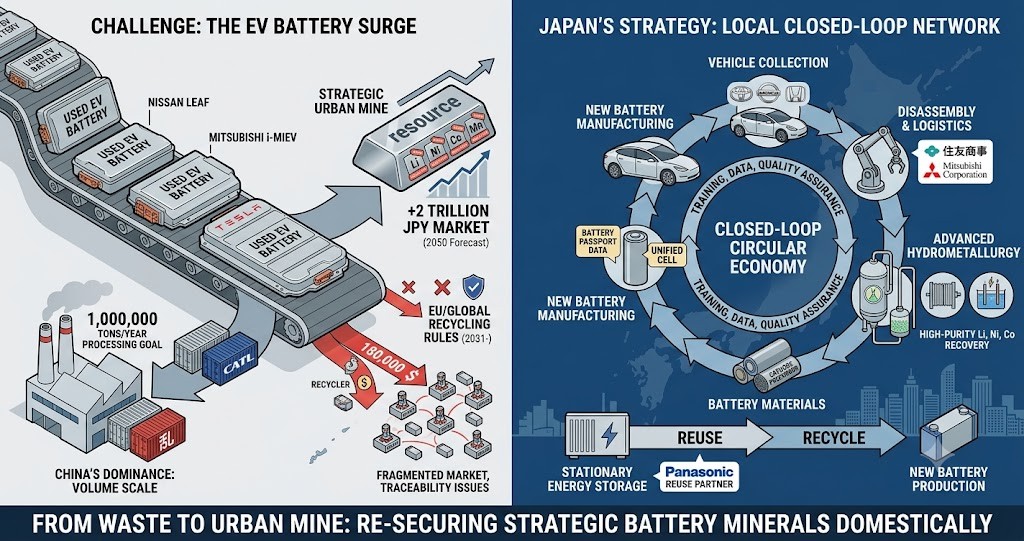
電気自動車(EV)の普及に伴い、かつては処理費用がかさむ「廃棄物」とみなされていたEVの使用済みバッテリーが、いまやリチウムやニッケル、コバルトなどの重要鉱物を国内で調達できる「一級の戦略資源(都市鉱山)」へとその価値を激変させています。
2050年には国内だけで2兆円を超える巨大市場へと成長が見込まれるなか、年間100万トン規模の処理を目指す中国勢が圧倒的な資金力で市場の席巻を狙っています。海外の資源ナショナリズムや地政学リスクに直面する日本企業は、この「廃バッテリー争奪戦」にどう立ち向かうのか。制度の壁、中国の動向、そして日本のカウンター戦略を整理します。
- 1. 廃バッテリー市場が「2兆円超」へ急成長する背景
- 2. 制度の壁:欧州「バッテリー規則」による実質的な囲い込み
- 3. 中国勢の驚異:圧倒的な「物量」と100万トン構想
- 4. 日本企業の反撃シナリオ:異業種アライアンスと高度精錬技術
- 5. 総括:日本企業が勝ち筋を見出すポイント
- 1. The Drivers Behind the “¥2 Trillion” Market Explosion
- 2. Regulatory Hurdles: Europe’s “Battery Regulation” Enclosure
- 3. The Chinese Threat: Bludgeoning the Market via Pure “Scale”
- 4. Japan’s Counter-Scenario: Cross-Industry Alliances and Advanced Metallurgy
- 5. Summary: Where Japan Can Carve Out a Winning Edge
1. 廃バッテリー市場が「2兆円超」へ急成長する背景
初期EVの寿命到来と「都市鉱山」の本格化
2010年前後に登場した量産型EV(日産「リーフ」や三菱「i-MiEV」など)から約15年が経過し、初期バッテリーの回収期が本格化しています。
- 2030年の予測:国内のEVバッテリー廃棄量は約15万台分(資源量にして約2万トン弱)に達する見込み。
- 市場規模の予測:国内のリユース・リサイクル市場は2030年に約1,200億円、2050年には2兆円超へ拡大。
経済安全保障としての資源自給
リチウムやコバルトの採掘・精錬は中国やアフリカなどの特定国に極端に依存しています。廃バッテリーを国内で循環させる「サーキュラーエコノミー(循環型経済)」の確立は、海外のリスクに左右されない強固な調達基盤を国内に維持するための、国家レベルの重要課題となっています。
2. 制度の壁:欧州「バッテリー規則」による実質的な囲い込み
世界的な市場ルールも、資源の回収と再利用を義務付ける方向へと大転換しています。
- リサイクル材の利用義務付け(2031年8月〜) EV用バッテリー製造時、コバルト16%、リチウム6%、ニッケル6%以上をリサイクル材で賄うことが法的に義務化されます。車両開発の初期段階から「分解しやすさ」を考慮した設計(構造の変革)が求められています。
- 【補足】「バッテリーパスポート」の義務化(2027年2月〜) EU域内で流通するEVバッテリーの材料組成やCO2排出量(カーボンフットプリント)、由来をデジタル上で追跡可能にする「バッテリーパスポート」の取得が2027年2月に義務化されます。2026年現在、自動車メーカー各社はデータ整備やサプライチェーンの透明化など、実務的な対応を急ピッチで進めています。
3. 中国勢の驚異:圧倒的な「物量」と100万トン構想
リサイクル市場において、最大の脅威は中国勢による大規模な投資と圧倒的な「規模の利益(スケールメリット)」です。
- CATLの巨大投資 車載電池世界最大手のCATL(寧徳時代)は、すでに年間27万トンという世界最大級の処理能力を保有。さらに今後、100万トン規模への拡大を掲げています。
- 回収網の乱立とトレーサビリティの課題 中国国内には車載バッテリー回収に関わる企業が約18万社存在しますが、その65%が資本金500万元(約1億円)以下の小規模事業者です。不適切な処理や資源の国外流出を防ぐため、中国政府も流通履歴の追跡(トレーサビリティ)の仕組みづくりを進めています。
4. 日本企業の反撃シナリオ:異業種アライアンスと高度精錬技術
大量処理で攻める中国に対し、日本企業は「自動車メーカーの回収網 ✕ 商社のインフラ ✕ 非鉄大手の精錬技術」を掛け合わせた横断ネットワークで対抗しています。
① 「クローズドループ(循環)」を狙う自動車メーカーの動き
- 日産自動車:住友商事との合弁「4Rエナジー」を通じて、回収・再利用・リサイクルを一気通貫で行う「4R体制」をいち早く確立。
- ホンダ:米リサイクル大手Ascend Elementsと協業し、再生資源を北米向けEVのサプライチェーンに組み込む体制を構築中。
- トヨタ自動車:グローバルでの電池回収・無害化および「電池3R(リデュース・リユース・リサイクル)」の運用を主要地域で本格化させています。
② 技術のコアを握る総合商社・非鉄金属メーカー
- 三井物産:バッテリーリサイクル企業と合弁会社を設立し、茨城県ひたちなか市の工場を本格稼働。
- DOWAエコシステム:得意とする「湿式製錬技術(水溶液の化学反応で金属を取り出す技術)」を活用し、複雑な構造の車載バッテリーから不純物を徹底的に除いた高純度な金属の回収を進めています。
③ 【補足】「リユース(二次利用)」市場の立ち上がり
回収したバッテリーをすぐに壊して金属に戻すだけでなく、まずは定置用蓄電池などとして長く使う「リユース」の取り組みも加速しています。パナソニックHDやオリックス、関西電力などが、独自のバッテリー劣化診断技術を活用し、「品質保証付きリユースEV」やリースアップ車両のバッテリーを再利用する実証実験・サービス展開を活発化させています。
5. 総括:日本企業が勝ち筋を見出すポイント
巨大な資本力と処理能力で先行する中国に対し、日本企業のアドバンテージは以下の3点に集約されます。
- 非鉄各社が長年培ってきた高度な「湿式製錬技術」による高純度・高品質な資源回収
- 車両のトレーサビリティと、リユース(電池の二次利用)市場を繋ぐ高度なデータ・品質管理
- 欧州などの厳しい環境規制(バッテリー規則)をクリアできる、クリーンで透明性の高いクローズドループの構築
かつての「廃棄物処理」は、国家の命運を握る「資源獲得競争」へと昇華しました。業種の垣根を超えたアライアンスをどれだけスピーディーに機能させられるかが、今後の日本の自動車産業の競争力を左右することになります。
出典:https://carview.yahoo.co.jp/news/detail/c727bc50800429f8e6144a3f843f5cf1ccbd58ce/
[The ¥2 Trillion Urban Mine] The EV Waste Battery “Battle Royale” Begins: How the Japan Alliance Challenges China’s 1-Million-Ton Ambition
With the rapid expansion of electric vehicles (EVs), used car batteries—once dismissed as costly “waste” to process—are undergoing a massive valuation paradigm shift. They are now viewed as “first-tier strategic resources” (urban mines) capable of securing critical minerals like lithium, nickel, and cobalt domestically.
While the Japanese market alone is projected to swell into a massive industry exceeding 2 trillion yen by 2050, Chinese players are already aiming to dominate the sector with overwhelming financial backing and a goal of processing 1 million tons annually. Faced with rising resource nationalism and geopolitical risks abroad, how will Japanese companies confront this “waste battery gold rush”? Below is a comprehensive breakdown of the regulatory hurdles, China’s aggressive moves, and Japan’s counterstrategies.
1. The Drivers Behind the “¥2 Trillion” Market Explosion
The Arrival of First-Gen EV Lifespans and the Rise of Urban Mining
Approximately 15 years have passed since the debut of early mass-produced EVs (such as the Nissan Leaf and Mitsubishi i-MiEV) around 2010. The retirement and collection phase for these pioneering batteries is now entering full swing.
- 2030 Forecast: Japan’s domestic EV battery waste is expected to reach approximately 150,000 vehicles (equivalent to nearly 20,000 tons of raw materials).
- Market Scale Forecast: The domestic reuse and recycling market is anticipated to expand to roughly 120 billion yen by 2030, skyrocketing to over 2 trillion yen by 2050.
Resource Self-Sufficiency as Economic Security
The mining and refining of lithium and cobalt remain heavily concentrated in specific regions like China and certain African nations. Establishing a “circular economy” that loops spent batteries back into production domestically has become a crucial national imperative to maintain a resilient manufacturing supply chain immune to foreign geopolitical volatility.
2. Regulatory Hurdles: Europe’s “Battery Regulation” Enclosure
Global trade and compliance rules are shifting drastically toward making resource recovery and the utilization of recycled materials legally mandatory.
- Mandatory Recycled Content (From August 2031) When manufacturing new EV batteries, it will be legally required to use recycled materials for at least 16% of the cobalt, 6% of the lithium, and 6% of the nickel. This forces a fundamental shift in automotive structural engineering, requiring cars to be designed for easy disassembly from the initial drafting phase.
- The “Battery Passport” Mandate (From February 2027) Starting in February 2027, any EV battery entering the EU market must carry a digital “Battery Passport” to trace its material composition, carbon footprint, and supply chain origin. As of 2026, global automakers are aggressively overhauling their data infrastructure and supply chain transparency to meet these imminent real-world compliance criteria.
3. The Chinese Threat: Bludgeoning the Market via Pure “Scale”
In the recycling arena, the biggest threat comes from China’s immense capital injection and overwhelming economies of scale.
- CATL’s Colossal Investment The world’s largest EV battery manufacturer, CATL (Contemporary Amperex Technology Co., Limited), already commands a world-leading annual processing capacity of 270,000 tons. Moving forward, the company has explicitly stated plans to scale this capacity to over 1 million tons.
- Fragmented Collection Networks and Traceability Woes While there are roughly 180,000 businesses involved in EV battery collection within China, 65% of them are small-scale operators with registered capital under 5 million yuan (approx. $700,000 USD). To curb improper processing and the illegal smuggling of critical resources out of the country, the Chinese government is enforcing strict traceability frameworks to clamp down on black-market loops.
4. Japan’s Counter-Scenario: Cross-Industry Alliances and Advanced Metallurgy
To push back against China’s volume-driven assault, Japanese enterprises are constructing a highly integrated, horizontal ecosystem blending “Automakers’ Collection Networks × Trading Houses’ Global Infrastructure × Non-Ferrous Metal Giants’ Advanced Refining.”
① Automakers Securing the “Closed-Loop”
- Nissan Motor: Established “4R Energy” early on via a joint venture with Sumitomo Corporation, securing an end-to-end “4R” framework (Reuse, Resell, Refabricate, Recycle).
- Honda: Partnered with US recycling leader Ascend Elements to weave recovered battery materials directly into its North American EV supply chain.
- Toyota Motor: Actively scaling its global battery collection, detoxification, and “Battery 3R” (Reduce, Reuse, Recycle) operations across primary global regions.
② Trading Companies and Non-Ferrous Metal Leaders Anchoring the Technical Core
- Mitsui & Co.: Set up a joint venture with a battery recycling specialist, launching full-scale commercial operations at its dedicated plant in Hitachinaka, Ibaraki Prefecture.
- DOWA Eco-System: Leveraging its signature hydrometallurgical refining technology (a process utilizing chemical aqueous reactions to extract metals), the company systematically isolates and extracts ultra-high-purity minerals from highly complex car battery cells, removing all traces of impurities.
③ The Rise of the Second-Life “Reuse” Market
Rather than immediately crushing collected batteries for raw ore, companies are moving rapidly to deploy a “Reuse” strategy for stationary energy storage systems (ESS). Companies like Panasonic HD, Orix, and Kansai Electric Power are utilizing proprietary battery degradation diagnostic technologies to roll out commercial services featuring “quality-assured certified used EVs” and grid-scale secondary battery storage setups.
5. Summary: Where Japan Can Carve Out a Winning Edge
Against China’s massive capital and immense capacity lead, Japan’s tactical advantages converge on three main fronts:
- Ultra-High-Purity Material Extraction: Relying on the sophisticated hydrometallurgical refining expertise developed over decades by non-ferrous metal conglomerates.
- Data-Driven Quality Management: Linking vehicle tracking histories with precise degradation diagnostics to feed a premium second-life battery market.
- Clean, Compliant Loops: Offering a highly transparent, verifiable closed-loop cycle capable of easily passing stringent Western environmental mandates like the EU Battery Regulation.
What used to be a simple conversation about “waste processing” has evolved into a high-stakes geopolitical race for resource sovereignty. How rapidly and seamlessly Japan can mobilize these cross-industry alliances will ultimately dictate the global competitiveness of its crown-jewel automotive industry.
コメント