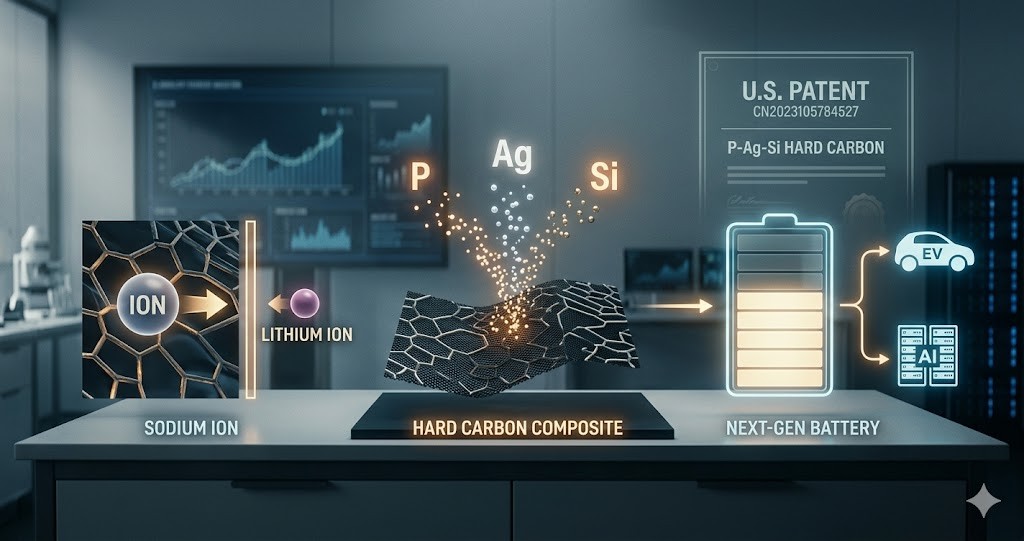
E-Power Inc.(NASDAQ: EPOW)は、2026年5月8日、独自の負極材料技術「リン(P)・銀(Ag)・シリコン(Si)共ドープ硬質炭素複合材料」の特許取得(特許番号: CN2023105784527)を発表しました。
1. 技術の核心:なぜ「P-Ag-Si」なのか?
従来のナトリウムイオン電池では、負極に硬質炭素(ハードカーボン)を使用するのが一般的ですが、エネルギー密度の低さやサイクル寿命に課題がありました。今回の特許技術は、3つの元素を同時に添加(ドープ)することで、これらを克服しています。
- シリコン (Si): 理論容量が非常に高く、電池の大容量化に寄与します。
- 銀 (Ag): 優れた導電性を付与し、高速な充放電を可能にします。
- リン (P): 充放電時にシリコンが膨張・収縮して構造が壊れるのを防ぐ「界面制御」の役割を果たします。
2. ナトリウムイオン電池が注目される背景
リチウムイオン電池(LIB)が普及する一方で、原料となるリチウムやコバルトは産出地が偏っており、価格高騰やサプライチェーンのリスクが常に懸念されています。
- 資源の豊富さ: ナトリウムは海水等から安価かつ無限に抽出可能です。
- 低温特性: マイナス20度といった極低温下でも出力が落ちにくいため、寒冷地での使用に適しています。
- 安全性: 熱暴走のリスクがリチウムイオン電池に比べて低く、輸送や保管の安全性が高いのが特徴です。
3. 特許の主なメリットと市場への影響
今回のP-Ag-Si/HC(複合材料)は、以下の3点で従来の硬質炭素を凌駕します。
| 項目 | 特徴・メリット |
| 高容量と安定性 | シリコンによる高容量化と、リンによる構造安定化の両立。 |
| 優れた導電性 | 銀の微細な配合により、内部抵抗を低減。 |
| 低コスト運用 | 安価な電力を使用した製造プロセスを背景に、高いコストパフォーマンスを実現。 |
E-Power社の戦略的ポジション
E-Power社は、AIデータセンター(AIDC)向けのマイクログリッドソリューションも手掛けており、膨大な電力を消費するAIインフラにおいて、安価で安全な蓄電池は不可欠なピースです。
会長の胡海平氏は、1999年から黒鉛負極材業界を牽引してきたパイオニアであり、今回の特許取得により、リチウムイオン電池向けの黒鉛(グラファイト)事業に加え、次世代のナトリウムイオン電池市場においても強力な主導権を握ることになります。
まとめ
今回の特許取得は、単なる材料の開発に留まらず、「高価なリチウムへの依存脱却」と「AI時代における大規模エネルギー貯蔵」を現実のものとする重要なマイルストーンです。E-Power社の技術が産業化されることで、電気自動車(EV)の低価格化や、再生可能エネルギーのさらなる普及が期待されます。
Revolutionizing Sodium-Ion Batteries: E-Power Inc. Secures Breakthrough Patent for High-Performance Hard Carbon
On May 8, 2026, E-Power Inc. (NASDAQ: EPOW) announced the successful patent registration of its proprietary anode material technology: “Phosphorus (P)-Silver (Ag)-Silicon (Si) Co-doped Hard Carbon Composite” (Patent No. CN2023105784527).
1. The Core of the Technology: Why “P-Ag-Si”?
While hard carbon is commonly used as an anode in conventional sodium-ion batteries (NIBs), challenges such as low energy density and limited cycle life have persisted. This patented technology overcomes these hurdles by simultaneously doping three specific elements:
- Silicon (Si): Provides extremely high theoretical capacity, contributing to higher battery energy density.
- Silver (Ag): Enhances electrical conductivity, enabling high-speed charging and discharging.
- Phosphorus (P): Acts as an “interfacial controller” to prevent the structural breakdown caused by the expansion and contraction of silicon during cycles.
2. Why Sodium-Ion Batteries are Gaining Attention
As lithium-ion batteries (LIBs) become ubiquitous, concerns remain regarding the localized supply chains and price volatility of raw materials like lithium and cobalt.
- Abundant Resources: Sodium can be extracted inexpensively and infinitely from sources such as seawater.
- Low-Temperature Performance: These batteries maintain high output even in extreme cold (e.g., -20 degrees Celsius), making them ideal for cold climates.
- Safety: They offer higher safety during transport and storage due to a lower risk of thermal runaway compared to LIBs.
3. Key Benefits and Market Impact
The P-Ag-Si/HC composite outperforms conventional hard carbon in three primary areas:
| Feature | Benefits |
| High Capacity and Stability | Achieves both high capacity (via Silicon) and structural stability (via Phosphorus). |
| Superior Conductivity | Reduces internal resistance through the precise integration of Silver. |
| Low-Cost Operation | Delivers high cost-performance, supported by a manufacturing process utilizing low-cost electricity. |
E-Power Inc.’s Strategic Position
E-Power also provides microgrid solutions for AI Data Centers (AIDC). In an era where AI infrastructure consumes massive amounts of power, affordable and safe energy storage is an indispensable component.
Chairman Haiping Hu, a pioneer in the graphite anode industry since 1999, has positioned the company to lead not only in the graphite sector for LIBs but also in the next-generation sodium-ion battery market through this patent acquisition.
Summary
This patent represents a vital milestone in moving toward “de-lithiumization” and realizing large-scale energy storage for the AI era. The industrialization of E-Power’s technology is expected to drive down the cost of electric vehicles (EVs) and further accelerate the adoption of renewable energy.


コメント