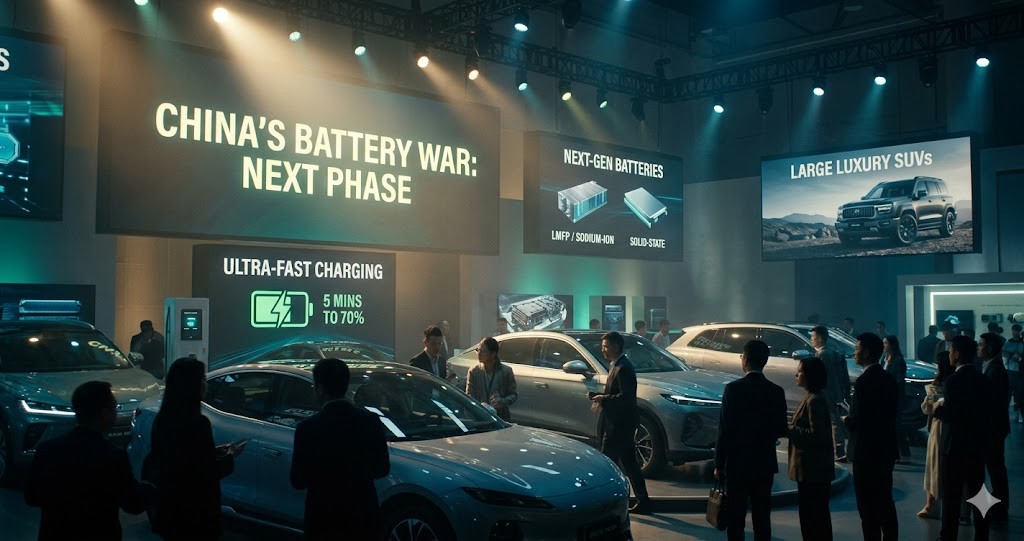
2026年の北京モーターショーは、中国の自動車産業が「模倣と追従」のフェーズを完全に脱し、独自の技術覇権と市場創出を狙う第2ステージへ突入したことを鮮烈に印象づけました。BEV(電気自動車)の普及が一段落した今、焦点は「いかに速く充電するか」「いかに安く、安全な次世代電池を作るか」、そして「いかに利益率の高い高級車セグメントを支配するか」へと移っています。
世界最大の市場でありながら、国内の過当競争「内巻」や経済不安という影を抱えるなか、中国メーカーが見据える「電池戦争」の次なるフェーズと、新たな車両戦略についてまとめます。
- 1. 次世代電池・充電技術の競争
- 2. 内燃機関の「再定義」とREEVへの回帰
- 3. 市場戦略の変遷:小型車から「大型ラグジュアリー」へ
- 結論:ラストダンスか、新たなる黎明か
- The End and Evolution of “China Speed”: The Future of Technological Hegemony at Auto China 2026
- 1. Competition in Next-Generation Battery and Charging Technology
- 2. The “Redefinition” of Internal Combustion Engines and the Return to REEVs
- 3. Shift in Market Strategy: From Small Cars to “Large Luxury”
- Conclusion: A Last Dance or a New Dawn?
1. 次世代電池・充電技術の競争
車載電池の主役は、従来のNCM(ニッケル・マンガン・コバルト)やLFP(リン酸鉄リチウム)から、さらに付加価値を高めた新技術へとシフトしています。
BYD:充電の「超高速化」と垂直統合
BYDは、第2世代「ブレードバッテリー」を軸に、BEVの最大の弱点である充電時間の克服を掲げています。
- LMFP(リン酸鉄リチウムマンガン)の採用: 公式発表はないものの、エネルギー密度(190~210Wh/kg)から、LFPにマンガンを加えたLMFPである可能性が濃厚です。
- 驚異的な充電能力: 8C急速充電に対応し、わずか5分で10%から70%まで充電可能。
- 極低温対応: マイナス30度の環境下でも、20%から97%まで12分で充電できるデモを公開。
- インフラ整備: 2026年末までに中国国内に2万基、海外に6000基の自前充電器を設置する計画です。
CATL:多角的な次世代ポートフォリオ
世界シェア首位のCATLは、圧倒的な技術の幅を見せつけました。
- Qilin(麒麟)Condensed: 半固体系技術を取り入れた高密度電池で、航続距離1500kmを視野に入れています。
- Naxtra(ナトリウムイオン電池): 2026年量産予定。リチウムをほぼ使わず低コストで、低温特性に優れます。エネルギー密度はリチウム系に劣るものの、普及価格帯の鍵となります。
- 電池交換(スワップ)式: 「BEVの乾電池化」を掲げ、バッテリーの標準化と所有から利用への転換を狙います。
2. 内燃機関の「再定義」とREEVへの回帰
BEV一本足打法からの脱却が進み、PHEV(プラグインハイブリッド)やREEV(レンジエクステンダーEV)向けの高度なエンジン技術が再び注目されています。
- 多気筒・高出力化: 長城汽車(GWM)の4.0L V8ツインターボや、SOUOの水平対向8気筒エンジンなど、高級車・スーパーカー向けの独自開発エンジンが登場。
- エンジンのユニット化: Horse Powertrainによる「X-RANGE C15」のように、エンジンを後付けの発電ユニット(レンジエクステンダー)として定義する動きが加速しています。
- 技術ナショナリズム: 「エンジンでも欧米に追いついた」ことを証明し、海外依存を脱却する狙いがあります。
3. 市場戦略の変遷:小型車から「大型ラグジュアリー」へ
価格競争が激化し利益の出にくい小型BEV市場を避け、メーカー各社は利益率の高い「大型クロスカントリーSUV」へと舵を切っています。
- ディフェンダー・スタイルの流行: ランドローバー・ディフェンダーやトヨタ・ランドクルーザーを彷彿とさせる、堅牢な箱型デザインのSUVが急増。
- REEVとの相性: 重い車体と長距離走行を両立させるため、純粋なBEVよりも航続距離の不安がないREEV方式が主流になりつつあります。
- 主要ブランド: この流れを作った長城汽車の「TANK」や、奇瑞汽車の「iCAR」などが市場を牽引しています。
結論:ラストダンスか、新たなる黎明か
中国の自動車メーカーは、新車開発期間を18〜20カ月まで短縮する「チャイナ・スピード」で世界を圧倒しました。しかし、模倣すべき対象を追い越し、自らが先頭に立った今、「次に何を作るべきか」という問いに直面しています。
2030年までに大規模な業界再編(淘汰)が予想されるなか、この2026年の熱狂が中国自動車産業の「最後の華」となるのか、あるいは世界標準を塗り替える真の始まりとなるのか。彼らは今、誰も経験したことのない未知の領域へと足を踏み入れています。
出典:https://motor-fan.jp/article/1479757/
The End and Evolution of “China Speed”: The Future of Technological Hegemony at Auto China 2026
Auto China 2026 has vividly demonstrated that the Chinese automotive industry has moved beyond the “imitation and follow” phase, entering a second stage focused on establishing original technological hegemony and market creation. With the initial wave of BEV (Battery Electric Vehicle) adoption plateauing, the focus has shifted toward: “how fast can it charge?”, “how cheaply and safely can next-generation batteries be produced?”, and “how to dominate the high-margin luxury vehicle segment?”
While operating in the world’s largest market, Chinese manufacturers face shadows of intense domestic competition (known as “neijuan” or involution) and economic uncertainty. This report summarizes the next phase of the “Battery War” and the new vehicle strategies being pursued.
1. Competition in Next-Generation Battery and Charging Technology
The primary focus of automotive batteries is shifting from conventional NCM (Nickel-Manganese-Cobalt) and LFP (Lithium Iron Phosphate) to new technologies with higher added value.
BYD: Ultra-Fast Charging and Vertical Integration
BYD is leveraging its second-generation “Blade Battery” to overcome charging time, the biggest weakness of BEVs.
- Adoption of LMFP (Lithium Manganese Iron Phosphate): Although not officially announced, the energy density (190–210 Wh/kg) strongly suggests the use of LMFP.
- Stunning Charging Performance: Supports 8C ultra-fast charging, allowing a 10% to 70% charge in just 5 minutes.
- Extreme Cold Performance: Demonstrated charging from 20% to 97% in 12 minutes even at -30°C.
- Infrastructure Expansion: Plans to deploy 20,000 charging stations in China and 6,000 overseas by the end of 2026.
CATL: A Diversified Next-Generation Portfolio
CATL, the global market leader, showcased an overwhelming breadth of technology.
- Qilin Condensed: A high-density battery utilizing semi-solid-state technology, targeting a cruising range of 1,500 km.
- Naxtra (Sodium-ion Battery): Scheduled for mass production in 2026. These batteries use almost no lithium, are low-cost, and offer excellent low-temperature performance—key for the mass-market segment.
- Battery Swapping: Promotes the “AAA-battery-ization of BEVs,” aiming for battery standardization and a shift from ownership to “as-a-service” models.
2. The “Redefinition” of Internal Combustion Engines and the Return to REEVs
Moving away from a BEV-only approach, advanced engine technologies for PHEVs (Plug-in Hybrids) and REEVs (Range-Extended EVs) are once again in the spotlight.
- High-Output Multi-Cylinder Engines: GWM’s 4.0L V8 twin-turbo and SOUO’s flat-eight engine represent original powerplants for luxury and supercars.
- Engine Modularization: Concepts like Horse Powertrain’s “X-RANGE C15” treat the engine as a “bolt-on” power generation unit (range extender).
- Technological Nationalism: A drive to prove that Chinese engine technology has caught up with the West, reducing reliance on foreign components.
3. Shift in Market Strategy: From Small Cars to “Large Luxury”
To avoid the fierce price wars of the low-margin small BEV market, manufacturers are pivoting toward high-margin “Large Luxury Cross-Country SUVs.”
- The “Defender Style” Trend: A surge in rugged, boxy SUV designs reminiscent of the Land Rover Defender or Toyota Land Cruiser.
- Synergy with REEVs: To balance heavy vehicle weights with long-distance travel, the REEV system is becoming the mainstream choice over pure BEVs for this segment.
- Leading Brands: Great Wall Motor’s “TANK” brand and Chery’s “iCAR” are currently driving this trend.
Conclusion: A Last Dance or a New Dawn?
Chinese automakers once shocked the world with “China Speed,” reducing vehicle development cycles to just 18–20 months. However, having overtaken their targets for imitation, they now face the challenge of being at the front of the pack: “What should we create next?”
With a massive industry restructuring (shakeout) expected by 2030, it remains to be seen if the fervor of 2026 is the “final flourish” of the industry or the true beginning of a new global standard. They are now stepping into a wilderness where no map exists.

コメント