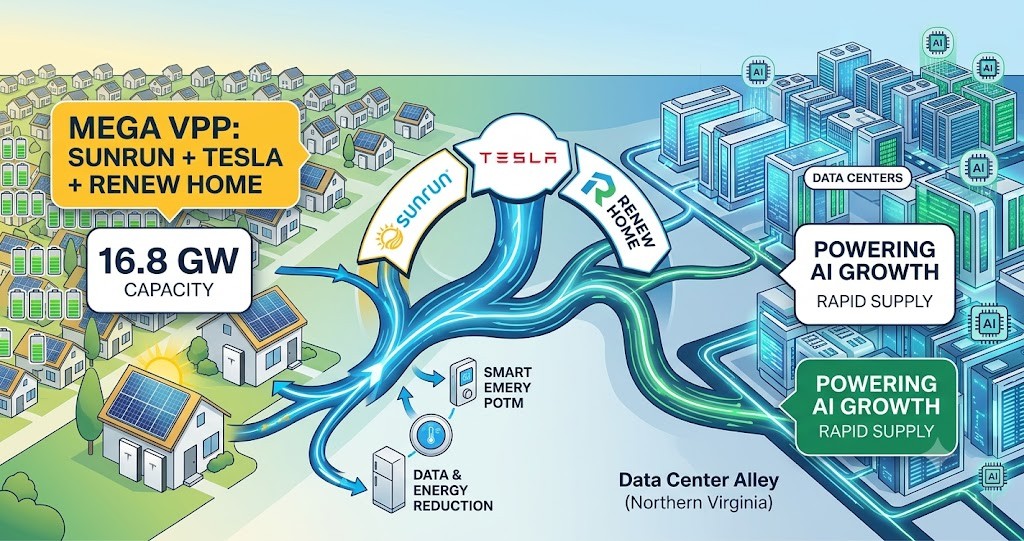
ChatGPTをはじめとする人工知能(AI)の爆発的な普及に伴い、テクノロジー大手(ハイパースケーラー)が運営するデータセンターの電力需要は、アメリカ全土で文字通り「桁違い」の急増を見せています。新たな巨大発電所や送電網の建設には数年から十数年の歳月がかかるため、AIの成長スピードに電力供給が追いつかないという深刻な危機に直面しています。
こうした中、住宅用太陽光・蓄電池最大手のSunrun、EVおよび家庭用蓄電池(Powerwall)を展開するTesla、そしてGoogle Nestからスピンアウトしたスマートホームエネルギー管理のRenew Homeの3社が、2026年6月に歴史的な提携を発表しました。
本提携は、全米の何百万もの家庭にある蓄電池やスマートサーモスタットをネットワークで統合し、一つの巨大な発電所のように機能させる「VPP(Virtual Power Plant:仮想発電所)」を構築するものです。これにより、インフラ建設を待つことなく、数ヶ月という短期間で巨大な「柔軟な電力容量(16.8GW)」をデータセンター市場に供給するという、エネルギー業界のビジネスモデルを根底から変える試みとして注目されています。
- 1. 提携の概要と「全米最大級VPP」の規模
- 2. PJM送電網と「データセンター街」が直面する危機
- 3. 「Capacity-as-a-Service(サービスとしての容量)」という新メリット
- 4. 今後の展望とクリアすべき課題
- 1. Partnership Overview and Scale of the Nation’s Largest VPP
- 2. Crises Confronting the PJM Grid and “Data Center Alley”
- 3. The Novel Benefits of “Capacity-as-a-Service”
- 4. Future Outlook and Challenges Ahead
1. 提携の概要と「全米最大級VPP」の規模
3社のネットワークを統合することで、従来の大型火力発電所や原子力発電所数基分に匹敵する、最大16.8ギガワット(GW)の柔軟な電力キャパシティを創出します。
3社のリソースの内訳
- Sunrun & Tesla: 両社が運用する数十万台の住宅用蓄電池システム(太陽光パネルと連携)から、必要に応じて送電網へ電力を直接逆送電(注入)します。
- Renew Home: 管理下にある800万台以上のスマートサーモスタットやスマート家電を制御し、電力需要のピーク時に家庭の負荷を自動でシフト(削減)します。
【関連情報:Renew Homeとは?】 Google Nestのエネルギー管理部門「Nest Renew」と、VPP大手のOhmConnectが統合して誕生した企業。家庭のエアコン需要などをAIで一括制御する技術に強みを持っています。
2. PJM送電網と「データセンター街」が直面する危機
今回の提携がまず照準を合わせているのが、米東部を中心に6,700万人以上の電力を統括する送電機関「PJMインターコネクション」の管轄エリア、特にバージニア州北部です。
- 世界最大のデータセンター密集地: バージニア州北部は「データセンター街(Data Center Alley)」と呼ばれ、世界のインターネットトラフィックの大部分が通過します。ここにあるハイパースケーラーのキャンパス1箇所で、最大1GW(一般家庭約75万世帯分)の電力を消費することがあります。
- PJMの「信頼性バックストッププロセス」への貢献: 化石燃料(石炭・ガス)発電所の廃止が進む一方で、AI需要が急増し、PJMの需給バランスは限界に達しつつあります。3社はこの危機に対応するため、PJMが提案する緊急の信頼性確保プロセス(Reliability Backstop Process)にこのVPP容量を提供することをコミットしました。承認されれば、バージニア州一帯で即座に1GW超の容量が解放される見込みです。
3. 「Capacity-as-a-Service(サービスとしての容量)」という新メリット
この取り組みは、従来の「電気を売る」モデルではなく、電力網がピンチの時に需要を減らしたり電気を供給したりする権利をパッケージ化して提供する「Capacity-as-a-Service」という枠組みを採用しています。これにより、関係者全員にメリットが生まれます。
- ハイパースケーラー(Tech大手): 新しいデータセンターを早期に稼働・相互接続させることが可能になります。
- 一般消費者(家庭): VPPプログラムに参加する世帯は、インセンティブ(特典・報酬)を獲得できるほか、ピーク時の電気代を削減できます(3社はすでに既存プログラムで顧客に計7,000万ドル近くを還元しています)。
- 電力会社・一般の電気料金負担者: 莫大なお金がかかる新規の送電インフラやピーク時用発電所の建設を先送り・回避できるため、地域全体の電気料金の高騰を抑えられます(Brattle Groupの試算では、電力網の利用効率向上により、全米で今後10年間に少なくとも1,100億ドルの電気代削減効果があるとされています)。
4. 今後の展望とクリアすべき課題
実用化と全国展開に向けては、計り知れないポテンシャルがある一方で、以下のステップが重要となります。
- 規制当局や電力会社との合意形成: VPPの価値を正しく評価し、分散型エネルギーが送電網にシームレスに参加できるようにするためには、各州の規制当局や地域の電力会社による前例のない柔軟な政策・ルールの策定(料金体系の見直しなど)が必要不可欠です。
- 枠組みから「確実な契約」への移行: 今回の発表は包括的な提携枠組みの提示であるため、今後、バージニア州をはじめとする各地域で、具体的なハイパースケーラーや電力会社との間で「収益を生み出す確定契約」へと移行していけるかどうかが、ビジネス的な成功の鍵を握ります。
AIの爆発的な進化がもたらした電力危機を、皮肉にも「AIを活用した一般家庭のスマート家電・蓄電池のネットワーク(VPP)」が救うという、エネルギー転換(エネルギートランスフォーメーション)の象徴的な事例と言えます。
Easing the AI Data Center Power Crunch: Sunrun, Tesla, and Renew Home Partner to Create America’s Largest 16.8GW Virtual Power Plant (VPP)
With the explosive proliferation of artificial intelligence (AI), such as ChatGPT, the power demand from data centers operated by tech giants (hyperscalers) is surging at a literally unprecedented magnitude across the United States. Because constructing new large-scale power plants and transmission grids can take anywhere from several years to over a decade, the industry faces a severe crisis where the power supply cannot keep pace with the sheer velocity of AI growth.
In response to this challenge, Sunrun, the nation’s leading residential solar and storage provider; Tesla, a major player in EVs and residential battery storage (Powerwall); and Renew Home, a smart home energy management company spun out from Google Nest, announced a historic partnership in June 2026.
This collaboration aims to build a Virtual Power Plant (VPP) that integrates battery storage systems and smart thermostats across millions of homes nationwide, networking them to function as a single, massive power plant. By supplying a colossal 16.8 gigawatts (GW) of flexible power capacity to the data center market in a matter of months—rather than waiting years for traditional infrastructure construction—this initiative is drawing immense attention for its potential to fundamentally disrupt the energy industry’s business model.
1. Partnership Overview and Scale of the Nation’s Largest VPP
By integrating the networks of all three companies, the partnership will unlock up to 16.8 GW of flexible energy capacity, equivalent to the output of several large conventional fossil-fuel or nuclear power plants.
Resource Breakdown Among the Three Partners
- Sunrun & Tesla: Millions of residential battery storage systems (integrated with solar panels) managed by both companies will directly inject stored electricity back into the grid whenever demand spikes.
- Renew Home: The company will orchestrate over 8 million connected smart thermostats and appliances to automatically shift (reduce) household loads during peak electricity demand hours.
[Context: What is Renew Home?] > Formed through the merger of Google Nest’s energy management arm “Nest Renew” and VPP leader OhmConnect, the company specializes in utilizing AI to aggregate and control household climate control demands and other smart appliances.
2. Crises Confronting the PJM Grid and “Data Center Alley”
The primary immediate target of this partnership is the territory managed by the PJM Interconnection—a regional transmission organization coordinating wholesale electricity for over 67 million people across the eastern U.S.—with a particular focus on Northern Virginia.
- The World’s Densest Data Center Hub: Northern Virginia is globally recognized as “Data Center Alley,” where a vast majority of the world’s internet traffic flows. A single hyperscaler data center campus in this region can consume up to 1 GW of electricity—equivalent to the consumption of roughly 750,000 homes.
- Contributing to PJM’s “Reliability Backstop Process”: As fossil-fuel (coal and gas) plants are rapidly retired while AI demand skyrockets, PJM’s supply-demand balance is reaching its absolute limit. To address this vulnerability, the three companies have committed to dedicating this VPP capacity to PJM’s emergency Reliability Backstop Process. Once approved, this initiative is expected to instantly unlock over 1 GW of capacity across Northern Virginia.
3. The Novel Benefits of “Capacity-as-a-Service”
Rather than relying on the traditional model of simply “selling electricity,” this initiative employs a “Capacity-as-a-Service” framework. This packages and delivers the right to curtail demand or supply power precisely when the grid is under stress, creating a win-win scenario for all stakeholders involved:
- Hyperscalers (Big Tech): Tech companies can bring new data centers online and interconnect them with the grid much faster.
- Consumers (Households): Participating households earn incentives and financial rewards while reducing their utility bills during peak hours. (The three companies have already returned nearly $70 million to customers through existing programs).
- Utilities and General Ratepayers: By deferring or completely avoiding the construction of exorbitantly expensive new transmission infrastructure and peak-demand power plants, the framework mitigates soaring electricity rates for the entire region. (According to estimates by the Brattle Group, improving grid utilization efficiency could save consumers at least $110 billion nationwide over the next decade).
4. Future Outlook and Challenges Ahead
While the potential for commercialization and nationwide expansion is immense, the following milestones will be crucial for long-term success:
- Securing Agreements with Regulators and Utilities: To accurately value VPPs and enable distributed energy resources to seamlessly participate in the wholesale market, utility regulators across various states and regional utilities must establish unprecedentedly flexible policies, rules, and revamped rate structures.
- Transitioning from a Framework to Tangible Contracts: Because this announcement outlines a broad, overarching collaborative framework, the key to commercial success lies in converting this agreement into revenue-generating, definitive contracts with specific hyperscalers and utilities across Northern Virginia and other target regions.
It is highly symbolic of the ongoing energy transition (energy transformation) that the very power crisis triggered by the explosive evolution of AI is, ironically, being mitigated by a massive network of ordinary household smart appliances and batteries managed by AI.
コメント