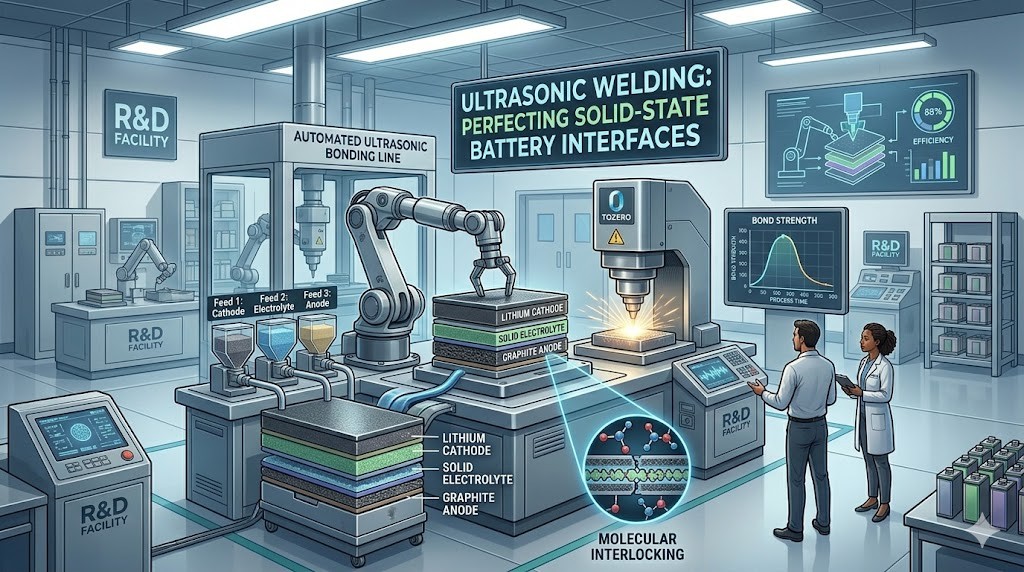
東北大学の研究グループ(WPI-AIMRの程准教授、金属材料研究所の加藤教授ら)は、次世代電池として期待される酸化物系全固体電池において、最大の難関の一つであった「固体電解質と電極の接合」を、室温かつ数秒で完了させる新手法を開発しました。
1. 技術の核心:超音波接合法の採用
従来、固体の電解質とリチウム金属を密着させるには、リチウムを溶かして流し込む(加熱)工程や、長時間の加圧が必要でした。今回の手法では、超音波振動を利用します。
- 絶縁層の破壊: 電解質(LLZO)表面に自然にできてしまう抵抗成分(炭酸リチウムなど)を振動で引き剥がします。
- 塑性変形: 柔らかいリチウム金属を振動と圧力で変形させ、硬い電解質の表面に隙間なく押し込みます。
- メリット: 加熱が不要なため、材料の劣化を防ぎ、製造コストと時間を大幅に削減できます。
2. 劇的な抵抗値の低減
界面の「電気の通りにくさ(界面抵抗)」において、驚異的な数値を記録しています。
- 超音波接合のみ: 約225 ohm cm2
- 金(Au)層の併用: 約1.5 ohm cm2
- 比較: 従来の加熱プロセスと同等、あるいはそれ以上の極めて低い抵抗値を、室温・短時間で実現しました。
関連情報:なぜこのニュースが重要なのか?
この技術の背景にある専門用語や、業界へのインパクトを補足します。
LLZO(ガーネット型酸化物固体電解質)とは
正式名称は Li7La3Zr2O12。数ある固体電解質の中でも、以下の特徴を持ちます。
- 化学的安定性: リチウム金属と直接触れても変質しにくい。
- 安全性: 燃えやすい有機電解液を使わないため、発火リスクが極めて低い。
- 課題: 非常に硬いセラミックスであるため、金属リチウムとの間に隙間ができやすく、それが電池性能を落とす原因となっていました。
リチウム金属電池のポテンシャル
現在主流のリチウムイオン電池は負極にグラファイト(炭)を使っていますが、これをリチウム金属そのものに置き換えると、理論上のエネルギー密度は数倍に跳ね上がります。今回の技術は、この「理想の電池」の実用化を後押しするものです。
製造コストへの影響
これまでは真空装置や高温炉を使った複雑な工程が必要でしたが、超音波接合は既存の産業用溶接技術を応用できるため、工場のライン簡素化に直結します。「全固体電池は高い」という常識を覆す鍵になるかもしれません。
出典:https://eetimes.itmedia.co.jp/ee/articles/2603/27/news039.html
Manufacturing Innovation in Oxide-Based All-Solid-State Batteries via Ultrasonic Bonding: Achieving Interface Formation at Room Temperature in Seconds
A research group at Tohoku University (including Associate Professor Jianfeng Cheng of WPI-AIMR and Professor Hidemi Kato of the Institute for Materials Research) has developed a new method to complete the bonding between a solid electrolyte and an electrode in seconds at room temperature. This process has long been one of the biggest challenges in developing oxide-based all-solid-state batteries, which are highly anticipated as next-generation energy storage.
1. Core Technology: Adoption of Ultrasonic Bonding
Conventionally, achieving close contact between a solid electrolyte and lithium metal required heating processes (melting and pouring lithium) or long periods of high pressure. This new method utilizes ultrasonic vibration.
- Destruction of the Insulating Layer: The vibration strips away resistive components (such as lithium carbonate, Li2CO3) that naturally form on the surface of the electrolyte (LLZO).
- Plastic Deformation: Soft lithium metal is deformed by vibration and pressure, pressing it into the hard electrolyte surface without any gaps.
- Benefits: Since heating is not required, material degradation is prevented, and manufacturing costs and time are significantly reduced.
2. Dramatic Reduction in Resistance
The method has recorded impressive values for interface resistance (the difficulty of electricity flow).
- Ultrasonic Bonding Only: approx. 225 ohm cm2
- With Gold (Au) Layer: approx. 1.5 ohm cm2
- Comparison: Extremely low resistance levels, equal to or better than conventional heating processes, were achieved at room temperature in a very short time.
Related Information: Why Is This News Important?
This section provides context on the technical terms and industry impact.
What is LLZO (Garnet-type Oxide Solid Electrolyte)?
The formal name is Li7La3Zr2O12. Among various solid electrolytes, it has the following characteristics:
- Chemical Stability: It is resistant to degradation even when in direct contact with lithium metal.
- Safety: Since it does not use flammable organic liquid electrolytes, the fire risk is extremely low.
- Challenge: Because it is a very hard ceramic, gaps tend to form between it and the lithium metal, which has been a cause of reduced battery performance.
Potential of Lithium Metal Batteries
Mainstream lithium-ion batteries currently use graphite (carbon) for the negative electrode. Replacing this with pure lithium metal can theoretically increase energy density several times over. This technology supports the practical application of this “ideal battery.”
Impact on Manufacturing Costs
Previously, complex processes involving vacuum equipment and high-temperature furnaces were necessary. Since ultrasonic bonding can adapt existing industrial welding technologies, it leads directly to the simplification of factory production lines. This could be the key to overturning the common perception that all-solid-state batteries are too expensive.

コメント