メルセデス・ベンツから出資・支援を受ける台湾のプロロジウム(ProLogium Technology)社が、次世代EV向け全固体電池セルのギガ規模での量産開始を発表し、自動車・電池業界で大きな注目を集めています。
エネルギー密度の高さ、急速充電性能、そして極めて高い耐熱・安全性特性を備えた大型全固体パウチセルの実用化は、従来のNMC(ニッケル・マンガン・コバルト)やLFP(リン酸鉄リチウム)電池に対する大きな技術的優位性を示しています。
ニュース記事の要約ならびに、全固体電池の技術分類や市場における位置付けといった関連情報をまとめて記載します。
要約と主要ポイント
1. プロロジウム社による全固体電池の量産開始とセル仕様
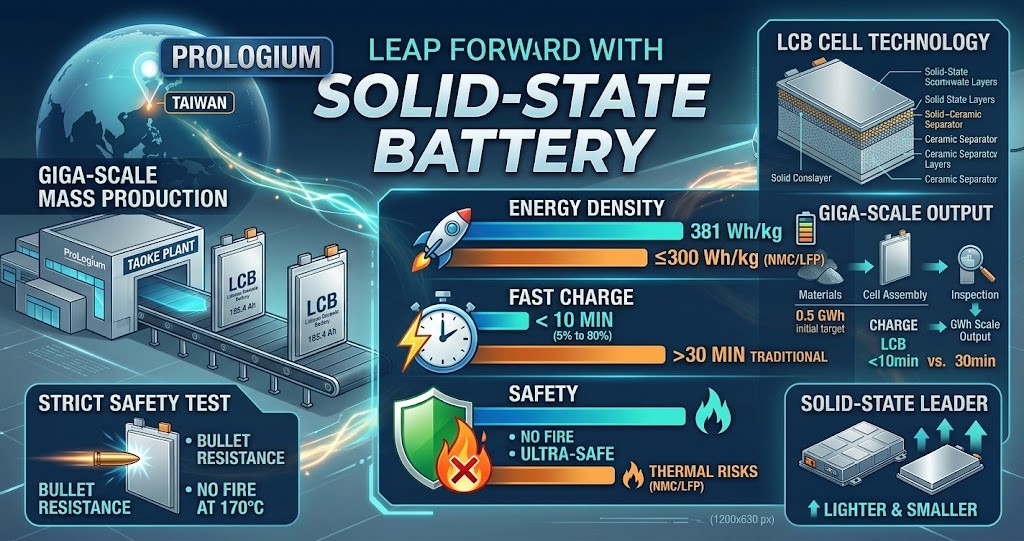
- 量産体制の確立: 台湾・桃園(Taoke工場)のギガワット級施設にて、第3.5世代となる185.4Ah(アンペア時)の大型パウチ型リチウムセラミック電池(LCB)セルの量産を開始。初期生産能力は0.5GWh(80kWh級EV用パックで約6000台分に相当)。
- 最高クラスのエネルギー密度: ドイツの第三者認証機関TUV(テューフ)による試験で、重量エネルギー密度381Wh/kg(ワット時/キログラム)、体積エネルギー密度903Wh/L(ワット時/リットル)を達成。主流のNMC電池(約300Wh/kg)と比較して約30%高く、LFP電池(150-200Wh/kg)を大幅に上回る。
- 超急速充電と極高安全性能: 充電状態5%から80%まで10分未満(第3世代規格では8.5分)で急速充電可能。銃弾貫通、170℃の高温露出、定格電圧2倍の過充電においても発火しない安全性を誇る。
- 真の全固体規格への適合: 中国の最新全固体電池安全規格「GB/T 43568-2026」に基づくUL Solutionsの試験において、120℃の真空状態に6時間保持した際の重量減少率が0.05%未満となり、半固体電池と区別される全固体電池基準(0.5%未満)を大幅にクリア。
2. 今後の拡張ロードマップと次世代展開
- グローバル生産拠点の拡張: 台湾拠点は2030年までに生産量を倍増予定。フランス・ダンケルクに建設予定の第2工場は、2028年稼働開始(初期4GWh、最終最大能力44GWh)を目指す。
- 第4世代セルへの移行コスト抑止: 完全無機超流動電解質システムを採用する第4世代セルの展開も控えており、既存の第3.5世代生産ライン設備のわずか10%をアップグレードするだけで組み立てラインへ転用可能。
関連情報・背景解説
1. 半固体電池(Semi-Solid State)と真の全固体電池(All Solid-State)の明確化
これまで自動車業界では、電解液を少量(数%から10%程度)残した「半固体(ゲル状・ハイブリッド型)電池」も全固体と称して発表される例が多く存在しました。今回適用された新規格「GB/T 43568-2026」は、高温真空下での揮発分(電解液)の重量減少率を測定することで、極小量の液体成分も厳密に見分ける仕組みです。プロロジウムのセルがこの厳しい基準をクリアしたことは、実用レベルでの「真の全固体電池」の本格量産化に向けた重要な進展を意味します。
2. メルセデス・ベンツとの戦略的提携とプレミアムEV戦略
メルセデス・ベンツは2022年にプロロジウムへの出資および取締役会への参画を発表し、共同で次世代バッテリーセル技術の開発を推進してきました。プロロジウムの初期出荷分(0.5GWh規模)は限定的な生産量であるため、最初はメルセデス・ベンツのフラッグシップEVや限定ハイパフォーマンスモデル、試作車テストへ先行展開される見込みです。高価なシリコンアノードやセラミック電解質を用いる全固体電池は、量産効果によるコスト低減が進むまでは高級車市場を中心に導入が進むと予想されます。
3. 複合固体電解質(セラミック・高分子複合型)の技術的特徴
プロロジウムが採用するリチウムセラミック電池(LCB)は、酸化物系セラミック材料と高分子ポリマーを組み合わせた「複合固体電解質」構造をとっています。硫化物系固体電解質(トヨタなどが注力)と比較すると、イオン電導度や界面抵抗の低減では高度な技術が必要となる反面、大気中での有毒ガス(硫化水素など)の発生リスクがなく、既存の電池製造設備・プロセスからの転用や製造安全性に優れるメリットを持ちます。
出典:https://insideevs.com/news/807472/solid-state-battery-mass-production-prologium/
Shocking Performance 30% Higher Than NMC Batteries! What is ProLogium’s “True All-Solid-State Battery”?
ProLogium Technology, a Taiwanese company backed and funded by Mercedes-Benz, has announced the start of gigawatt-scale mass production of next-generation all-solid-state battery cells for electric vehicles (EVs), drawing significant attention across the automotive and battery industries. The commercialization of large-format all-solid-state pouch cells featuring high energy density, ultra-fast charging capability, and exceptionally high thermal safety exhibits a clear technological edge over traditional NMC (nickel-manganese-cobalt) and LFP (lithium iron phosphate) batteries. Below is a summary of the news article along with relevant background information on battery technology classifications and market positioning.
Executive Summary & Key Highlights
1. ProLogium’s Solid-State Battery Mass Production & Cell Specifications
- Establishment of Mass Production Capacity: Mass production of the 3.5th-generation 185.4 Ah large-format pouch Lithium Ceramic Battery (LCB) cells has commenced at the company’s gigawatt-scale facility in Taoke, Taoyuan, Taiwan. Initial production capacity stands at 0.5 GWh (equivalent to roughly 6,000 packs for 80 kWh-class EVs).
- Class-Leading Energy Density: Tested by the German third-party certification body TÜV, the cell achieves a gravimetric energy density of 381 Wh/kg and a volumetric energy density of 903 Wh/L. This is approximately 30% higher than mainstream NMC batteries (~300 Wh/kg) and vastly exceeds LFP batteries (150–200 Wh/kg).
- Ultra-Fast Charging & Extreme Safety: Capable of charging from 5% to 80% State of Charge (SOC) in under 10 minutes (8.5 minutes for 3rd-generation specifications). It demonstrates extreme safety with no ignition even under bullet penetration, exposure to high temperatures of 170°C, or overcharging to double its rated voltage.
- Compliance with True All-Solid-State Standards: In testing conducted by UL Solutions under China’s latest solid-state battery safety standard “GB/T 43568-2026,” the cell demonstrated a mass loss rate of less than 0.05% after being held in a vacuum at 120°C for 6 hours, easily beating the threshold (<0.5%) that distinguishes true solid-state batteries from semi-solid variants.
2. Expansion Roadmap & Next-Gen Rollout
- Global Footprint Expansion: Production capacity at the Taiwan facility is projected to double by 2030. Construction of a second plant in Dunkirk, France, is slated to start operations in 2028, targeting an initial capacity of 4 GWh and a ultimate maximum capacity of 44 GWh.
- Low-Cost Transition to 4th-Gen Cells: The deployment of 4th-generation cells utilizing a fully inorganic ultra-fluid electrolyte system is also planned. Transitioning the assembly line requires upgrading just 10% of existing 3.5th-generation equipment.
Related Information & Technical Context
1. Differentiating Semi-Solid State from True All-Solid-State
In the automotive industry, “semi-solid-state (gel/hybrid)” batteries—which retain small amounts of liquid electrolyte (~few % to 10%)—have frequently been labeled as solid-state. The newly applied GB/T 43568-2026 standard measures weight loss from volatile liquid components under high-temperature vacuum conditions, strictly detecting even trace amounts of liquid. ProLogium’s cell passing this rigorous test marks a pivotal step toward real-world mass deployment of “true all-solid-state batteries.”
2. Strategic Partnership with Mercedes-Benz & Premium EV Strategy
Mercedes-Benz announced an investment in ProLogium and a seat on its board of directors in 2022 to jointly develop next-generation battery cell technology. Given ProLogium’s initial output (0.5 GWh) is relatively small, early shipments are expected to be allocated to Mercedes-Benz’s flagship EVs, limited high-performance models, and prototype fleet testing. Due to the higher cost of silicon anodes and ceramic solid electrolytes, adoption is expected to center on premium vehicle segments until economies of scale drive down production costs.
3. Technical Features of Composite Solid Electrolytes (Ceramic-Polymer Hybrid)
The Lithium Ceramic Battery (LCB) architecture adopted by ProLogium utilizes a composite solid electrolyte combining oxide ceramics and polymer materials. Compared to sulfide-based solid electrolytes (the primary focus of companies like Toyota), composite systems face higher technical hurdles in maximizing ionic conductivity and minimizing interface resistance; however, they avoid the risk of generating toxic gases (such as hydrogen sulfide) upon exposure to air and offer superior manufacturing safety and compatibility with existing production equipment.

コメント