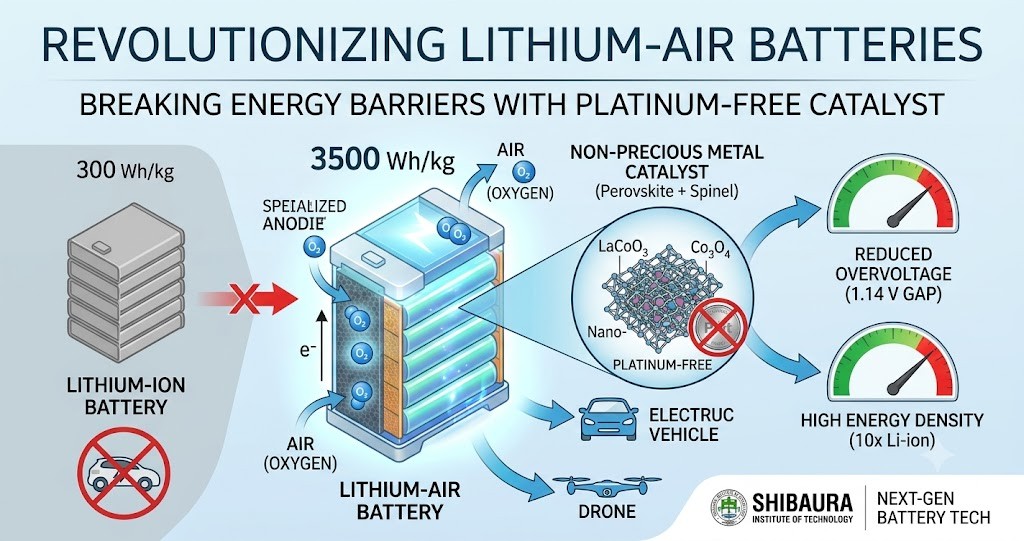
電気自動車(EV)の航続距離拡大やドローン・電動航空機の実現に向けて、現在主流であるリチウムイオン電池の性能限界(約300 Wh/kg)を打破する「次世代バッテリー」の開発が世界中で激化しています。中でも、大気中の酸素を反応物質として利用し、理論上ガソリンに匹敵するエネルギー密度(約3,500 Wh/kg)を持つ「リチウム酸素電池」は、究極の蓄電池として期待されてきました。
しかし、充電と放電の際にかかる電圧差(過電圧)が大きくエネルギー効率が低いことや、反応を助ける触媒に高価な白金(プラチナ)などの貴金属が必要であることが、実用化の大きな壁となっていました。今回のニュースは、芝浦工業大学の研究チームが安価な遷移金属酸化物を組み合わせることで、高価な白金を使わずに過電圧を大幅に低減させる画期的な触媒技術を開発したというものです。
ニュースの要点まとめ
- 何が起きたか 芝浦工業大学の研究チームが、ペロブスカイト型酸化物(LaCoO3)とスピネル型酸化物(Co3O4)をナノレベルで複合化した、白金不要のリチウム酸素電池向け非貴金属触媒を開発しました。
- なぜ重要か 従来のリチウムイオン電池の最大10倍のエネルギー密度(約3,500 Wh/kg)を持つリチウム酸素電池において、充放電の電圧ギャップ(過電圧)を非貴金属触媒として記録的な1.14 Vまで縮小させることに成功しました。
- 今後の注目点 クリーンな純酸素下での実験結果から、現実の空気中に含まれる水分や二酸化炭素(CO2)による劣化耐性の確保、および長期的な充放電サイクルにおける安定性の検証へと移行します。
発表内容の詳細解説
1. リチウムイオン電池の限界とリチウム酸素電池の仕組み
現在の主流であるリチウムイオン電池は、電極の骨組みとなる重い金属酸化物内部にリチウムが出入りする仕組み(インターカレーション)のため、重量あたりのエネルギー密度が約300 Wh/kg程度で物理的な限界を迎えています。
これに対し、リチウム酸素電池は正極に電池外部の「大気中の酸素」を取り込んで利用します。
- 放電時: 負極から出たリチウムイオンと取り込んだ酸素が反応し、正極に過酸化リチウム(Li2O2)が形成されます。
- 充電時: 絶縁体である過酸化リチウム(Li2O2)を分解し、再びリチウムと酸素に分離させます。
重い正極材料を内部に保持する必要がないため、従来の最大10倍もの高エネルギー密度を実現できます。
2. 「表面積至上主義」を覆した新触媒のブレイクスルー
従来は「触媒の表面積を広くして反応サイト(接点)を増やすほど性能が上がる」と考えられており、白金や酸化ルテニウムなどの貴金属を微粒子化して広い表面積を持たせる手法が主流でした。
しかし、研究チームは最も表面積が小さい複合酸化物が最高の触媒活性を示すことを発見しました。
- 共沈法の採用: 2つの素材(ペロブスカイト型のLaCoO3とスピネル型のCo3O4)を溶液中から同時に沈殿させる「共沈法」で合成。
- 酸素空孔の生成: 異なる結晶構造の接合面(界面)に原子配列のズレが生じ、酸素原子が抜け落ちた「酸素空孔」と呼ばれるナノレベルの欠陥が豊富に形成されました。
- 電子の立体交差: この欠陥が電子移動のバイパス道路として機能し、物理的な表面積の広さではなく「分子レベルの電子伝導性の質」を高めることで、充放電の反応速度を劇的に向上させました。
3. 性能指標(1.14 Vの過電圧)
充放電の電圧ギャップは1.14 Vまで縮小しました(通常の非貴金属触媒では1.5 V以上)。
- 酸素発生反応(充電): 産業用ベンチマークである市販の酸化ルテニウムを上回る分解スピードを達成。
- 酸素還元反応(放電): 高価な白金系触媒に匹敵する還元スピードを達成。
関連情報・背景知識の補足
貴金属フリー化がもたらす経済的・産業的価値
白金(プラチナ)やイリジウムといった貴金属は、供給量が極めて限定的で価格変動も激しいため、数百万台規模で生産される電気自動車(EV)や大型ドローンへの全面採用は現実的ではありませんでした。安価なコバルトやランタンなどの遷移金属酸化物で白金同等の性能が出せるようになったことは、将来的な量産コストを劇的に下げる大きな一歩です。
全固体電池とリチウム酸素電池の位置づけ
現在実用化が進んでいる「全固体電池」は、主に安全性の向上や急速充電能力の獲得を目的としています。一方で「リチウム酸素電池」は、エネルギー密度の極限追求を目的としており、長距離トラック、大型船、電動航空機(eVTOLなど)といった、バッテリー重量が航続性能を決定づける大型モビリティ分野での本命技術と位置づけられています。
実用化に向けた「空気成分」との戦い
リチウム酸素電池をラボ環境から現実世界に持ち出す際の最大の障壁は、大気中に含まれる「水分」と「二酸化炭素(CO2)」です。
- 二酸化炭素の課題: 二酸化炭素とリチウムが反応すると炭酸リチウム(Li2CO3)が生成され、過酸化リチウム(Li2O2)以上に分解が難しく、電池寿命を急速に縮めます。
- 解決への業界動向: 今回のような高性能触媒の開発と並行して、酸素のみを選択的に通し、水分や二酸化炭素の侵入をブロックする「選択的透過膜(ガス分離膜)」や、副反応を起こしにくい新電解液の開発が世界各地で進められています。
A Step Forward Toward 10x EV Driving Range! New Catalyst Developed for Platinum-Free Lithium-Oxygen Batteries
To extend the driving range of electric vehicles (EVs) and enable drones and electric aircraft, global competition is intensifying to develop next-generation batteries that overcome the performance limit of current lithium-ion batteries (approx. 300 Wh/kg). Among these, lithium-oxygen batteries, which use atmospheric oxygen as a reactant and theoretically possess energy density comparable to gasoline (approx. 3,500 Wh/kg), have been anticipated as the ultimate energy storage technology.
However, major hurdles to practical application have included a large voltage gap (overpotential) during charge and discharge leading to low energy efficiency, as well as the need for expensive precious metals such as platinum as catalysts. This news highlights a breakthroughs by a research team at Shibaura Institute of Technology, who combined low-cost transition metal oxides to develop a novel catalyst technology that significantly reduces overpotential without using costly platinum.
Key Takeaways
- What Happened: A research team at Shibaura Institute of Technology developed a platinum-free, non-precious metal catalyst for lithium-oxygen batteries by combining perovskite-type oxide (LaCoO3) and spinel-type oxide (Co3O4) at the nanometer level.
- Why It Matters: In lithium-oxygen batteries offering up to 10 times the energy density of conventional lithium-ion batteries (approx. 3,500 Wh/kg), the team successfully reduced the charge-discharge voltage gap (overpotential) to a record-low 1.14 V for a non-precious metal catalyst.
- What to Watch Next: Following results in clean, pure oxygen environments, research will shift toward ensuring durability against degradation caused by moisture and carbon dioxide (CO2) in real ambient air, as well as verifying stability over long-term charge-discharge cycles.
Detailed Breakdown of the Announcement
1. Limits of Lithium-Ion Batteries and How Lithium-Oxygen Batteries Work
Mainstream lithium-ion batteries rely on intercalation, where lithium ions move in and out of heavy metal oxide electrode frameworks, reaching a physical energy density limit of around 300 Wh/kg by weight.
In contrast, lithium-oxygen batteries draw oxygen directly from the ambient air outside the cell to serve as the positive electrode reactant:
- Discharging: Lithium ions released from the negative electrode react with incoming oxygen to form solid lithium peroxide (Li2O2) at the positive electrode.
- Charging: The insulating lithium peroxide (Li2O2) decomposes back into lithium and oxygen.
Because there is no need to store heavy positive electrode materials inside the cell, energy density up to 10 times higher than conventional batteries can be achieved.
2. Breakthrough Challenging “Surface Area Primacy”
It was long believed that increasing the total surface area of a catalyst created more reaction sites and improved performance, leading researchers to focus on downsizing precious metals like platinum and ruthenium oxide to maximize surface area. However, the research team discovered that the composite oxide with the smallest surface area actually exhibited the highest catalytic activity.
- Adoption of Co-precipitation: Synthesized using a co-precipitation method, where two materials (perovskite LaCoO3 and spinel Co3O4) are precipitated simultaneously from a solution.
- Formation of Oxygen Vacancies: Atomic lattice mismatches at the interface between the two distinct crystal structures created abundant nanometer-scale defects known as oxygen vacancies.
- Electronic Bypass Pathways: These defects act as high-speed bypass routes for electron transport. Rather than relying on physical surface area, improving the quality of electron conductivity at the molecular level drastically accelerated charge and discharge reaction rates.
3. Performance Metrics (1.14 V Overpotential)
The charge-discharge voltage gap was reduced to 1.14 V (compared to over 1.5 V for typical non-precious metal catalysts).
- Oxygen Evolution Reaction (Charging): Achieved decomposition speeds surpassing commercial ruthenium oxide, the industry benchmark.
- Oxygen Reduction Reaction (Discharging): Achieved reduction speeds matching expensive platinum-based catalysts.
Supplementary Context and Background Knowledge
Economic and Industrial Value of Eliminating Precious Metals
Precious metals like platinum and iridium have limited supply and volatile prices, making them impractical for mass adoption in millions of EVs or commercial drones. Achieving platinum-equivalent performance using affordable transition metal oxides such as cobalt and lanthanum represents a major step toward lowering future mass-production costs.
Positioning Relative to All-Solid-State Batteries
All-solid-state batteries currently nearing commercialization primarily aim to enhance safety and enable rapid charging. Meanwhile, lithium-oxygen batteries aim for the absolute extreme of energy density. They are positioned as the leading technology for heavy-duty mobility applications where battery weight directly dictates operational range, such as long-haul trucks, large ships, and electric vertical takeoff and landing (eVTOL) aircraft.
Overcoming the Challenge of Ambient Air Components
The main obstacle to transitioning lithium-oxygen batteries from lab settings to real-world applications is the presence of moisture and carbon dioxide (CO2) in ambient air.
- The CO2 Challenge: CO2 reacts with lithium to form lithium carbonate (Li2CO3), which is even harder to decompose than lithium peroxide (Li2O2) and rapidly degrades battery life.
- Industry Directions: Alongside advanced catalyst development, researchers worldwide are developing selective gas-permeable membranes to block moisture and CO2 while allowing only oxygen to pass, as well as novel electrolytes designed to resist side reactions.


コメント