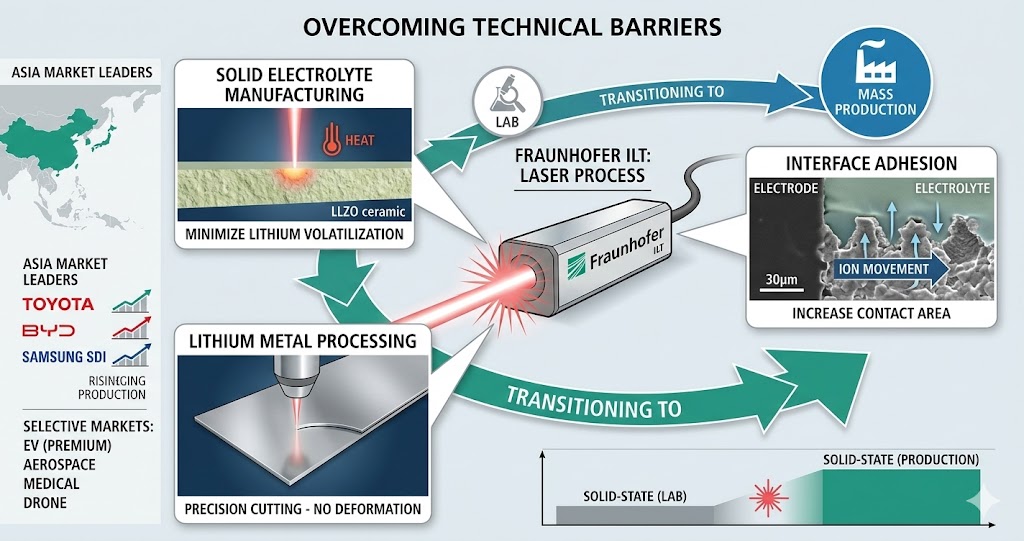
全固体電池は、高い安全性とエネルギー密度を兼ね備えた次世代電池の筆頭ですが、ラボ(研究室)から大量生産への移行には高い技術的障壁が存在します。ドイツのフラウンホーファー・レーザー技術研究所(ILT)は、この課題を解決する鍵として「レーザープロセス」を提唱しています。
主な技術的課題とレーザーによる解決策
- 固体電解質の製造: 酸化物系セラミック(LLZOなど)は高温焼結が必要ですが、リチウムの揮発が課題です。レーザーによる局所的な高速加熱・冷却により、熱ダメージを抑えた緻密化が可能になります。
- 界面の密着性向上: 電解質と電極の接合面で抵抗が高まる問題を、超短パルスレーザーによる微細構造化(約30μm幅)で解決。接触面積を増やし、イオン移動をスムーズにします。
- リチウム金属の加工: 非常に柔らかく反応性が高いリチウム箔は、従来の刃物では付着や変形が起きます。非接触のレーザー切断により、バリのない精密な形状加工を実現します。
関連情報:市場の動向
- アジア勢の先行: トヨタ、BYD、サムスンSDIなどは2027年以降のパイロット生産を計画しており、日本・中国・韓国勢が量産化レースをリードしています。
- 用途の差別化: 当面はコストが高いため、電気自動車(EV)の高級車モデル、航空宇宙、医療機器、ドローンなど、付加価値の高い分野から導入が進む見込みです。
Breaking Barriers to Mass Production: Laser Technology Bridges the Gap Between Lab and Factory for Solid-State Batteries
Solid-state batteries (SSBs) are the leading candidates for next-generation energy storage, combining high safety with superior energy density. However, significant technical barriers exist in transitioning these batteries from laboratory-scale prototypes to mass production. The Fraunhofer Institute for Laser Technology (ILT) in Germany proposes “laser processing” as the key to overcoming these industrial challenges.
Key Technical Challenges and Laser Solutions
- Manufacturing Solid Electrolytes: Oxide-based ceramics, such as LLZO, require high-temperature sintering, which often leads to the problematic evaporation of lithium. By utilizing localized, high-speed laser heating and cooling, it is possible to achieve densification while minimizing thermal damage and material loss.
- Improving Interface Adhesion: Resistance often increases at the junction between the electrolyte and the electrodes. This issue is addressed through micro-structuring via ultrashort pulse (USP) lasers (approx. 30 micrometers wide). This process increases the contact area, ensuring smooth ion mobility.
- Processing Lithium Metal: Lithium foil is extremely soft and highly reactive, causing it to stick to or deform under conventional cutting blades. Non-contact laser cutting enables precise, burr-free shaping without mechanical stress or contamination.
Related Information: Market Trends
- Asian Leadership: Companies such as Toyota, BYD, and Samsung SDI are planning to launch pilot production from 2027 onwards. Currently, players from Japan, China, and South Korea are leading the global race for mass production.
- Niche Application Strategy: Due to initially high production costs, adoption is expected to begin in high-value sectors. This includes luxury electric vehicle (EV) models, aerospace, medical devices, and high-performance drones.

コメント