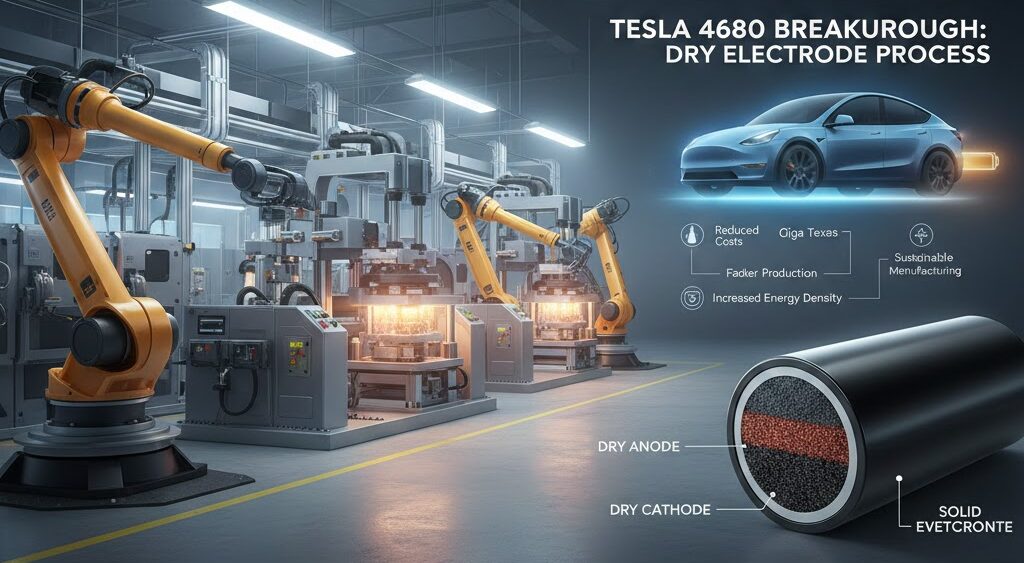
テスラが次世代バッテリー「4680」の開発における最大の技術的難関、「完全乾式電極プロセス」を突破しました。2020年の「バッテリー・デー」での構想発表から数年、ついに陽極(アノード)と陰極(カソード)の両方を乾式プロセスで生産し始めたことが、2026年1月の最新報告で確認されました。
このブレークスルーは、単なる製造効率の向上にとどまらず、テスラのコスト競争力と垂直統合戦略を決定づける歴史的な転換点となります。
1. 乾式電極プロセス(Dry Electrode Process)とは?
従来のバッテリー製造では、材料を溶媒と混ぜて液体状の「スラリー」にし、それを金属箔に塗って巨大なオーブンで乾燥させる「湿式」が主流でした。テスラが実現した「乾式」は、この常識を覆す技術です。
- 乾燥工程の撤廃: 溶媒を使用せず、粉末状の材料を熱と圧力だけで直接電極に形成します。
- 設備の簡素化: 数十メートルにおよぶ巨大な乾燥炉や溶媒回収装置が不要になります。
- 環境負荷の低減: 有毒な溶媒を使用せず、製造時のエネルギー消費を大幅に削減します。
2. なぜ「カソード(正極)」が困難だったのか
これまで、負極(アノード)の乾式化は比較的早期に達成されていましたが、カソード(正極)は材料の特性上、均一に成形するのが極めて困難でした。 今回、テスラがカソードの乾式化を「解決した」と公式に発表したことは、バッテリーを「より速く、より安く、よりコンパクトな工場で」大量生産する準備が整ったことを意味します。
3. モデルYへの搭載と供給網の柔軟性
テスラは、この新型4680セルを使用したバッテリーパックを、一部のモデルY向けに生産開始しました。
- 供給ベクトルの拡大: 米国テキサス州のギガファクトリーで内製することで、関税リスクや複雑な国際サプライチェーンに左右されない、安定した供給体制を構築します。
- コスト削減の継承: 製造コストの削減(予測では最大50%以上)により、車両価格の引き下げや利益率の向上が期待されます。
【関連情報】乾式電極がもたらすバッテリー革命の未来
テスラの成功を受けて、業界全体で注目されているポイントは以下の通りです。
- エネルギー密度の向上: 乾式プロセスではバインダー(接着剤)の使用量を最小限に抑えられるため、より多くの活物質を詰め込むことが可能です。これにより、同じサイズでも走行距離を約10%から20%伸ばせる可能性があります。
- 全固体電池への応用: 乾式電極技術は、次世代バッテリーの筆頭である「全固体電池」の製造プロセスとも親和性が高く、この分野での主導権争いにおいてもテスラが一歩リードした形となります。
- シリコンアノードの採用: 最新の特許情報では、乾式プロセスを用いて高い比率のシリコンを負極に組み込む技術も示唆されています。これが実現すれば、さらなる高容量化と超急速充電が可能になります。
出典:https://www.teslarati.com/tesla-confirms-finally-solved-4680-battery-dry-cathode-process/
Tesla Succeeds in “Full Dry” 4680 Battery Production, Establishing Mass Production for Both Anode and Cathode
Tesla has overcome the most significant technical hurdle in the development of its next-generation “4680” battery: the Full Dry Electrode Process. Years after the initial concept was unveiled at “Battery Day” in 2020, a January 2026 report has finally confirmed that Tesla has begun producing both the anode and cathode using the dry process.
This breakthrough is more than just an improvement in manufacturing efficiency; it marks a historic turning point that defines Tesla’s cost competitiveness and vertical integration strategy.
1. What is the Dry Electrode Process?
In traditional battery manufacturing, materials are mixed with solvents to create a liquid “slurry,” which is then coated onto metal foils and dried in massive ovens—a method known as the “wet process.” Tesla’s “dry process” upends this industry standard.
- Elimination of the Drying Stage: No solvents are used; powdered materials are formed directly into electrodes using only heat and pressure.
- Simplified Facilities: Massive drying ovens spanning dozens of meters and solvent recovery systems are no longer required.
- Reduced Environmental Impact: By eliminating toxic solvents, the energy consumption during manufacturing is drastically reduced.
2. Why the “Cathode” Was So Challenging
While the dry process for the anode was achieved relatively early, the cathode was notoriously difficult to form uniformly due to its specific material properties. Tesla’s official announcement that they have “solved” dry cathode production signifies that they are now ready for mass production—making batteries “faster, cheaper, and in more compact factories.”
3. Implementation in Model Y and Supply Chain Flexibility
Tesla has commenced production of battery packs utilizing these new 4680 cells for specific Model Y units.
- Expanding Supply Vectors: By manufacturing in-house at the Giga Texas factory, Tesla establishes a stable supply system resilient to tariff risks and complex international supply chain disruptions.
- Inheriting Cost Savings: Reductions in manufacturing costs—estimated to be as high as 50% or more—are expected to lead to lower vehicle prices and improved profit margins.
[Related Information] The Future of the Battery Revolution Driven by Dry Electrodes
Following Tesla’s success, the industry is closely watching several key areas:
- Increased Energy Density: The dry process allows for a minimal amount of binder (adhesive), enabling more active material to be packed into the cell. This could potentially extend the driving range by 10% to 20% within the same form factor.
- Application to Solid-State Batteries: Dry electrode technology is highly compatible with the manufacturing processes of “solid-state batteries,” the frontrunner for next-generation power. This success puts Tesla a step ahead in the race for this technology.
- Adoption of Silicon Anodes: Recent patent information suggests techniques for incorporating high ratios of silicon into the anode using the dry process. If realized, this would enable even higher capacity and ultra-fast charging capabilities.

コメント