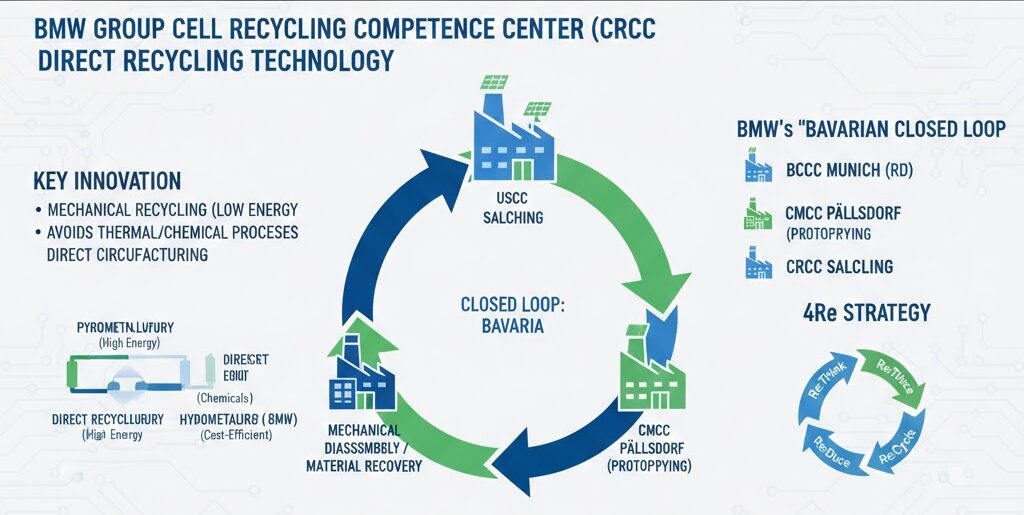
BMWグループは、ドイツ・バイエルン州ザルヒングに新設したセルリサイクル・コンピテンスセンター(CRCC)にて、エネルギー消費を大幅に抑えた革新的な「直接リサイクル(ダイレクトリサイクル)」技術の実装を開始しました。
ニュースの要点
- 新手法の導入: 従来の熱処理や化学処理(エネルギー多消費型)を避け、機械的に分解・回収するメカニカルリサイクルを採用。
- 直接循環: 回収された材料は基本成分まで分解せず、そのままバッテリーセルの製造プロセスへ直接戻すことが可能です。
- 拠点の役割: ザルヒングのCRCCは、年間数十トンの材料を回収し、近隣のパルスドルフにある試作拠点(CMCC)へ供給する循環構造を担います。
- 運営体制: BMWとInterzeroの合弁会社であるEncory(エンコリー)が運営を担当し、技術の知的財産権はBMWが保有します。
関連情報の補足:リサイクル技術の比較
現在、EVバッテリーのリサイクルには主に3つの方法があり、BMWが採用した「直接リサイクル」は最も環境負荷が低いとされています。
- 乾式精錬(パイロメタラジー): 高温で溶かして金属を抽出。エネルギー消費が大きく、一部の材料が失われる。
- 湿式精錬(ハイドロメタラジー): 薬品で溶かして抽出。純度は高いが、化学薬品の処理が必要。
- 直接リサイクル(BMWが採用): 材料の結晶構造を保ったまま回収。エネルギー消費を最小限に抑え、コスト効率が非常に高いのが特徴です。
BMWの「バイエルン・クローズドループ」
BMWは、バッテリー開発から廃棄までをバイエルン州内の3拠点に集約し、輸送コストとCO2排出を削減する独自の垂直統合モデルを構築しています。
| 拠点名 | 場所 | 役割 |
| BCCC | ミュンヘン | バッテリーセルの研究・開発(設計の起点) |
| CMCC | パルスドルフ | 量産化に向けた試作・パイロット生産 |
| CRCC | ザルヒング | 使用済み材料のリサイクル・再循環(今回の新拠点) |
循環型経済の指針「4Re戦略」
BMWグループは、車両のライフサイクル全体を通じて以下の4原則を掲げています。
- Re:Think: プロセスの再考
- Re:Duce: 資源の削減
- Re:Use: 素材の再利用
- Re:Cycle: 原材料のリサイクル
今回のCRCCはこの戦略を具体化するものであり、屋上に太陽光発電システムを設置するなど、施設自体のサステナビリティも追求されています。
結論と今後の展望
BMWの直接リサイクル技術は、バッテリー生産における「外部原材料への依存」を減らし、地政学的なリスクやコスト変動に対する耐性を高めるものです。この技術が確立されれば、将来的にはセルメーカーによる大規模な量産ラインへの導入も期待されており、EVの真の持続可能性を支える重要な柱となるでしょう。
出典:https://www.bmwgroup.com/en/news/general/2026/direct-battery-recycling-now-underway.html
BMW Group and Encory Launch Innovative Direct Recycling for Battery Raw Materials
The BMW Group has commenced the implementation of innovative “Direct Recycling” technology, which significantly reduces energy consumption, at its newly opened Cell Recycling Competence Center (CRCC) in Salching, Bavaria, Germany.
Key News Highlights
- Implementation of New Methods: Adoption of mechanical recycling, which involves mechanical disassembly and recovery, avoiding traditional energy-intensive thermal (heat) or chemical treatments.
- Direct Circulation: Recovered materials do not need to be broken down into their primary chemical elements; instead, they can be returned directly to the battery cell production cycle.
- Role of the Facility: The CRCC in Salching will recover dozens of tons of battery cell material annually, supplying it to the Cell Manufacturing Competence Center (CMCC) in nearby Parsdorf for pilot production.
- Operational Structure: Encory, a 50:50 joint venture between the BMW Group and the Interzero Group, builds and operates the facility, while the BMW Group retains all intellectual property rights for the direct recycling process.
Context: Comparison of Recycling Technologies
Currently, there are three primary methods for EV battery recycling. The “Direct Recycling” method adopted by BMW is considered to have the lowest environmental impact.
- Pyrometallurgy: Extracting metals by melting at high temperatures. High energy consumption; some materials are lost in the process.
- Hydrometallurgy: Extracting materials by dissolving them in chemicals. Achieves high purity but requires the management of chemical waste.
- Direct Recycling (BMW’s approach): Recovering materials while preserving their crystalline structure. Characterized by minimal energy consumption and extremely high cost-efficiency.
BMW’s “Bavarian Closed Loop”
BMW has concentrated its battery cell expertise across three sites in Bavaria to minimize transport costs and CO2 emissions through a unique vertically integrated model.
| Site Name | Location | Role |
| BCCC | Munich | Battery cell research and development (The starting point of design) |
| CMCC | Parsdorf | Scaling for production and pilot manufacturing |
| CRCC | Salching | Material recycling and recirculation (The new facility) |
The “4Re Strategy”: Guidelines for a Circular Economy
The BMW Group adheres to four core principles throughout the entire vehicle lifecycle:
- Re:Think: Rethinking processes
- Re:Duce: Reducing resource consumption
- Re:Use: Reusing materials
- Re:Cycle: Recycling raw materials
The CRCC embodies this strategy, further demonstrated by its rooftop solar PV system, which generates a portion of the energy required for operations.
Conclusion and Future Outlook
BMW’s direct recycling technology reduces “dependency on external raw materials” in battery production, enhancing resilience against geopolitical risks and price fluctuations. Once fully established, this technology is expected to be adopted for mass production by cell manufacturers in the long term, serving as a vital pillar for the true sustainability of Electric Vehicles.
コメント