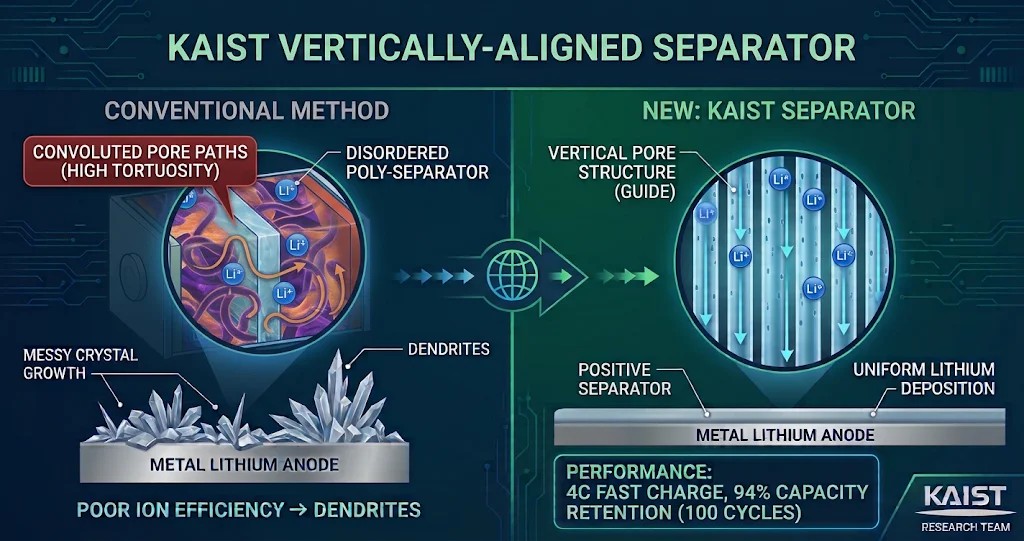
電気自動車の普及や再生可能エネルギーの導入拡大に伴い、蓄電池には高エネルギー密度と高速充電の性能が強く求められています。しかし、金属リチウムを負極に用いるリチウム金属電池では、急速充電時にデンドライト(樹枝状結晶)が成長しやすく、電池の劣化や短絡を引き起こすことが大きな課題でした。
この問題に対し、KAISTの研究チームは液晶高分子の分子配向を制御するというアプローチを採用。ナノ細孔チャネルを電極面に対して垂直に配向させることで、リチウムイオンの移動経路の曲折率を水平配向の場合の約2.5分の1に低減することに成功しました。これにより、イオン輸送効率の改善と電極表面での均一なリチウム析出が促進され、4Cの高速充電条件でも100サイクル後に94%の容量維持率を達成しています。
1. ニュースのポイントと研究成果
- 分子配向の制御: 液晶高分子の自己組織化特性を利用し、ナノ細孔チャネルの方向を電極面に対して垂直に揃える技術を開発。
- 移動経路の効率化: 従来の複雑な迷路状の経路を直線化し、有効曲折率を水平配向の約2.5分の1に低減。
- 優れたサイクル特性: 高ニッケル系正極(NCM811)を用いた実験室規模のフルセルにおいて、4Cの高速充電条件で100サイクル後に94%の容量を維持、平均クーロン効率99.86%を記録。
2. 技術のメカニズムと特徴
- イオン輸送の「ハイウェイ」: 垂直配向した細孔チャネルがリチウムイオンの移動方向と一致するため、移動抵抗が大幅に減少(炭酸塩系電解液中でイオン伝導度1.77mS/cm、活性化エネルギー0.12eV)。
- デンドライト成長の抑制: イオンが電極表面へ均一に供給されることで、局所的な電析や過剰な固体電解質界面相(SEI)の形成が抑えられ、副反応を軽減。
3. 実用化に向けた今後の課題
- 実用セル条件での検証: 実験室のコインセルから、低電解液量(リーン電解液)や高正極目付量、薄い金属リチウム負極を採用した商用セル同等の条件での長期安定性の確認。
- 大面積製造と量産技術: ロールツーロール製造ラインなどで、長尺フィルム全体にわたって均一な垂直配向を安定して維持・生産するプロセスの確立。
- 機械的・熱的安定性の向上: 実際の充放電に伴う体積変化や、異常発熱時における安全性、耐久性の検証。
A New Approach to Improving Storage Battery Performance: The Mechanism of the Vertically Aligned Separator Developed by KAIST
With the spread of electric vehicles (EVs) and the expanded adoption of renewable energy, high energy density and fast-charging performance are strongly demanded of storage batteries. However, in lithium-metal batteries using metallic lithium as the negative electrode, dendrites (branch-like crystals) tend to grow during fast charging, posing a major challenge by causing battery degradation and internal short circuits.
To address this issue, a research team at KAIST adopted an approach of controlling the molecular orientation of liquid crystal polymers. By aligning nano-pore channels perpendicularly to the electrode surface, they successfully reduced the tortuosity of the lithium-ion migration path to approximately 1/2.5 of that of horizontal orientation. This promotes improved ion transport efficiency and uniform lithium deposition on the electrode surface, achieving a 94% capacity retention rate after 100 cycles even under 4C fast-charging conditions.
1. Key Points of the News and Research Results
- Control of Molecular Orientation: Developed a technology utilizing the self-assembling properties of liquid crystal polymers to align the direction of nano-pore channels perpendicular to the electrode surface.
- Streamlining Migration Paths: Straightened conventional complex labyrinth-like paths, reducing the effective tortuosity to approximately 1/2.5 of horizontal orientation.
- Superior Cycling Performance: Recorded a 94% capacity retention rate after 100 cycles under 4C fast-charging conditions and an average Coulombic efficiency of 99.86% in a laboratory-scale full cell using a high-nickel cathode (NCM811).
2. Technology Mechanism and Features
- Ion Transport “Highway”: Because the vertically aligned pore channels match the direction of lithium-ion migration, migration resistance is significantly reduced (ionic conductivity of 1.77 mS/cm in carbonate-based electrolyte, activation energy of 0.12 eV).
- Suppression of Dendrite Growth: By supplying ions uniformly to the electrode surface, local electrodeposition and the excessive formation of solid electrolyte interphase (SEI) are suppressed, mitigating side reactions.
3. Future Challenges Toward Commercialization
- Verification Under Practical Cell Conditions: Confirming long-term stability under conditions equivalent to commercial cells, such as low electrolyte volume (lean electrolyte), high cathode active material loading, and thin metallic lithium anodes, moving up from laboratory coin cells.
- Large-Area Manufacturing and Mass Production Technology: Establishing processes to stably maintain and produce uniform vertical alignment across long films using roll-to-roll manufacturing lines or similar methods.
- Improvement of Mechanical and Thermal Stability: Verifying safety and durability against volume changes accompanying actual charge-discharge cycles and during abnormal heat generation.


コメント