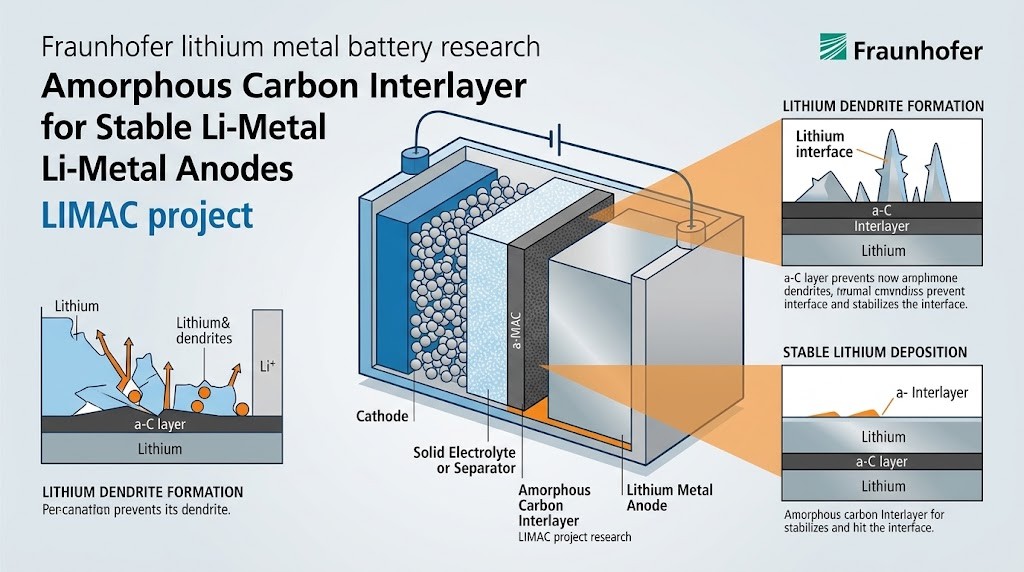
次世代の高エネルギー密度バッテリーとして期待されるリチウム金属電池ですが、実用化に向け最大の課題となるのが充放電に伴う負極の劣化や不安定な界面です。こうした中、フラウンホーファー表面工学・薄膜研究所(IST)とフラウンホーファー米国センター・ミッドウエスト(CMW)は、2026年9月から新たに共同研究プロジェクト「LIMAC」を始動させました。本プロジェクトでは、リチウム金属負極と電解質の間に非晶質炭素の中間層を設けることで、界面の安定化と電池の長寿命化を目指しています。
プロジェクトの主なポイントとアプローチ
- 非晶質炭素中間層による界面安定化: リチウム金属は高い比容量を持つため高エネルギー密度な電池を実現できる一方、電解質との反応不安定性が課題でした。本研究では、レーザーアークPVDプロセスを用いて銅集電体上に薄いアモルファスカーボン(非晶質炭素)層を成膜し、リチウム金属負極と電解質の界面を安定させる効果を検証します。
- 実験室規模から実用サイズ(パウチ型)への拡張: まずはコイン型電池を用いた試験フォーマットで評価を行い、最終的にはより大型のパウチ型セルへの技術拡張に向けたコンセプト開発も並行して進められます。
- 環境負荷の評価(LCA)の統合: 技術的な性能向上だけでなく、ライフサイクルアセスメント(LCA)を活用して物質やエネルギーの流れ、環境影響を包括的に検証することで、持続可能な電池技術としての評価も行います。
- 幅広い産業への応用期待: 成功すれば、高エネルギー密度を維持しながらバッテリーシステムの軽量化が可能になり、電気自動車(EV)、航空宇宙分野、定置型エネルギー貯蔵システムなどの性能や航続距離の大幅な向上が期待されます。
プロジェクト概要
- 正式名称: LIMAC – 信頼性の高いリチウム金属電池セルを実現する非晶質炭素中間層
- プロジェクト期間: 2026年9月 〜 2028年8月
- 主なパートナー:
- フラウンホーファー表面工学・薄膜研究所(IST)
- フラウンホーファー米国センター・ミッドウエスト(CMW)
Extending the Lifespan of Lithium Metal Batteries: Fraunhofer’s New “LIMAC” Project
Lithium metal batteries are anticipated as next-generation high-energy-density batteries, but their greatest challenge toward practical application is the degradation of the negative electrode and unstable interfaces during charging and discharging. In response, the Fraunhofer Institute for Surface Engineering and Thin Films (IST) and the Fraunhofer Center Midwest (CMW) in the USA launched a new joint research project called “LIMAC” in September 2026. This project aims to stabilize interfaces and extend battery lifespan by introducing an amorphous carbon interlayer between the lithium metal anode and the electrolyte.
Key Points and Approach of the Project
- Interface Stabilization via Amorphous Carbon Interlayer: While lithium metal offers high specific capacity enabling high-energy-density batteries, its reactive instability with the electrolyte has been a challenge. This research uses a laser-arc PVD process to deposit a thin amorphous carbon layer on a copper current collector, verifying its effect in stabilizing the interface between the lithium metal anode and the electrolyte.
- Scaling from Lab Scale to Practical Size (Pouch Cells): Evaluations will first be conducted using test formats with coin cells, followed by parallel concept development for technical scaling up to larger pouch cells.
- Integration of Environmental Impact Assessment (LCA): Beyond technical performance improvements, Life Cycle Assessment (LCA) is utilized to comprehensively verify material and energy flows as well as environmental impacts, ensuring evaluation as a sustainable battery technology.
- Expectations for Broad Industrial Applications: If successful, it will enable the lightweighting of battery systems while maintaining high energy density, promising significant improvements in performance and driving range for applications such as electric vehicles (EVs), aerospace, and stationary energy storage systems.
Project Overview
- Official Name: LIMAC – Amorphous Carbon Interlayers for Reliable Lithium Metal Battery Cells
- Project Period: September 2026 – August 2028
- Main Partners:
- Fraunhofer Institute for Surface Engineering and Thin Films (IST)
- Fraunhofer Center Midwest (CMW)


コメント