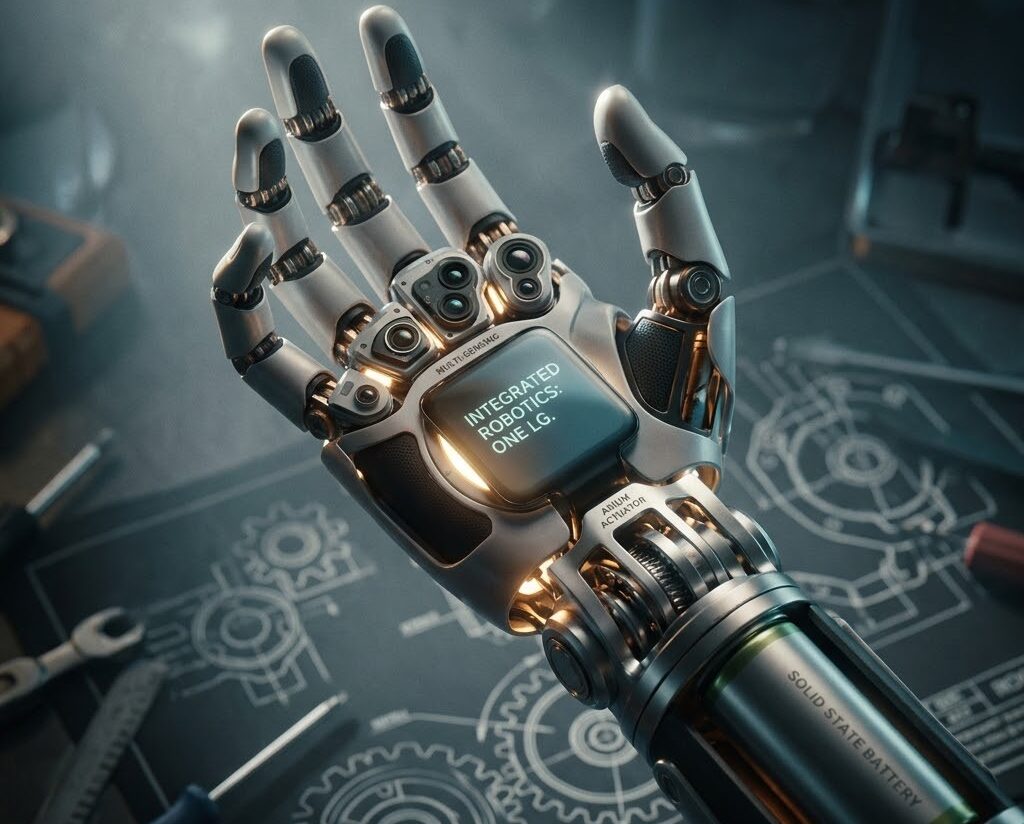
LGグループは、自動車部品やAIデータセンター分野で成功を収めた「One LG」戦略(グループ各社の専門性を統合して一括提案する手法)をロボット分野にも適用し、主要部品からソフトウェアまでをパッケージ化した「サブシステム・サプライヤー」としての地位を確立しようとしています。
1. 主要子会社による役割分担と開発状況
LGは、ロボットの製造コストの大部分を占めるアクチュエーター、バッテリー、センサーの各層で強みを発揮しています。
- LGエレクトロニクス(駆動系): 年間4,500万台の家電用モーター生産実績を活かし、年末までに「アクシウムアクチュエーター」の量産体制を整備予定。
- LGイノテック(感覚系): カメラ、LiDAR(ライダー)、レーダーを統合した複合センシングモジュールを開発。ボストン・ダイナミクスやFigure AIなどの主要企業向けに初期生産を開始し、2027年から2028年の本格量産を目指す。
- LGエナジーソリューション(電源系): 硫化物系全固体電池をロボット向けに開発。2030年までにエネルギー密度を最大化した「アノードフリー全固体電池」の投入を計画。
- 現行のNCMA円筒形セルでも、歩行や重量物保持に必要な「瞬発的な高出力」に対応した最適化モデルを展開。
- LGディスプレイ(インターフェース): 車載向け曲面プラスチックOLED技術を転用した、ロボットの顔用7インチ・フレキシブルOLEDを実証。
- LG AIリサーチ(認知系): 視覚言語モデル「Exaone 4.5」を開発。次世代ヒューマノイド「KAPEX」の認知層として採用。
2. 戦略的背景:部品表(BOM)の支配
ヒューマノイドロボットの製造コストにおいて、アクチュエーターは全体の40%から60%を占めると推定されています。LGはこの高付加価値領域に加え、バッテリーとセンサーという「三大制約要素」を自社グループ内で完結できる稀有なサプライヤーを目指しています。
【関連情報】LGのロボット戦略を支える背景と競合状況
- 「One LG」の成功事例: LGは、メルセデス・ベンツへの統合車載部品の提案や、インドネシアでのAIデータセンタープロジェクト(冷却、電力、施設管理の一括受注)など、グループの総合力を活かした受注実績を積み重ねています。
- アノードフリー全固体電池の重要性: 人型ロボットは限られた胴体スペースに多数のモーターと基板を収める必要があるため、体積あたりのエネルギー密度が極めて重要です。陽極(アノード)を排除する設計は、ロボットの稼働時間延長と軽量化に直結する「ゲームチェンジャー」となります。
- 競合他社との比較: テスラの「Optimus」が自社垂直統合を進める一方で、LGは多くのロボットメーカーを顧客とする「オープンプラットフォーム型の主要部品ベンダー」という立ち位置を狙っています。
出典:https://www.koreaherald.com/article/10710964
“One LG” Aims for Robot Hegemony: From Joints to Solid-State Batteries, a Total Supply Solution
LG Group is applying its successful “One LG” strategy—a method of integrating the expertise of group companies to provide unified proposals, previously proven in automotive parts and AI data centers—to the robotics sector. The group aims to establish itself as a “subsystem supplier” that packages everything from key hardware components to software.
1. Division of Roles and Development Status of Key Subsidiaries
LG is demonstrating strength in the actuators, batteries, and sensors segments, which together account for the majority of robot manufacturing costs.
- LG Electronics (Drivetrain): Leveraging its experience producing 45 million appliance motors annually, the company plans to establish a mass-production system for “Axium Actuators” by the end of 2026.
- LG Innotek (Sensing): Developing integrated sensing modules that combine Cameras, LiDAR, and Radar. Initial production has begun for major clients like Boston Dynamics and Figure AI, with a goal for full-scale mass production between 2027 and 2028.
- LG Energy Solution (Power): Developing sulfide-based all-solid-state batteries specifically for robots. The company plans to introduce “Anode-free all-solid-state batteries” by 2030 to maximize energy density. Even with current NCMA cylindrical cells, they are deploying optimized models capable of the “instantaneous high power” required for walking and lifting.
- LG Display (Interface): Demonstrated a 7-inch flexible OLED for robot faces, repurposing curved plastic OLED technology originally developed for automotive interiors.
- LG AI Research (Cognition): Developed the “Exaone 4.5” vision-language model, which has been adopted as the cognitive layer for the next-generation humanoid “KAPEX.”
2. Strategic Background: Dominating the Bill of Materials (BOM)
In the manufacturing cost of a humanoid robot, actuators are estimated to account for 40% to 60% of the total. LG aims to be a rare supplier capable of providing the “three major constraints”—actuators, batteries, and sensors—entirely within its own group.
[Related Information] Background and Competition for LG’s Robot Strategy
- Success Cases of “One LG”: LG has accumulated a track record of integrated orders, such as proposing unified automotive components to Mercedes-Benz and securing a 100 billion KRW AI data center project in Indonesia (covering cooling, power, and facility management).
- Importance of Anode-free Solid-State Batteries: Humanoid robots must fit numerous motors and circuit boards into a limited torso space, making volumetric energy density critical. An “Anode-free” design is a game-changer, directly leading to longer operating times and reduced weight.
- Comparison with Competitors: While Tesla’s “Optimus” pursues in-house vertical integration, LG is positioning itself as an “open-platform key component vendor” serving a wide range of global robot manufacturers.

コメント