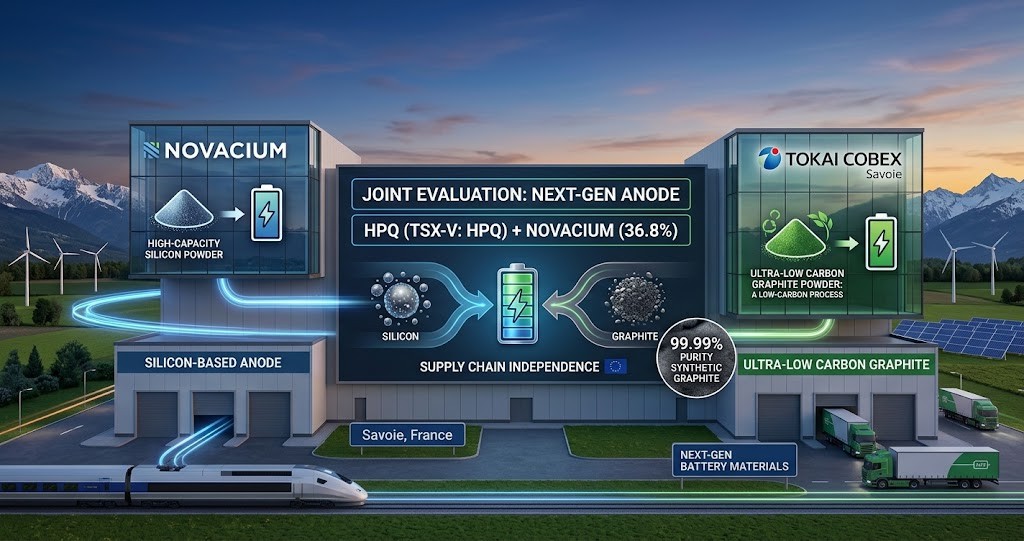
カナダの先端材料企業HPQ Silicon Inc.(TSX-V: HPQ)は、同社が株式36.8%を保有するフランスの戦略的パートナーNovacium SASが、東海カーボングループのTokai COBEX Savoie(東海コベックス・サヴォワ)と共同評価作業を開始したと発表しました。
本取り組みは、Novaciumが誇る高容量シリコン系負極材と、Tokai COBEXがフランス国内で低炭素プロセスを用いて製造する超低炭素・高純度(99.99%)合成黒鉛(グラファイト)を組み合わせ、欧州域内での自立した次世代リチウムイオン電池用負極材サプライチェーンの構築を目指すものです。
主な提携内容と評価ポイント
- 相補的な材料技術の統合 理論比容量が約372 mAh/gに限られる黒鉛に対し、約4,200 mAh/gと10倍以上の容量を持つシリコンを組み合わせることで、黒鉛の安定性と導電性を維持しながら、エネルギー密度を大幅に向上させた複合負極材の開発を目指します。
- シリコンの課題克服と実績 充放電時の体積膨張(300%以上)というシリコン特有の問題に対し、Novaciumの独自技術(GEN3、GEN4)により検証済みの安定性を提示。GEN4では21700セルで平均容量6,600 mAh以上を達成し、独立機関からUL 1642安全認証を取得しています。
- 業界最低水準の低炭素製造プロセス Tokai COBEXが開発した合成黒鉛は、従来の黒鉛製造(材料1 kgあたり約40 kg-CO2換算)に対し、材料1 kgあたり3 kg-CO2換算未満という極めて低いカーボンフットプリントを実現しています。
- 研究開発の近接性と進展 Novacium(ソレーズ)とTokai COBEXの研究開発センター(ヴェニシュー)は地理的に極めて近く、試験サイクルおよび試作の高速化を図ります。現段階では探索的な共同評価であり、今後の商業化に関する拘束力のある契約はありません。
背景と関連情報
1. 欧州における電池サプライチェーンの「自立(主権)」と脱中国化
現在、リチウムイオン電池用黒鉛の世界的供給および加工は中国が圧倒的なシェアを握っています。EU(欧州連合)は重要原材料法(CRMA)などを通じて欧州域内での調達・精製比率を引き上げる方針を掲げており、フランス国内で原料調達から加工まで完結できる本ソリューションは、欧州の経済・産業安全保障の観点から高く評価されます。
2. シリコン負極材(Si-Anode)市場の急速な拡大
既存の黒鉛負極材がエネルギー密度の物理的限界に達しつつある中、EVの航続距離伸ばしや急速充電性能の向上を実現する鍵としてシリコン負極への移行が世界的に加速しています。従来の黒鉛に数%から数十%のシリコンを添加する「シリコン・グラファイト複合材料」は、既存の製造ラインを活用しやすく、最も実現性の高い次世代負極ソリューションとして市場展開が進んでいます。
3. EUバッテリー規制とカーボンフットプリント要件
欧州市場で流通するバッテリーに対しては、原材料調達から製造に至るライフサイクル全体でのCO2排出量開示および制限(EUバッテリー規制)が厳格化されています。Tokai COBEXが持つ超低炭素プロセス技術と組み合わせることで、高い電池性能だけでなく、欧州の厳しい環境規制をクリアする製品供給が可能となります。
Novacium, a Subsidiary of HPQ Silicon, and Tokai COBEX Launch Development of Fully Integrated Anode Materials for the European Battery Market
Canadian advanced materials company HPQ Silicon Inc. (TSX-V: HPQ) announced that its French strategic partner, Novacium SAS, in which HPQ holds a 36.8% stake, has initiated joint evaluation work with Tokai COBEX Savoie, a subsidiary of the Tokai Carbon Group.
This initiative aims to build a self-reliant, next-generation lithium-ion battery anode material supply chain within Europe by combining Novacium’s high-capacity silicon-based anode materials with the ultra-low-carbon, high-purity (99.99%) synthetic graphite manufactured by Tokai COBEX using low-carbon processes in France.
Key Collaboration Details and Evaluation Points
- Integration of Complementary Material Technologies While graphite is limited to a theoretical specific capacity of approximately 372 mAh/g, combining it with silicon—which boasts a capacity of around 4,200 mAh/g, over 10 times higher—aims to develop a composite anode material that significantly enhances energy density while maintaining the stability and conductivity of graphite.
- Overcoming Silicon’s Challenges and Proven Results Novacium addresses the key issue of silicon’s volume expansion (over 300%) during charging and discharging with verified stability in its proprietary GEN3 and GEN4 technologies. Under standard protocols, GEN4 achieved an average capacity of over 6,600 mAh in 21700 cells and earned UL 1642 safety certification from an independent laboratory.
- Industry-Leading Low-Carbon Manufacturing Process The synthetic graphite developed by Tokai COBEX achieves an extremely low carbon footprint of under 3 kg CO2 equivalent per 1 kg of material, compared to conventional graphite production which averages around 40 kg CO2 equivalent per 1 kg of material.
- Geographical Proximity and R&D Progress Novacium (Solize) and Tokai COBEX’s R&D center (Vénissieux) are located close to each other, accelerating testing cycles and prototyping iterations. At this stage, the collaboration remains an exploratory evaluation without binding contracts regarding future commercialization.
Background and Related Information
- 1. Battery Supply Chain Self-Reliance (Sovereignty) in Europe and Reducing Reliance on China China currently holds an overwhelming share of global supply and processing for lithium-ion battery graphite. Under initiatives like the Critical Raw Materials Act (CRMA), the EU aims to increase internal sourcing and refining ratios. This solution, which enables localized material sourcing and processing entirely within France, is highly valued for European economic and industrial security.
- 2. Rapid Expansion of the Silicon Anode (Si-Anode) Market With conventional graphite anodes approaching their physical energy density limits, the transition to silicon anodes is accelerating globally as a key factor in extending EV driving ranges and enabling fast charging. Adding a percentage of silicon to traditional graphite to create silicon-graphite composites represents the most feasible next-generation anode solution, as it can leverage existing manufacturing lines.
- 3. EU Battery Regulations and Carbon Footprint Requirements Batteries sold in the European market are subject to increasingly strict EU Battery Regulations requiring lifecycle carbon footprint disclosures and limit thresholds. Pairing high battery performance with Tokai COBEX’s ultra-low-carbon processing technology enables product delivery that fully complies with Europe’s stringent environmental mandates.

コメント