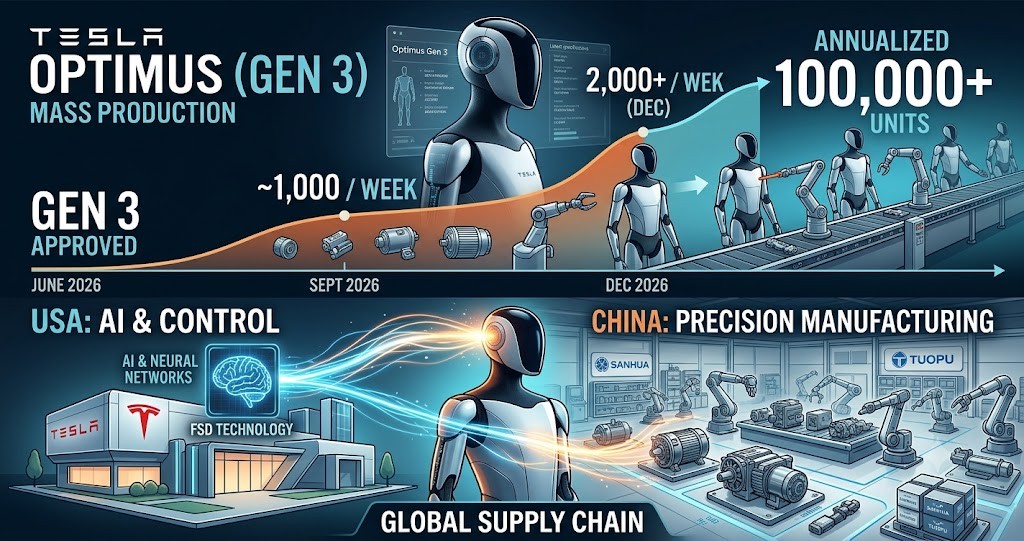
イーロン・マスクCEO率いるテスラが、開発を進めてきた人型ロボット(ヒューマノイド)「Optimus(オプティマス)」の量産化に向けて大きく舵を切りました。2026年6月末に最新仕様(Gen 3)が承認されたことを受け、テスラは部品サプライヤーに対して具体的な調達指示を開始。年換算で約10万台規模に相当する急速な生産能力の引き上げを求めています。
本稿では、最新の量産計画のタイムライン、自動車事業で培った中国サプライチェーンとの連携構造、そしてロボット産業全体における本動向のインパクトについて整理・解説します。
1. 量産計画のタイムラインと生産目標
- 仕様確定(Gen 3の承認)
- 2026年6月末の幹部会議にて、イーロン・マスクCEOがOptimusの最新バージョン(Gen 3)を審査・承認。開発開始から約3年を経て設計・仕様が固まり、大幅な変更を伴わない量産体制へと移行しました。
- 段階的な生産能力の引き上げ目標
- 2026年9月まで: 週産1,000台体制を確立。
- 2026年末まで: 週産2,000〜2,500台へ拡大。
- 年間換算能力: 年末時点の目標ペース(週産2,000〜2,500台)は、年換算で約10万台分の部品供給・生産能力に相当します。
2. 米中補完関係と中国サプライチェーンの活用
人型ロボットの「頭脳」と「身体」において、米中の強みを組み合わせた製造戦略が取られています。
- 「米国のAI(頭脳)」×「中国の精密製造(身体)」
- 米国(テスラ): FSD(Full Self-Driving)で培った自律走行AIやニューラルネットワーク技術をロボットの制御AIに応用。
- 中国(サプライヤー): モーター、減速機、アクチュエータ、各種センサーなどのハードウェア精密加工において高いコスト競争力と量産ノウハウを保有。
- 主要サプライヤーとの提携
- テスラは中国現地チームを通じて、センサーやアクチュエータ関連メーカーを順次訪問・協議。
- EV(自動車)事業で長年Tier 1(一次サプライヤー)として協業してきた三花智控(Sanhua Intelligent Controls)や拓普集団(Tuopu Group)などが、Optimus向け主要部品の有力供給先として挙がっています。
3. 関連・補足情報(技術背景と市場インパクト)
今回の量産化の背景と、業界に与える影響についての補足情報をまとめました。
① 人型ロボットにおける主要なハードウェア課題
人型ロボットは自動車以上に高密度かつ精密な機構が求められます。
- アクチュエータ(駆動部)と減速機
- 関節部に使われる「波動歯車減速機(ハーモニックドライブ)」や「ローラービス」などは、軽量かつ高トルクが求められ、最も製造難易度が高い部品です。
- 繊細なハンド部(Dextrous Hand)
- 物体をつかむ・操作する手先部には、多数の小型モーターと触覚・圧力センサーが集中しており、量産性と耐久性の確保がカギとなります。
② 初期の導入先とテスラの狙い
- テスラ自社工場(Gigafactory)への先行導入
- 初期のOptimusは、まずテスラの自動車工場内での単純作業(部品の搬送、棚卸し、単純な組み立て等)に投入され、自社内で実証実験とデータ収集を行う見通しです。
- 人手不足解消とコスト低減
- 工場内での実用性が証明されれば、製造業・物流倉庫・危険作業現場、さらには家庭用ケア・サービス領域へと段階的に市場が拡大すると期待されています。
③ グローバルなヒューマノイド開発競争
- 米国勢の追随
- Figure AI(OpenAI等が出資)、Boston Dynamics(Atlas)、Agility Roboticsなどが実証実験を進めており、商業化を競っています。
- 中国政府の推進と国産化圧力
- 中国政府も人型ロボットを国家重点産業として位置付けており、国内メーカー(Unitree、Fourier Intelligenceなど)の育成とサプライチェーンの内製化を急ピッチで進めています。
“U.S. Brains, Chinese Bodies”—Tesla’s Global Supply Chain Strategy for Humanoid Robot Mass Production
Tesla, led by CEO Elon Musk, is making a major pivot toward mass-producing its humanoid robot, “Optimus.” Following the approval of the latest design specifications (Gen 3) at the end of June 2026, Tesla has begun issuing specific procurement directives to component suppliers. The company is pushing for a rapid ramp-up in production capacity, targeting an annualized scale of approximately 100,000 units.
This report outlines and analyzes the latest mass-production timeline, the collaborative structure leveraging Tesla’s established automotive supply chain in China, and the broader impact of this move on the robotics industry.
1. Mass-Production Timeline and Output Targets
- Finalization of Specifications (Approval of Gen 3)During an executive meeting in late June 2026, CEO Elon Musk reviewed and approved the latest iteration of Optimus (Gen 3). After roughly three years of development, the design and specifications have been locked in, signaling a transition to mass production without major design overhauls.
- Phased Production Ramp-up Goals
- By September 2026: Establish a weekly production capacity of 1,000 units.
- By End of 2026: Expand capacity to 2,000–2,500 units per week.
- Annualized Capacity: The year-end target rate (2,000–2,500 units/week) equates to a component supply and manufacturing capacity of approximately 100,000 units annually.
2. U.S.-China Complementarity & Leveraging the Chinese Supply Chain
Tesla is employing a manufacturing strategy that combines the respective strengths of the U.S. and China across the “brain” and “body” of the humanoid robot.
- “U.S. AI (Brains)” × “Chinese Precision Manufacturing (Bodies)”
- United States (Tesla): Applying autonomous driving AI and neural network technologies cultivated through FSD (Full Self-Driving) to the robot’s control architecture.
- China (Suppliers): Possesses deep expertise in cost-competitive mass production and precision hardware manufacturing for motors, reducers, actuators, and various sensors.
- Partnerships with Major Suppliers
- Through its local team in China, Tesla has been visiting and negotiating with manufacturers of sensors and actuators.
- Long-time Tier 1 suppliers from Tesla’s EV (automotive) business, such as Sanhua Intelligent Controls and Tuopu Group, have emerged as primary candidates to supply core components for Optimus.
3. Supplementary Information: Technical Background & Market Impact
① Key Hardware Challenges in Humanoid Robotics
Humanoid robots require a higher density and precision of mechanical components than automobiles.
- Actuators and ReducersComponents used in joints, such as strain wave gears (harmonic drives) and roller screws, represent the highest manufacturing difficulty due to the simultaneous demand for lightweight design and high torque output.
- Dexterous HandsThe hands—responsible for gripping and manipulating objects—house a high concentration of miniature motors alongside tactile and pressure sensors. Ensuring both mass-producibility and durability remains a crucial hurdle.
② Initial Deployment and Tesla’s Strategic Objectives
- In-House Deployment at Tesla GigafactoriesInitial Optimus units are expected to be deployed within Tesla’s own automotive plants for simple tasks (moving parts, inventory checks, basic assembly) to gather real-world operational data and conduct internal validation.
- Mitigating Labor Shortages and Reducing CostsOnce practical utility in manufacturing environments is proven, the market is expected to expand step-by-step into industrial manufacturing, logistics warehousing, hazardous work environments, and eventually home care and service domains.
③ The Global Humanoid Race
- U.S. Competitors Pushing AheadCompanies like Figure AI (backed by OpenAI and others), Boston Dynamics (Atlas), and Agility Robotics are actively conducting field trials, racing toward commercialization.
- Chinese Government Initiatives & Domestic PressuresThe Chinese government has designated humanoid robotics as a strategic key industry, aggressively supporting domestic manufacturers (such as Unitree and Fourier Intelligence) and accelerating the localization of supply chains.

コメント