電気自動車(EV)をはじめとする電動車の普及が世界的に議論される中、バッテリー技術の中核をなす車載用リチウムイオン電池(LiB)市場の動向は、今後の自動車産業の行方を大きく左右します。本稿では、矢野経済研究所が公表した「車載用リチウムイオン電池世界市場に関する調査(2026年)」の発表内容を取り上げ、市場の現状、地域別のトピック、および将来予測について関連情報を交えて分かりやすくまとめます。
1. 2026年の市場概況
2026年の車載用LiB世界市場規模は、容量ベースで前年比116.6%となる1,682 GWhに達する見込みです。電動車(xEV:BEV、PHEV、HEVの総称)の世界生産台数の増加に連動し、市場は拡大傾向にあります。
- xEVタイプ別内訳(2026年推計)
- BEV(電気自動車):1,345 GWh
- PHEV(プラグインハイブリッド車):320 GWh
- HEV(ハイブリッド車):16 GWh
xEV市場全体の成長率は鈍化傾向にあるものの、世界の自動車生産台数全体に占める割合は4割を超える見通しです。
2. 地域別の市場動向と注目トピック
各地域の政策、経済動向、規制により市場環境は大きく異なります。
- 中国
- 内景と影響:NEV(PHEV、EV)購入免税措置の縮小により、低容量~中容量BEVの国内需要が急減しています。
- コスト要因:2025年後半から2026年前半にかけてのLiB価格の上昇に加え、2026年に施行された安全基準の国家標準や消費税課税の再開が新たなコスト押し上げ要因となっています。
- 今後の影響:国内需要減分を輸出増加で補う構造ですが、価格を重視する層向けの低~中容量BEV市場では厳しい競争が続きます。
- 欧州
- 成長要因:政策的な補助金や自動車OEMによる低価格BEVモデルの拡充が追い風となり、2025年から2026年上期にかけて成長を維持しています。
- リスクと規制:補助金依存度の高さが課題です。また、2026年3月に発表された産業加速法(IAA:Industrial Accelerator Act)に基づき、公共調達や財政支援を受けるBEVには域内産(Made in EU)および低炭素要件への適合が求められるため、部材コストの増加が見込まれます。
- 米国・北米
- 動向:政権交代に伴う政策の大幅な転換を背景に、2025年に続き2026年も需要低迷が続いています。2030年頃までは低成長が続くと予測されており、OEM各社は電動車戦略の見直しを進めています。
- 日本およびSHEV(ストロングハイブリッド)の動向
- 日本:2026年上期にBEV購入時の補助金が拡充されたことを受けて、BEV販売が急伸しています。
- SHEVの台頭:ガソリン価格の高騰等を背景に、欧米を中心にSHEV(ストロングハイブリッド)市場が拡大しています。中国でもNEV免税措置の縮小に伴い、PHEVとSHEVの価格差・性能差が縮まることで、SHEVの開発・展開が活発化する兆しを見せています。
3. 将来予測(2030年・2035年のシナリオ)
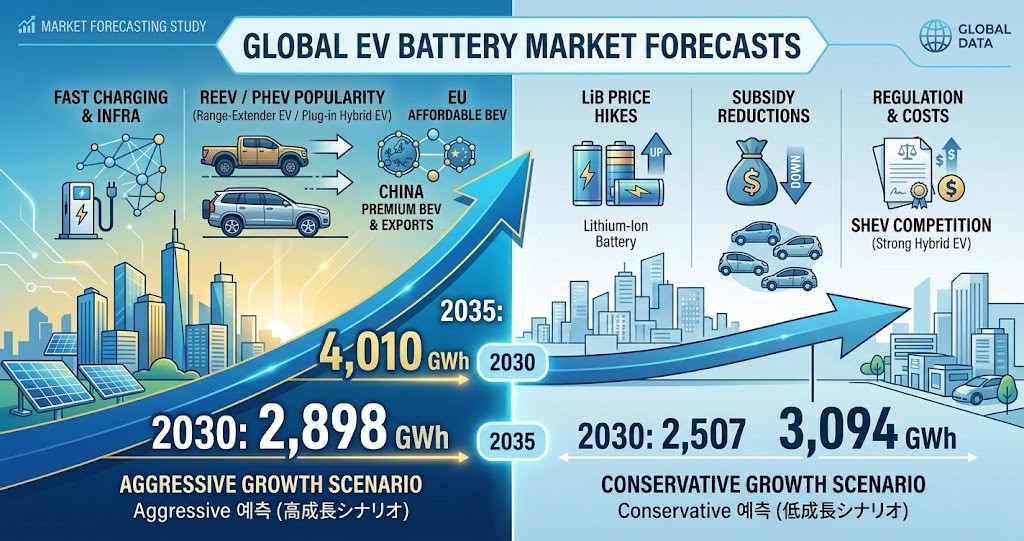
市場の不確実性を考慮し、「Aggressive予測(高成長シナリオ)」と「Conservative予測(低成長シナリオ)」の2つのシナリオが提示されています。
- Aggressive予測(高成長シナリオ)
- 市場規模予測:2030年に2,898 GWh、2035年に4,010 GWh
- 成長要因:欧州での低価格BEV普及、中国の富裕層向け高級BEV需要と新興国向け輸出の堅調さ、REEV(レンジエクステンダーEV)の採用拡大。充電インフラが未整備の地域や、ピックアップトラック・大型SUV等の大型車の電動化ソリューションとしてREEVやPHEVのニーズが高まると予想されます。
- Conservative予測(低成長シナリオ)
- 市場規模予測:2030年に2,507 GWh、2035年に3,094 GWh
- 影響要因:LiB価格上昇や補助金終了に伴う低~中容量BEV需要の減退、欧州のIAA規制に伴うコスト増加。また、エンジンとバッテリーの2つのパワートレインを持つPHEV/REEVは小型化やコスト削減に限界があるため、1パワートレインでコスト競争力に優れるSHEVとの競争が激化し、SHEVのシェアがより拡大するシナリオです。
【関連情報】車載用LiB市場を取り巻く技術・産業動向
矢野経済研究所の調査結果をさらに深く理解するための関連知識・補足情報です。
- LFP(リン酸鉄リチウム)電池の台頭とコスト競争
- 低~中容量BEV市場において、従来のNCM(ニッケル・コバルト・マンガン)三元系電池に比べ、安価で熱安定性に優れるLFP電池の採用が進んでいます。中国メーカー(CATLやBYDなど)はこのLFP電池の供給で主導権を握っており、欧米メーカーも低価格BEV投入に向けてLFP採用を進めています。
- REEV(レンジエクステンダーEV)の仕組みと利点
- REEVは、基本的にはモーターで駆動し、搭載した小型エンジンは発電のみに使用するシステムです。外部充電インフラが不十分な地域でもガソリン給油で航続距離を伸ばせるため、特に大型車や広大な地域(中国の地方部、北米、新興国など)で現実的な解決策(現実解)として注目を集めています。
- 地政学リスクとバッテリーサプライチェーンの現地化
- 欧州の産業加速法(IAA)や米国のインフレ削減法(IRA)に見られるように、各地域で「バッテリーおよびその材料の自国・域内調達割合」を高める法規制が強化されています。これにより、電池メーカーや自動車メーカーは地産地消型のサプライチェーン構築を迫られており、短期的には製造・調達コストの上昇要因となっています。
出典:https://www.yano.co.jp/press-release/show/press_id/4197
Overview and Outlook of the Global Market for Automotive Lithium-Ion Batteries (LiB)
As global discussions continue regarding the adoption of electric vehicles (EVs) and other electrified vehicles, trends in the automotive lithium-ion battery (LiB) market—the core of battery technology—will significantly influence the future course of the automotive industry. This report summarizes the findings of the “Global Automotive Lithium-ion Battery Market Study (2026)” published by Yano Research Institute, providing a clear overview of current market conditions, regional key topics, future forecasts, and relevant supplementary information.
- 2026 Market Overview
The global automotive LiB market size in 2026 is expected to reach 1,682 GWh on a capacity basis, representing 116.6% compared to the previous year. Driven by the increase in global production of electrified vehicles (xEVs: a collective term for BEVs, PHEVs, and HEVs), the market continues on an expanding trajectory.
- Breakdown by xEV Type (2026 Estimate)
- BEV (Battery Electric Vehicles): 1,345 GWh
- PHEV (Plug-in Hybrid Electric Vehicles): 320 GWh
- HEV (Hybrid Electric Vehicles): 16 GWh
Although the overall growth rate of the xEV market is expected to slow down, xEVs are projected to account for over 40% of total global automobile production.
- Regional Market Trends and Key Topics
Market environments vary significantly depending on regional policies, economic conditions, and regulations.
- China
- Background and Impact: Due to the reduction of purchase tax exemptions for NEVs (PHEVs and EVs), domestic demand for low- to medium-capacity BEVs is falling sharply.
- Cost Factors: In addition to rising LiB prices from late 2025 into early 2026, newly enforced national safety standards in 2026 and the reinstatement of consumption taxes on batteries have emerged as new cost drivers.
- Future Impact: While export growth is offsetting the decline in domestic demand, the market for low- to medium-capacity BEVs—which targets price-sensitive consumers—will continue to face a fierce competitive environment.
- Europe
- Growth Drivers: Policy tailwinds, including subsidies in major countries and automotive OEMs expanding their low-cost BEV lineups, have helped sustain growth from 2025 into the first half of 2026.
- Risks and Regulations: High reliance on subsidies remains a challenge. Furthermore, under the Industrial Accelerator Act (IAA) announced in March 2026, BEVs receiving public procurement or financial assistance are required to meet “Made in EU” and low-carbon standards, which is expected to drive up component costs.
- United States / North America
- Trends: Against the backdrop of major policy shifts following the change in administration, sluggish demand persists in 2026 following a weak 2025. Slow growth is projected to continue through around 2030, prompting OEMs to review their electrification strategies.
- Japan and SHEV (Strong Hybrid Vehicle) Trends
- Japan: BEV sales have surged rapidly in the first half of 2026 due to expanded subsidies for BEV purchases.
- Emergence of SHEVs: High gasoline prices and other factors have driven the expansion of the SHEV (Strong Hybrid Electric Vehicle) market, primarily in Europe and North America. In China as well, as NEV tax exemptions phase down, the price and performance gaps between PHEVs and SHEVs are narrowing, showing signs of accelerated development and deployment of SHEVs.
- Future Outlook (2030 and 2035 Scenarios)
Considering market uncertainties, the market growth is evaluated under two scenarios: the Aggressive Forecast (high-growth scenario) and the Conservative Forecast (low-growth scenario).
- Aggressive Forecast (High-Growth Scenario)
- Market Size Forecast: 2,898 GWh in 2030; 4,010 GWh in 2035
- Growth Factors: Widespread adoption of low-cost BEVs in Europe, steady demand for high-end BEVs among wealthy consumers in China alongside strong exports to emerging markets, and expanding adoption of REEVs (Range-Extender EVs). Demand for REEVs and PHEVs is expected to rise as electrification solutions for regions with undeveloped charging infrastructure, as well as for larger vehicles such as pickup trucks and large SUVs.
- Conservative Forecast (Low-Growth Scenario)
- Market Size Forecast: 2,507 GWh in 2030; 3,094 GWh in 2035
- Impact Factors: Weakened demand for low- to medium-capacity BEVs due to rising LiB prices and the expiration of subsidies, alongside increased costs associated with Europe’s IAA regulations. Additionally, because PHEVs and REEVs carry dual powertrains (engine and battery), downsizing and cost reduction face technical limits. Consequently, competition with SHEVs—which hold superior cost competitiveness with a single powertrain—will intensify, leading to a broader market share for SHEVs.
Related Information: Technology and Industry Trends Surrounding the Automotive LiB Market
The following background knowledge and supplementary information provide a deeper context for the Yano Research Institute survey findings:
- Rise of LFP (Lithium Iron Phosphate) Batteries and Cost CompetitionIn the low- to medium-capacity BEV market, the adoption of LFP batteries—which offer lower costs and superior thermal stability compared to conventional NCM (Nickel-Cobalt-Manganese) ternary batteries—is accelerating. Chinese manufacturers (such as CATL and BYD) dominate LFP battery supply, while Western automakers are increasingly adopting LFP chemistry to introduce lower-cost BEVs.
- Mechanism and Advantages of REEVs (Range-Extender EVs)REEVs are propelled primarily by an electric motor, with a small onboard internal combustion engine used solely to generate electricity. Because they extend driving range using gasoline refueling in areas with insufficient external charging infrastructure, REEVs are gaining attention as a practical solution (a “real-world compromise”), especially for large vehicles and vast geographical regions (such as rural China, North America, and emerging markets).
- Geopolitical Risks and Localizing the Battery Supply ChainAs seen in Europe’s Industrial Accelerator Act (IAA) and the U.S. Inflation Reduction Act (IRA), regulatory frameworks enforcing higher local or regional sourcing ratios for batteries and raw materials are tightening across markets. As a result, battery manufacturers and automakers are being compelled to establish localized, “produce-for-local” supply chains, driving up manufacturing and procurement costs in the short term.

コメント