次世代の蓄電技術として期待が集まる全固体電池において、重量の削減とリチウムイオンの移動しやすさ(高いイオン伝導性)を両立させる新たな結晶構造が見出されました。本稿では、電気通信大学と日亜化学工業の共同研究チームが発表した成果の概要と背景、そして実用化に向けた課題を分かりやすく整理してまとめます。
1. 研究の要点と背景
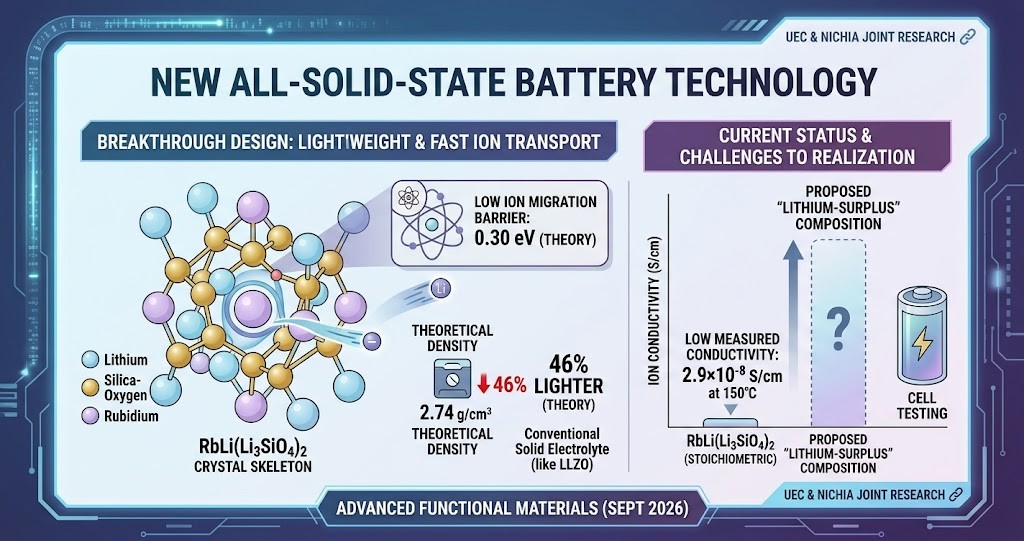
- 何が起きたか 電気通信大学の中村淳教授らと日亜化学工業の市川諒英氏らの研究チームは、軽量元素で構成される結晶骨格 RbLi(Li3SiO4)2 が、理論計算上で 0.30 eV という低いリチウムイオン移動障壁を持つことを解明しました。本成果は2026年9月24日付の学術誌『Advanced Functional Materials』に掲載されました。
- なぜ重要か 重元素(ランタンやジルコニウムなど)を含む従来の代表的な酸化物系固体電解質(LLZO等)と比較して、理論結晶密度が約46%低い(2.74 g/cm3)特徴を持ちます。これにより、軽量な固体電解質を分子レベルで設計するための具体指針が提示されました。
- 現状の課題と注目点 今回合成された化学量論組成の試料における実測のイオン伝導率は、150 ℃ で 2.9×10⁻⁸ S/cm と極めて低い値にとどまっています。理論上の高いイオン移動性を実際の伝導率向上へつなげるため、提案された「リチウム過剰組成」の実証や電池セルとしての動作検証が今後の焦点となります。
2. 構造的特徴と計算科学による解析
もともと緑色LED用蛍光体の母体材料として知られていたケイ酸塩化合物 RbLi(Li3SiO4)2 に着目し、第一原理計算(DFT)と機械学習ポテンシャルを用いた分子動力学シミュレーション(PFP-MD)を組み合わせて解析が行われました。
- 3次元的な伝導ネットワークの形成 一見すると1次元的なトンネル状チャネルに見える構造ですが、原子の熱振動を考慮した計算により、リチウムイオンが隣接するトンネル間を移動できる3次元的な経路を形成していることが判明しました。これにより、局所的な結晶欠陥による伝導阻害を受けにくい利点があります。
- 低い移動障壁(0.30 eV)と協奏運動 リチウムイオンが移動する際のエネルギー障壁は 0.30 eV と試算され、既存の有力な酸化物系電解質と同等の優れた値を示しました。隣接するイオン同士のクーロン反発力が相互に移動を促す「協奏運動」が寄与していると考えられています。
| 材料名 | 本研究での位置づけ | 理論密度 (g/cm3) | イオン移動障壁 (eV) | 実測イオン伝導率 |
|---|---|---|---|---|
| RbLi(Li3SiO4)2 | 今回の研究対象 | 2.74 | 0.30 | 2.9×10⁻⁸ S/cm (150 ℃) |
| LLZO (Li7La3Zr2O12) | 既存の基準材料 | 5.12 | 0.26 | 本研究では未測定 |
| LATP (Li1.3Al0.3Ti1.7(PO4)3) | 既存の基準材料 | 提示なし | 0.27 | 本研究では未測定 |
3. 低伝導率の原因と「リチウム過剰組成」による解決策
イオンが動きやすい構造であるにもかかわらず、実験での伝導率が低かった原因は「イオンの動きやすさ」ではなく「移動できるイオン(電荷担体)の不足」にあります。
- フレンケル欠陥対の形成エネルギーが高い(1.26 eV) 完全な結晶からリチウムイオンが格子間位置へ移動して欠陥を生むために大きなエネルギーが必要となるため、化学量論組成では移動可能なリチウムイオン数が制限されていました。
- リチウム過剰組成の提案 あらかじめ化学量論組成よりもリチウムを多く含ませた「リチウム過剰組成」とすることで、高エネルギーを要する欠陥形成プロセスを経ずにキャリア濃度を高め、室温での高伝導率化を実現できる可能性が示されています。
【関連情報】固体電解質の分類とケイ酸塩系の位置づけ
本研究の位置づけをより深く理解するための、全固体電池における電解質種類の比較と補足情報です。
- 硫化物系固体電解質(LGPSなど)
- 特徴: 室温で 10−3 ~ 10−2 S/cm 以上の極めて高いイオン伝導率を持ち、成型性にも優れる。
- 課題: 大気中の水分と反応して有毒な硫化水素(H2S)ガスを発生するリスクがある。
- 酸化物系固体電解質(LLZO、LATPなど)
- 特徴: 大気中で安定しており、安全性が高い。
- 課題: 硬く焼結が必要で電極との接合が難しいほか、重元素を含むため重量エネルギー密度の向上において不利になりやすい。
- ケイ酸塩系(本研究)の意義
- 酸化物系としての高い安全性を維持しながら、軽元素で構成された骨格を利用することで重量課題を克服する新しい材料設計のアプローチとして期待されています。
4. 今後の展望と主な課題
- リチウム過剰相の合成実証: 計算モデル通りの相を実際に安定して合成できるかどうかの検証。
- 製造プロセスの改善: 焼結条件の最適化により結晶粒界での抵抗を低減し、ペレット全体の密度(緻密性)を高めること。
- 電池セルとしての動作評価: 金属リチウム負極や高電圧正極との界面安定性を確認し、充放電サイクル評価へ展開すること。
出典:https://xenospectrum.com/lightweight-ucr4c4-solid-electrolyte-framework/
A Breakthrough for Solid-State Batteries? Japanese Research Team Discovers Potential for a Solid Electrolyte 46% Lighter Than Conventional Options
In the development of all-solid-state batteries—highly anticipated as a next-generation energy storage technology—a novel crystal structure has been identified that achieves both weight reduction and high lithium-ion mobility (high ionic conductivity). This article summarizes the research findings published by a joint team from The University of Electro-Communications and Nichia Corporation, detailing the background, key discoveries, and remaining challenges for practical application.
- Key Findings and Research Background
- What Happened: A research team led by Professor Jun Nakamura at The University of Electro-Communications and Ryohei Ichikawa at Nichia Corporation revealed that the crystal framework RbLi(Li3SiO4)2, composed of lightweight elements, exhibits a low lithium-ion migration barrier of 0.30 eV in theoretical calculations. This work was published in the journal Advanced Functional Materials on September 24, 2026.
- Why It Matters: Compared to conventional representative oxide solid electrolytes (such as LLZO) containing heavy elements like lanthanum or zirconium, its theoretical crystal density is approximately 46% lower (2.74 g/cm3). This provides specific design guidelines for engineering lightweight solid electrolytes at the molecular level.
- Current Challenges and Points to Watch: The measured ionic conductivity of the synthesized stoichiometric sample remained extremely low at 2.9 x 10^-8 S/cm at 150 degrees C. To bridge the gap between theoretical ion mobility and macro-level conductivity, future research will focus on demonstrating the proposed “lithium-excess composition” and verifying performance within actual battery cells.
- Structural Features and Analysis via Computational Science
The research focused on the silicate compound RbLi(Li3SiO4)2, originally known as a host matrix for green LED phosphors, analyzing it through a combination of First-Principles Density Functional Theory (DFT) calculations and Molecular Dynamics simulations using Machine Learning Potentials (PFP-MD).
- Formation of a 3D Conduction Network: While the structure initially appears to feature isolated 1D tunnel-like channels, calculations accounting for atomic thermal vibrations revealed that lithium ions can hop between adjacent tunnels to form a 3D conduction pathway. This structure offers the advantage of being less susceptible to conduction bottlenecks caused by localized crystal defects.
- Low Migration Barrier (0.30 eV) and Concerted Motion: The calculated energy barrier for lithium-ion migration is 0.30 eV, matching the performance of leading oxide solid electrolytes. Cooperative movement (“concerted motion”) driven by Coulombic repulsion between adjacent ions is believed to facilitate this low barrier.
| Material | Role in Study | Theoretical Density (g/cm3) | Ion Migration Barrier (eV) | Measured Ionic Conductivity |
| RbLi(Li3SiO4)2 | Target of this study | 2.74 | 0.30 | 2.9 x 10^-8 S/cm (150 degrees C) |
| LLZO (Li7La3Zr2O12) | Conventional benchmark | 5.12 | 0.26 | Not measured in this study |
| LATP (Li1.3Al0.3Ti1.7(PO4)3) | Conventional benchmark | Not specified | 0.27 | Not measured in this study |
- Cause of Low Conductivity and Solution via “Lithium-Excess Compositions”
Despite the crystal structure allowing smooth ion movement, the low experimental conductivity stems not from “poor ion mobility,” but rather from a “lack of mobile charge carriers (ions).”
- High Frenkel Defect Formation Energy (1.26 eV): Significant energy is required to move a lithium ion from its normal lattice site to an interstitial position to form a defect pair. Consequently, the number of mobile lithium ions in the stoichiometric composition is strictly limited.
- Proposed Solution (Lithium-Excess Composition): By intentionally incorporating more lithium than the stoichiometric ratio (“lithium-excess composition”), carrier concentration can be increased without relying on high-energy defect formation processes, potentially enabling high ionic conductivity at room temperature.
Related Information: Classification of Solid Electrolytes and Significance of Silicates
To better understand the positioning of this research, here is a comparison of different electrolyte types used in all-solid-state batteries:
- Sulfide-based Solid Electrolytes (e.g., LGPS):
- Features: Extremely high room-temperature ionic conductivity (10^-3 to 10^-2 S/cm or higher) and excellent formability.
- Challenges: Risk of reacting with atmospheric moisture to generate toxic hydrogen sulfide (H2S) gas.
- Oxide-based Solid Electrolytes (e.g., LLZO, LATP):
- Features: Chemically stable in ambient air and highly safe.
- Challenges: Hard and requires high-temperature sintering, making electrode contact difficult; heavy-element content poses a disadvantage for gravimetric energy density.
- Significance of Silicates (This Study):
- Expected to serve as a new material design approach that maintains the high safety of oxide systems while overcoming weight constraints by utilizing a light-element framework.
- Future Outlook and Main Challenges
- Demonstrating Synthesis of Lithium-Rich Phases: Verifying whether stable phases following the computational models can be synthesized experimentally.
- Improving Manufacturing Processes: Optimizing sintering conditions to minimize grain-boundary resistance and increase the overall density (compactness) of the pellets.
- Performance Evaluation in Battery Cells: Confirming chemical and electrochemical interface stability against lithium metal anodes and high-voltage cathodes, leading to full charge-discharge cycle evaluations.

コメント