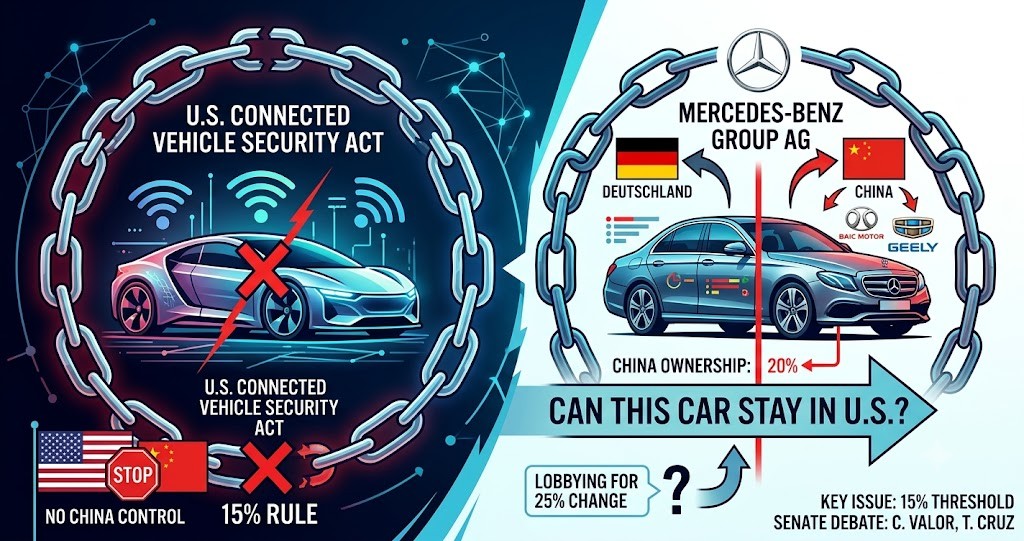
米上院商務・科学・運輸委員会において、中国資本が一定割合以上入っている自動車メーカーによる「コネクテッドカー(通信機能を備えた自動車)」の米国販売を規制・禁止する「コネクテッドカーセキュリティ法案(Connected Vehicle Security Act)」が進展を見せています。
この法案は、最新の自動車が収集する位置情報、カメラ映像、個人データなどが中国当局に流出する国家安全保障上のリスクを排除することを目的としています。しかし、その規制基準を巡り、伝統的な欧州高級車ブランドであるドイツのメルセデス・ベンツ・グループAG(Mercedes-Benz Group AG)が予期せぬ形で影響を受ける可能性が浮上し、法案の成立に向けた大きな論点となっています。
1. 法案の主な内容とメルセデス・ベンツが直面する課題
- 15%ルールの適用: 本法案では、中国企業または中国系資本が「15%以上」の株式を所有する自動車メーカーに対して、米国市場でのコネクテッドカーの販売を禁止する条項が含まれています。
- メルセデス・ベンツの株主構成: 現在、メルセデス・ベンツには中国の国有自動車大手である北京汽車(BAIC Motor Corp.)が約10%、さらに吉利汽車(Geely)の創業者である李樹福氏が投資会社を通じて約10%の株式を保有しています。両者を合わせると中国資本の出資比率は約20%に達し、法案の「15%」という出資制限基準を超えてしまいます。
- ロビー活動と変更要請: メルセデス・ベンツは法案の修正を求めてロビー活動を行っており、中国資本の上限基準を15%から「25%」へ引き上げるよう働きかけていると報じられています。
2. 上院における議論と対立点
2026年7月22日、上院商務・科学・運輸委員会は本法案を全会一致で可決し、上院本会議へ送付することを決定しました。しかし、公聴会では議員間での見解の違いが顕著になりました。
- テッド・クルーズ上院議員(共和党・テキサス州)の主張:
- 単純な数字(15%)による一律規制を批判し、対外投資委員会(CFIUS)の仕組みのような、個別で実質的な国家安全保障リスクを評価する「定性的なリスク評価」に置き換えるべきだと主張しました。
- この15%という基準は、競合するゼネラルモーターズ(GM)の高級車ブランド「キャデラック」を利するための策略であると指摘しました。
- さらに、2024年にアラバマ州にあるメルセデス・ベンツの工場労働者が全米自動車労働組合(UAW)への加入を反対多数で否決した経緯に触れ、UAWによる同社への腹いせ・報復攻撃の側面もあると非難しました。
- クルーズ氏は「15%条項が残ったままでは、この法案が最終的に成立することはない」と強調しています。
- バーニー・モレノ上院議員(共和党・オハイオ州/共同提案者)の主張:
- メルセデス・ベンツなどの特定の欧州メーカーを標的にしたものではないと反論しました。
- 仮に法案が成立した場合でも、2030年までの猶予期間が設定されていることや、要件を満たせない場合でも米国商務省へ免除申請(適用除外)を行う制度が存在することを説明しました。
- 「アメリカ国内でのメルセデス・ベンツの販売を禁止する意図は誰にもない」と述べ、国家安全保障とビジネスのバランスを取る姿勢を示しました。
3. 背景と関連情報
- 米中技術冷戦とコネクテッドカー規制の背景: 米バイデン・ハリス政権および米議会は近年、中国製EV(電気自動車)だけでなく、車両に搭載されたセンサー、カメラ、車載ソフトウエアを通じた情報漏洩リスクを極めて重く見ています。2024年以降、米商務省は中国由来のハードウエアやソフトウエアを搭載した車両の輸入規制方針を強めており、今回の法案もその流れに沿ったものです。
- 自動車業界への広範な影響: メルセデス・ベンツに限らず、グローバルな自動車産業では中国市場での事業展開やサプライチェーンの提携、資本受け入れが深く進んでいます。単純な「出資比率」による規制が導入された場合、欧州をはじめとする他の主要自動車メーカーのグローバル経営戦略や米国市場での販売体制にも大きな再編を迫る可能性があります。
Impact of the Chinese Capital “15% Rule”: The U.S. Connected Vehicle Security Act and Mercedes-Benz’s Crisis
In the U.S. Senate Committee on Commerce, Science, and Transportation, the Connected Vehicle Security Act is advancing. This bill aims to restrict or ban the U.S. sales of connected vehicles (vehicles with communication capabilities) produced by automakers with a certain percentage of Chinese capital. The bill is intended to eliminate national security risks, such as location data, camera footage, and personal information collected by modern vehicles being leaked to Chinese authorities. However, concerning its regulatory threshold, the possibility has emerged that Germany’s Mercedes-Benz Group AG, a traditional European luxury brand, could be unexpectedly affected, making it a major point of contention toward the bill’s passage.
1. Main Contents of the Bill and Challenges Facing Mercedes-Benz
- Application of the 15% Rule: This bill includes a clause that prohibits the sale of connected vehicles in the U.S. market by automakers in which Chinese companies or Chinese-affiliated capital own 15% or more of the shares.
- Mercedes-Benz’s Shareholder Structure: Currently, Chinese state-owned auto giant BAIC Motor Corp. holds about 10% of Mercedes-Benz’s shares, and Li Shufu, founder of Geely, holds about 10% through an investment firm. Combined, Chinese capital accounts for about 20% of the ownership, exceeding the bill’s 15% investment limit threshold.
- Lobbying and Requests for Amendments: Mercedes-Benz is reportedly lobbying for amendments to the bill, pushing to raise the upper limit threshold for Chinese capital from 15% to 25%.
2. Debates and Points of Conflict in the Senate
On July 22, 2026, the Senate Committee on Commerce, Science, and Transportation unanimously voted to pass the bill and send it to the full Senate floor. However, deliberations during the hearing revealed distinct differences in opinion among lawmakers.
- Arguments by Senator Ted Cruz (Republican, Texas):
- He criticized the flat regulation based on a simple number (15%) and argued that it should be replaced with a “qualitative risk assessment” that evaluates individual, substantive national security risks, modeled after the mechanism used by the Committee on Foreign Investment in the United States (CFIUS).
- He pointed out that the 15% threshold is a ploy to benefit General Motors’ (GM) Cadillac brand, a competitor.
- Furthermore, referencing the event in 2024 where Mercedes-Benz factory workers in Alabama voted against joining the United Auto Workers (UAW) by a majority, he criticized the provision as an attack by the UAW to directly inflict pain on the company in retaliation.
- Senator Cruz emphasized, “If the 15% Chinese ownership provision remains in the bill, this bill will not pass.”
- Arguments by Senator Bernie Moreno (Republican, Ohio / Co-sponsor):
- He countered the view that the bill intends to target specific European manufacturers like Mercedes-Benz.
- He explained that even if the bill becomes law, a grace period until 2030 is established, and a process exists for companies to apply to the U.S. Department of Commerce for an exemption if they cannot meet the requirements.
- He stated, “What we are absolutely not going to do, and nobody intends to do, is ban the sale of Mercedes-Benz cars in America,” demonstrating an effort to balance national security with business operations.
3. Background and Related Information
- Background of U.S.-China Tech Cold War and Connected Vehicle Regulations: In recent years, the Biden-Harris administration and the U.S. Congress have taken security risks extremely seriously regarding not only Chinese-made EVs (electric vehicles) but also data leaks through sensors, cameras, and in-vehicle software installed in automobiles. Since 2024, the U.S. Department of Commerce has been strengthening its stance on import restrictions for vehicles equipped with hardware or software originating from China, and this bill aligns with that trend.
- Broad Impact on the Automotive Industry: Not limited to Mercedes-Benz, the global automotive industry has deep ties with the Chinese market regarding business expansion, supply chain partnerships, and capital intake. If a regulation based strictly on ownership percentage is introduced, it could force major global automotive manufacturers, including those in Europe, into significant restructuring of their global business strategies and sales operations in the U.S. market.

コメント