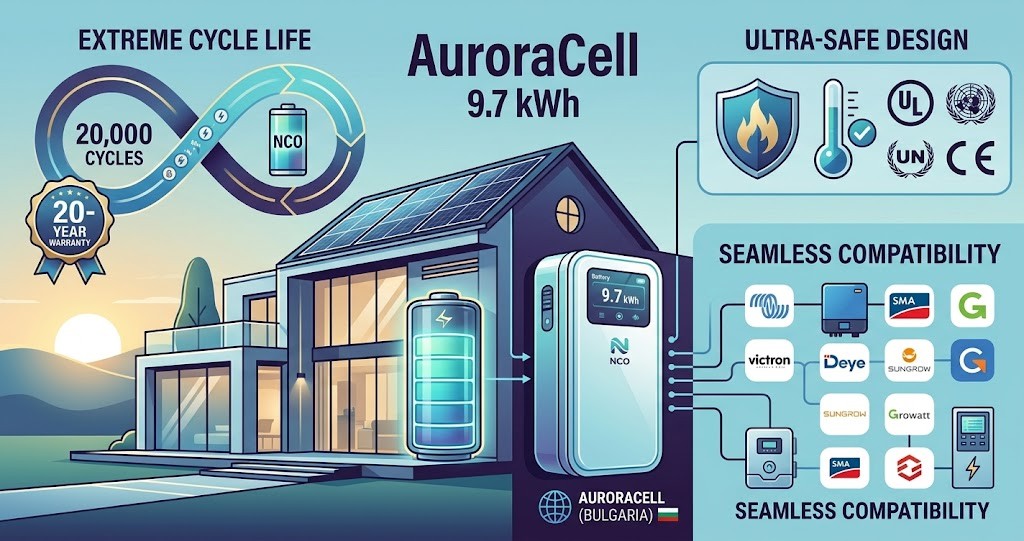
ブルガリアのAuroraCell社が発表した、ナトリウムイオンクロム酸化物(NCO)正極を採用した最新の家庭用蓄電システム「AuroraCell 9.7 kWh – 48 V RESS Pack」の概要と、関連する技術背景および市場動向を取りまとめてお届けします。
AuroraCell 9.7 kWh – 48 V RESS Pack 製品概要
ブルガリアに拠点を置くAuroraCell社は、ナトリウムイオンクロム酸化物(NCO)電池技術を採用した9.7kWhの家庭用エネルギー貯蔵システムを発表しました。
1. 主な製品仕様
- 定格エネルギー容量: 9.744 kWh
- 公称容量 / 公称電圧: 210 Ah / 46.4 V
- 動作電圧範囲: 32 V – 54.4 V
- 定格充放電レート: 標準充電 0.5C / 最大充電 0.5C / 標準放電 0.5C
- 最大放電電流: 150 A (0 ℃ – 60 ℃)
- 動作温度範囲: 充電 0 ℃ – 60 ℃ / 放電 -40 ℃ – 60 ℃
- 外形寸法 / 重量: 483 mm x 254 mm x 754 mm / 110.5 kg
- 保護等級: IP65
- 製品保証: 20年間
2. 性能と安全性の特長
- 超高サイクル寿命: 25 ℃環境下における放電深度(DoD)100%の条件で、20,000サイクルのサイクル寿命を実現。
- 高安全性設計: 熱安定性に優れ、火災や爆発のリスクがない「超安全」アーキテクチャを採用。主要な安全・輸送認証(UL9540A、UN38.3、MSDS、CE)を取得済み。
- 拡張性と互換性: モジュール式の並列接続に対応。Victron Energy、Deye、Solis、Growatt、Schneider Electric、SMA、Sungrow、Sofar Solar、Studer、Ingeteamなどの主要な48 VDCハイブリッドインバーターと高い互換性を保有。
補足・関連情報(技術的背景と課題)
正極材料(NCO)と従来のナトリウムイオン電池 ナトリウムイオン電池(SIB)は、一般的なリン酸鉄リチウム(LFP)等と比べてリチウムやコバルトなどの希少金属を使用せず、資源豊富で低コストなナトリウムを利用できるメリットがあります。従来の層状酸化物系(O3型やP2型など)やプルシアンブルー類似体正極では、構造劣化や結晶水に起因する耐候性・サイクル特性の課題が存在していました。クロム系複合酸化物(NCO)等の材料技術は、相転移の抑制や構造安定性の改善を目的として研究開発が進められており、定置用バッテリーとして重要な熱安定性や極低温域(-40 ℃)での動作能力の向上に寄与します。
20,000サイクル / 20年保証の実現性 20,000サイクルという値は、1日1回のフル充放電で約54年分、1日2回の超高頻度利用でも27年以上に相当します。従来のLFPバッテリーの平均サイクル数(6,000 – 10,000サイクル前後)を大きく上回る数値であり、定置用蓄電池の長期運用コスト(LCOE: 均等化発電原価)を低減させる可能性を秘めています。
エネルギー密度と重量パフォーマンス 本製品の重量は110.5 kgで、定格9.744 kWhに対するセル/パックレベルのエネルギー密度は約88 Wh/kgとなります。LFPを用いた家庭用蓄電池(一般に100 – 140 Wh/kg程度)と比較すると重量面でのトレードオフが存在しますが、移動を伴わない定置用(家庭用・産業用)用途においては、重量増加よりも安全性・寿命・低温特性・コスト効率が優先されるため、実用上の適合性が高い仕様となっています。
20,000 Cycles at 100% DoD: Durability and Thermal Stability of Sodium-Ion Batteries Enabled by NCO Cathode
Here is an overview of the latest residential energy storage system, the “AuroraCell 9.7 kWh – 48 V RESS Pack,” announced by Bulgaria-based AuroraCell and featuring a sodium-ion chromium oxide (NCO) cathode, along with related technical background and market trends.
AuroraCell 9.7 kWh – 48 V RESS Pack Product Overview
Bulgaria-based AuroraCell has announced a 9.7 kWh residential energy storage system utilizing sodium-ion chromium oxide (NCO) battery technology.
1. Main Product Specifications
- Rated Energy Capacity: 9.744 kWh
- Nominal Capacity / Nominal Voltage: 210 Ah / 46.4 V
- Operating Voltage Range: 32 V – 54.4 V
- Rated Charge/Discharge Rate: Standard Charge 0.5C / Max Charge 0.5C / Standard Discharge 0.5C
- Max Discharge Current: 150 A (0 deg C – 60 deg C)
- Operating Temperature Range: Charging 0 deg C – 60 deg C / Discharging -40 deg C – 60 deg C
- External Dimensions / Weight: 483 mm x 254 mm x 754 mm / 110.5 kg
- Ingress Protection: IP65
- Product Warranty: 20 years
2. Performance and Safety Features
- Ultra-High Cycle Life: Achieves a cycle life of 20,000 cycles at 100% depth of discharge (DoD) under 25 deg C conditions.
- High Safety Design: Features an “ultra-safe” architecture with superior thermal stability and no risk of fire or explosion. Acquired major safety and transport certifications, including UL9540A, UN38.3, MSDS, and CE.
- Scalability and Compatibility: Supports modular parallel connection. Highly compatible with major 48 VDC hybrid inverters such as Victron Energy, Deye, Solis, Growatt, Schneider Electric, SMA, Sungrow, Sofar Solar, Studer, and Ingeteam.
Supplementary Information (Technical Background and Challenges)
Cathode Material (NCO) and Conventional Sodium-Ion Batteries Sodium-ion batteries (SIBs) offer the advantage of using abundant, low-cost sodium rather than critical metals such as lithium or cobalt compared to conventional lithium iron phosphate (LFP). Conventional layered oxides (such as O3 or P2 types) and Prussian blue analogues have faced challenges regarding weatherability and cycle performance stemming from structural degradation and crystal water. Material technologies such as chromium-based complex oxides (NCO) are being researched to suppress phase transitions and enhance structural stability, contributing to improved thermal stability and low-temperature operating capabilities down to -40 deg C, which are critical for stationary storage.
Feasibility of 20,000 Cycles / 20-Year Warranty A figure of 20,000 cycles corresponds to approximately 54 years at one full charge/discharge per day, or over 27 years even under ultra-high frequency usage of twice per day. This significantly exceeds the average cycle count of conventional LFP batteries (around 6,000 – 10,000 cycles) and holds potential to reduce the levelized cost of storage (LCOS) for stationary batteries.
Energy Density and Weight Performance With a total weight of 110.5 kg for a rated capacity of 9.744 kWh, the cell/pack-level energy density is approximately 88 Wh/kg. While there is a weight trade-off compared to LFP-based residential batteries (typically around 100 – 140 Wh/kg), stationary residential and industrial applications prioritize safety, cycle life, low-temperature performance, and cost efficiency over weight, making this a highly suitable specification for stationary use.
コメント