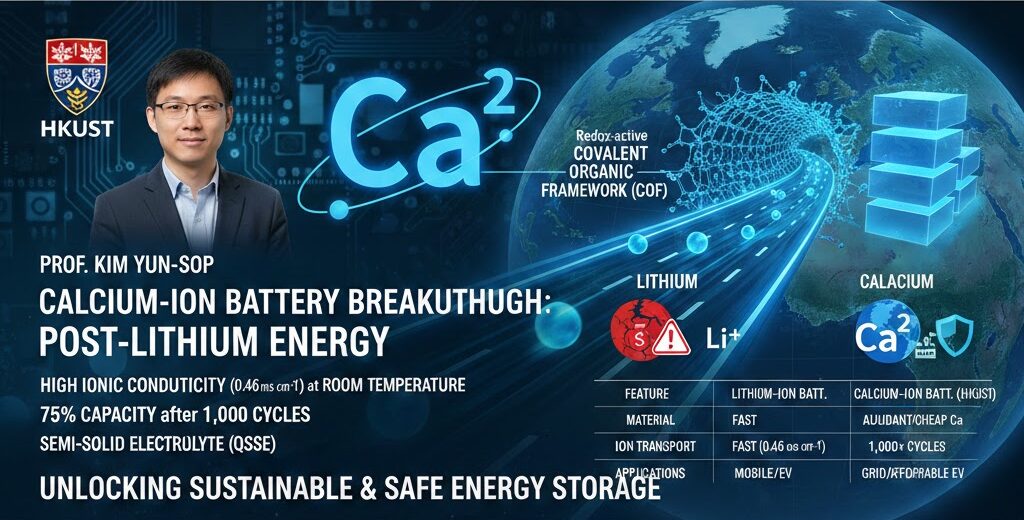
香港科技大学のキム・ユンソブ准教授らによる研究チームは、カルシウムイオン電池の最大の弱点であった「イオン移動の遅さ」と「安定性の低さ」を、新しい電解質設計によって克服しました。
- 革新技術: 「酸化還元活性共有結合性有機構造体(Redox-active COF)」を用いた準固体電解質(QSSE)を開発。
- 性能: 室温で高いイオン伝導率(0.46 mS cm-1)を達成し、1,000回の充放電後も約75パーセントの容量を維持。
- 意義: 地球上に豊富に存在するカルシウムを利用することで、リチウム依存からの脱却と、より安全で安価なエネルギー貯蔵を実現する。
関連情報:なぜカルシウム電池が「ポスト・リチウム」の本命なのか
この研究の重要性を理解するための、3つの背景情報を付け加えます。
1. 資源リスクの解消(リチウム vs カルシウム)
現在主流のリチウムは産出地が偏っており、価格変動や供給不足のリスクが常に付きまといます。
- 埋蔵量: カルシウムは地殻中に5番目に多く存在する元素であり、リチウムに比べて圧倒的に安価で入手が容易です。
- 安全性: カルシウム電池はリチウム電池で懸念される「デンドライト(樹枝状結晶)」による発火リスクが低く、安全性が極めて高いのが特徴です。
2. 「2価イオン」が持つ高いエネルギー密度
カルシウムイオン(Ca 2+)は「2価の陽イオン」です。
- 1価のリチウムイオン(Li +)が1つの電子を運ぶのに対し、カルシウムイオンは1つ動くごとに「2つの電子」を運びます。
- これにより、理論上はリチウムイオン電池に匹敵、あるいはそれを上回る体積エネルギー密度を実現できるポテンシャルを秘めています。
3. 「準固体(QSSE)」という選択の賢明さ
今回の研究で「準固体」電解質を採用したことは、実用化への大きな一歩です。
- 液体の漏れを防止: 従来の液体電解質のような液漏れや発火の不安を解消しつつ、完全な固体電解質よりもイオンが動きやすい「いいとこ取り」の設計です。
- 安定した経路: 開発された有機構造体(COF)の中にある規則正しい「孔(あな)」が、カルシウムイオン専用の高速道路のような役割を果たし、効率的な充放電を可能にしました。
まとめ:次世代電池としての位置付け
今回の成果により、カルシウムイオン電池が「研究室レベルの理論」から「実用可能な技術」へと近づきました。
| 比較項目 | リチウムイオン電池 | カルシウムイオン電池(今回の成果) |
| 主原料 | リチウム(希少・高価) | カルシウム(豊富・安価) |
| イオン輸送 | 高速 | 改良により高速化に成功(0.46 mS cm-1) |
| サイクル寿命 | 非常に長い | 1,000サイクル以上(実用レベルへ前進) |
| 主な用途 | モバイル機器・EV | 大規模電力網・安価なEV |
今後の展望:
この技術が社会実装されれば、太陽光や風力発電などの不安定な再生可能エネルギーを、安価かつ安全に蓄電できる巨大な「街の電池」としての活用が期待されます。また、リチウム資源を巡る国際的な争いから解放される、エネルギー安全保障上の大きな鍵となるでしょう。
出典:https://www.sciencedaily.com/releases/2026/02/260212234154.htm
High Performance Without Lithium: HKUST Paves the Way for a Storage Revolution with Low-Cost Calcium-Ion Batteries
A research team led by Associate Professor Kim Yoon-Seob at the Hong Kong University of Science and Technology (HKUST) has overcome the primary weaknesses of calcium-ion batteries—slow ion mobility and low stability—through a breakthrough electrolyte design.
- Innovative Technology: Developed a quasi-solid-state electrolyte (QSSE) using “Redox-active Covalent Organic Frameworks (COFs).”
- Performance: Achieved high ionic conductivity (0.46 mS cm-1) at room temperature, maintaining approximately 75 percent capacity even after 1,000 charge-discharge cycles.
- Significance: By utilizing calcium, which is abundant on Earth, this technology enables a shift away from lithium dependency and provides a safer, more affordable energy storage solution.
Contextual Information: Why Calcium Batteries are the Top “Post-Lithium” Contender
To understand the importance of this research, here are three key background factors:
1. Eliminating Resource Risks (Lithium vs. Calcium)
The lithium currently used in mainstream batteries is concentrated in specific regions, leading to constant risks of price volatility and supply shortages.
- Abundance: Calcium is the fifth most abundant element in the Earth’s crust, making it far cheaper and easier to source than lithium.
- Safety: Calcium batteries are characterized by extremely high safety, as they have a lower risk of fire caused by “dendrites” (needle-like crystals), a common concern with lithium batteries.
2. High Energy Density of “Divalent Ions”
Calcium ions (Ca 2+) are “divalent cations.”
- While a monovalent lithium ion (Li +) carries one electron, a calcium ion carries “two electrons” for every ion that moves.
- This gives them the potential to achieve a volumetric energy density that rivals or even exceeds that of lithium-ion batteries in theory.
3. The Strategy of Choosing “Quasi-Solid-State (QSSE)”
Adopting a “quasi-solid-state” electrolyte is a major step toward practical application.
- Preventing Leaks: This design offers the best of both worlds—eliminating fears of leakage or fire associated with traditional liquid electrolytes, while allowing ions to move more freely than in purely solid electrolytes.
- Stable Pathways: The regular “pores” within the developed organic framework (COF) act like a high-speed highway dedicated to calcium ions, enabling efficient charging and discharging.
Summary: Positioning as a Next-Generation Battery
These results bring calcium-ion batteries closer to becoming a “viable technology” rather than just a “laboratory theory.”
| Feature | Lithium-ion Batteries | Calcium-ion Batteries (This Study) |
| Primary Material | Lithium (Rare/Expensive) | Calcium (Abundant/Inexpensive) |
| Ion Transport | Fast | Successfully accelerated (0.46 mS cm-1) |
| Cycle Life | Very Long | 1,000+ cycles (Moving to practical level) |
| Primary Uses | Mobile devices, EVs | Large-scale grids, Affordable EVs |
Future Outlook:
Once this technology is implemented in society, it is expected to serve as a massive “city battery” capable of cheaply and safely storing unstable renewable energy from solar and wind power. Furthermore, it will be a major key to energy security, liberating the world from international conflicts over lithium resources.


コメント