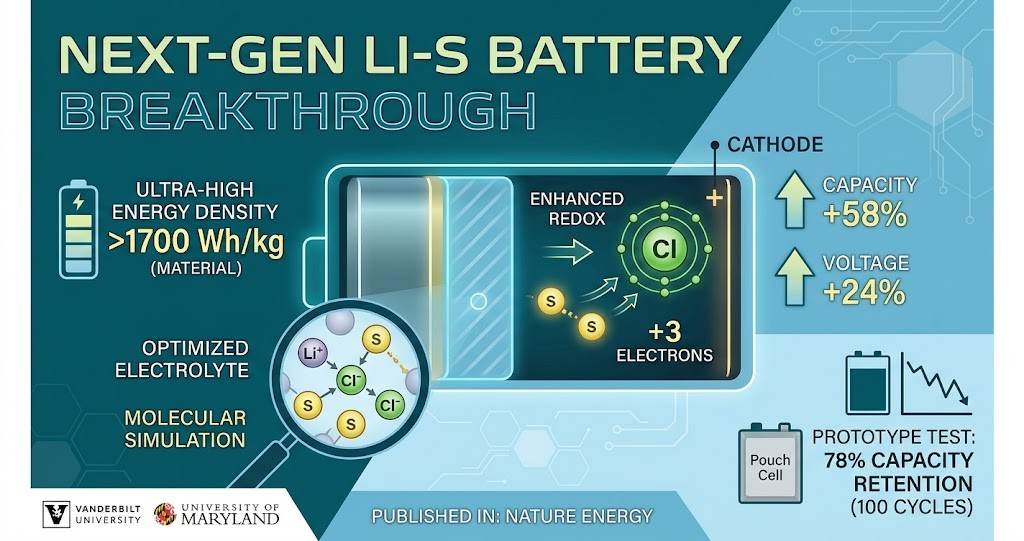
次世代バッテリーとして期待される「リチウム硫黄(Li-S)電池」のエネルギー密度を大幅に引き上げる新たな化学技術が発表されました。ヴァンダービルト大学およびメリーランド大学の研究チームは、塩素を導入することで従来活用されていなかった硫黄の酸化還元能力を引き出し、作動電圧と蓄電容量を同時に向上させることに成功しました。
1. 研究の背景と成果概要
- 研究チーム: ヴァンダービルト大学のDe-en Jiang教授(化学工学・化学)およびメリーランド大学らの共同研究チーム
- 掲載誌: Nature Energy
- 核心的成果: 塩素(Chlorine)をバッテリー系内に導入することで、従来の硫黄酸化還元反応の限界を打破。各硫黄原子が3つ目の電子を交換できる追加の反応プロセスを実現した。
- 主要な性能向上データ:
- 電荷蓄積容量: 標準的なリチウム硫黄系と比較して約 58% 増加
- 平均動作電圧: 従来の約 2.05 V から 2.54 V へ上昇
- 材料レベルのエネルギー密度: 硫黄 1 kg あたり 1,700 Wh 以上を記録
- スタックレベル(セル全体)の比エネルギー: 約 477 Wh/kg と推計され、従来型リチウム硫黄システムより約 37% 向上
2. 電解質設計と技術的ブレイクスルー
- 課題: 塩素と硫黄の反応生成物(硫黄-塩素化合物)が溶出し、リチウム金属負極側へ移動して副反応を引き起こす問題(シャトル効果類似現象)の防止。
- 解決アプローチ: 分子シミュレーションを用いてリチウムイオンと塩化物イオンの挙動を解析。
- 電解質(Electrolyte)の最適化:
- 塩化物が硫黄と反応しやすい環境を保持。
- 反応生成物が溶解しにくい電解液を選定することで正極(カソード)内に生成物を留め、可逆的な充放電反応を達成。
- 検証: 分光法による構造解析に加え、小型の単層パウチセル(Pouch Cell)を試作。100サイクルの充放電後も初期容量の 78% を維持した。
3. 関連情報・背景解説
- リチウム硫黄(Li-S)電池の基礎知識:
- 強み: 正極に安価で資源量が豊富な硫黄(S)を使用するため、コバルトやニッケルなどの高価なレアメタルを必要としない。従来のグラファイト/NCM系リチウムイオン電池に比べ、理論エネルギー密度が格段に高い(理論値:約 2,600 Wh/kg)。
- 用途期待: 軽量かつ高エネルギー密度が求められるドローン、電気航空機(eVTOL)、新興EV市場での活用が期待されている。
- 実用化に向けた現在の課題と今後の展望:
- 多硫化物シャトル効果(Polysulfide Shuttle Effect): 充電中に中間生成物(多硫化物)が電解液に溶出し、負極の劣化や急速な容量低下を招く問題。
- 体積膨張: 充放電時に正極材料が大幅に伸縮するため、構造的劣化が生じやすい。
- 商業化へのハードル: 今回の試作セルはリチウム金属電極を使用しており、電解液の含有量が市販レベルより多く、硫黄の担持量も比較的少ない。実用化には電解液量の削減や高面耐圧電極の実現など、さらなるスケールアップ研究が必要とされる。
Boosting Energy Density and Operating Mechanism of Lithium-Sulfur Batteries Through Novel Chemistry
A new chemical approach has been announced that significantly increases the energy density of lithium-sulfur (Li-S) batteries, a promising candidate for next-generation energy storage. A research team from Vanderbilt University and the University of Maryland successfully enhanced both operating voltage and charge storage capacity by introducing chlorine to unlock previously unexploited redox capacity in sulfur.
Based on this published study, this report summarizes the key research outcomes, electrolyte design innovations, and technical background surrounding lithium-sulfur battery technology.
1. Research Background & Key Outcomes
- Research Team: Joint research team led by Professor De-en Jiang (Chemical Engineering and Chemistry) at Vanderbilt University, alongside researchers from the University of Maryland and other institutions.
- Journal: Nature Energy
- Core Achievement: By introducing chlorine into the battery system, the researchers broke through the traditional limits of sulfur redox reactions, enabling an additional reaction process where each sulfur atom can exchange a third electron.
- Key Performance Improvements:
- Charge Storage Capacity: Increased by approximately 58% compared to standard lithium-sulfur systems.
- Average Operating Voltage: Rose from approximately 2.05 V in conventional systems to 2.54 V.
- Material-Level Energy Density: Exceeded 1,700 Wh per 1 kg of sulfur.
- Stack-Level Specific Energy: Estimated at approximately 477 Wh/kg, representing a roughly 37% increase over conventional lithium-sulfur systems used for comparison.
2. Electrolyte Design & Technical Breakthroughs
- Challenge: Preventing the dissolution of sulfur-chlorine reaction intermediates and their migration toward the lithium metal anode, which would cause side reactions (a phenomenon similar to the polysulfide shuttle effect).
- Solution Approach: Analyzed the behavior of lithium ions and chloride ions in various electrolyte environments using molecular simulations.
- Electrolyte Optimization:
- Maintained an environment where chloride remains reactive toward sulfur.
- Selected an electrolyte in which the sulfur-chlorine reaction products do not easily dissolve, keeping the products contained within the cathode and enabling reversible charge-discharge reactions.
- Validation: Confirmed through spectroscopic analysis as well as testing on a small, single-layer pouch cell, which retained 78% of its initial capacity after 100 cycles.
3. Key Perspectives & Background
- Fundamentals of Lithium-Sulfur (Li-S) Batteries:
- Strengths: Uses low-cost, abundant sulfur (S) for the cathode, eliminating the need for expensive rare metals like cobalt and nickel. Offers a significantly higher theoretical energy density (approx. 2,600 Wh/kg) compared to conventional graphite/NCM lithium-ion batteries.
- Target Applications: Expected to find use in weight-sensitive, high-energy-density applications such as drones, electric vertical takeoff and landing (eVTOL) aircraft, and next-generation electric vehicles.
- Current Challenges & Future Outlook for Commercialization:
- Polysulfide Shuttle Effect: Dissolution of intermediate polysulfides into the electrolyte during cycling leads to anode degradation and rapid capacity loss.
- Volume Expansion: Substantial expansion and contraction of cathode material during charge-discharge cycles causes structural degradation.
- Hurdles to Commercialization: The prototype cell relied on lithium metal anodes with higher electrolyte ratios and lower sulfur loadings than desired for commercial production. Further scale-up research—including reducing electrolyte volume and increasing active material loading—will be required before practical market deployment.


コメント