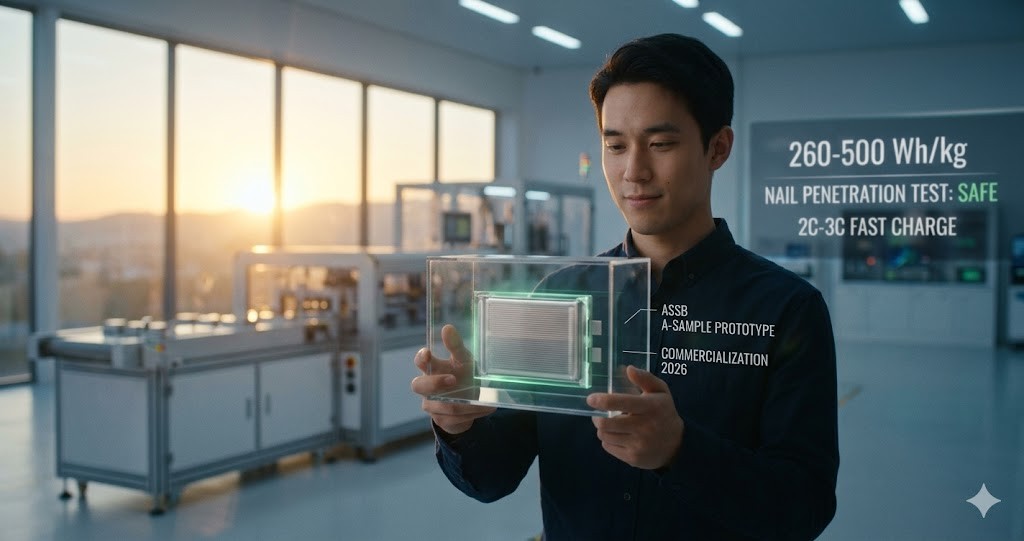
次世代のエネルギー技術として注目される全固体電池(ASSB)の分野で、大きな進展がありました。広州汽車集団(GACグループ)が出資するGreater Bay Technology(グレーターベイ・テクノロジー)社が、最新のプロトタイプ(Aサンプル)を発表し、商用化に向けた具体的なロードマップを提示しています。
以下に、ニュースの要約と関連する技術背景をまとめて解説します。
グレーターベイ社による全固体電池の画期的な成果
1. 発表の核心:Aサンプルセルの展開
Greater Bay社は、液体電解質を一切使用しない全固体電池のAサンプルセルをラインオフ(生産開始)したと発表しました。これは、実験室レベルの研究から、工業化・量産化フェーズへ移行するための重要なマイルストーンです。
2. 卓越した安全性と性能
開発されたプロトタイプは、従来のリチウムイオン電池が抱える熱暴走のリスクを根本から解決したとして、以下の成果を主張しています。
- 極限状態の安全性: 釘刺し、圧壊、熱衝撃などの厳しい安全性試験において「発火・爆発なし」を達成。
- 高いエネルギー密度: 260Wh/kgから最大500Wh/kgを実現。これは現在主流の液体リチウム電池を大きく上回ります。
- 高速充電の実現: 2Cから3Cの安定した急速充電が可能。固体電池の弱点とされていた充電速度の遅さを克服しました。
3. 独自の技術アプローチ:複合電解質
同社は、世界で主流となっている硫化物系や酸化物系とは異なる、深共晶ベースの複合電解質システムを採用しています。
- 特徴: イオン伝導性と構造安定性を両立。
- 優位性: 性能、歩留まり、コストのバランスに優れ、半固体電池などの過渡的な技術を飛び越えた「真の全固体」として差別化を図っています。
4. 量産化スケジュール
- 2026年: ギガワット時(GWh)規模の量産開始を目指す。
- 知的財産: 電解質材料や製造プロセスにおいて50件以上の特許を出願済み。
関連情報:全固体電池を取り巻く市場環境
全固体電池は、電気自動車(EV)の航続距離を飛躍的に伸ばし、充電時間を短縮する「ゲームチェンジャー」として期待されています。
固体電池の主な技術分類
現在、世界中のメーカーが以下の3つの方式を中心に開発を競っています。
- 硫化物系: イオン伝導率が極めて高いが、水分と反応して有害な硫化水素を発生させるリスクがあり、封止技術が重要。
- 酸化物系: 化学的安定性が高く安全だが、硬いため電極との接触界面の形成が難しい。
- ポリマー系: 製造が比較的容易だが、高温で作動させる必要があり、常温での伝導率が低い。
競合他社の動向
- トヨタ自動車: 2027年から2028年の実用化を目指し、出光興産と提携。
- 日産自動車: 2028年度までの量産開始を目標に、自社開発を加速。
- 中国勢 (NIO, CATLなど): すでに「半固体電池(電解質に一部液体を含む)」を搭載した車両の投入を開始しており、全固体への移行を急いでいます。
まとめ
Greater Bay社による今回の発表は、中国の電池メーカーが従来の製造規模だけでなく、次世代の材料科学においても世界をリードしようとしている姿勢を象徴しています。2026年という量産目標は非常に野心的であり、今後の実車への搭載タイミングが業界の注目ポイントとなります。
出典:https://cnevpost.com/2026/04/14/greater-bay-breakthrough-solid-state-batteries/
“No Fire, No Explosion”: GAC-Backed Greater Bay Unveils All-Solid-State Battery A-Sample
Significant progress has been made in the field of All-Solid-State Batteries (ASSB), a technology drawing intense global focus as the next generation of energy storage. Greater Bay Technology, backed by Guangzhou Automobile Group (GAC Group), has announced its latest prototype (A-sample) and presented a concrete roadmap toward commercialization.
The following is a summary of the news and an explanation of the underlying technical background.
Breakthrough Achievements in All-Solid-State Batteries by Greater Bay
1. Core of the Announcement: Deployment of A-Sample Cells
Greater Bay announced that its All-Solid-State Battery A-sample cells, which contain zero liquid electrolyte, have rolled off the production line. This marks a critical milestone in transitioning from laboratory-level research to the industrialization and mass-production phase.
2. Exceptional Safety and Performance
The developed prototype claims to fundamentally solve the risk of thermal runaway inherent in conventional lithium-ion batteries, achieving the following results:
- Safety under Extreme Conditions: Achieved “no fire, no explosion” in rigorous safety tests, including nail penetration, crushing, and thermal shock.
- High Energy Density: Reached 260 Wh/kg to 500 Wh/kg, significantly exceeding the energy density of mainstream liquid lithium batteries currently on the market.
- Fast Charging Capability: Supports stable fast charging at 2C to 3C, overcoming the slow charging speeds previously considered a weakness of solid-state batteries.
3. Unique Technical Approach: Composite Electrolytes
The company employs a deep eutectic-based composite electrolyte system, distinguishing itself from the sulfide or oxide-based systems that are currently mainstream worldwide.
- Characteristics: Simultaneously achieves high ionic conductivity and structural stability.
- Advantages: Offers a superior balance of performance, yield, and cost. The company aims to differentiate its “True Solid-State” technology by bypassing transitional stages like semi-solid or quasi-solid-state batteries.
4. Mass Production Schedule
- 2026: Aims to achieve gigawatt-hour (GWh) scale mass production.
- Intellectual Property: More than 50 patents have been filed regarding electrolyte materials and manufacturing processes.
Related Information: Market Environment for Solid-State Batteries
All-solid-state batteries are expected to be a “game-changer” that will dramatically extend the cruising range of electric vehicles (EVs) and shorten charging times.
Key Technical Classifications of Solid-State Batteries
Currently, manufacturers worldwide are competing to develop the following three main types:
- Sulfide-based: Offers extremely high ionic conductivity but carries the risk of generating toxic hydrogen sulfide gas if it reacts with moisture, making high-quality sealing technology essential.
- Oxide-based: High chemical stability and safety, but its hardness makes it difficult to form a seamless contact interface with the electrodes.
- Polymer-based: Relatively easy to manufacture, but typically requires high-temperature operation due to low conductivity at room temperature.
Competitor Trends
- Toyota Motor: Partnered with Idemitsu Kosan, aiming for practical application between 2027 and 2028.
- Nissan Motor: Accelerating in-house development with a goal to start mass production by fiscal year 2028.
- Chinese Players (NIO, CATL, etc.): Have already begun deploying vehicles equipped with “semi-solid-state batteries” (containing some liquid electrolyte) and are rushing the transition to all-solid-state.
Summary
This announcement by Greater Bay symbolizes the ambition of Chinese battery manufacturers to lead the world not only in manufacturing scale but also in next-generation material science. The mass production goal of 2026 is highly ambitious, and the timing of actual vehicle integration will be a primary focus for the industry moving forward.

コメント