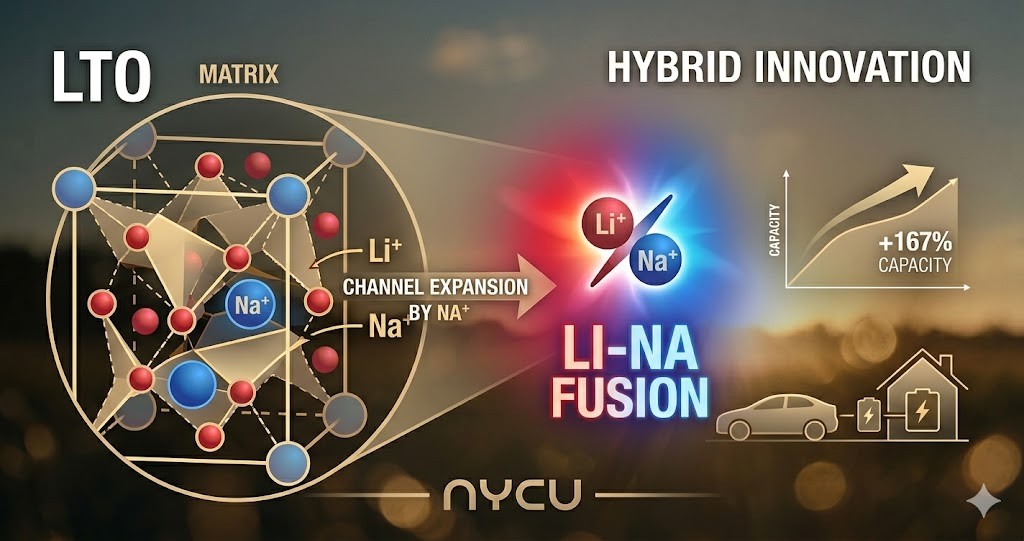
電気自動車(EV)の普及において、航続距離(エネルギー密度)と充電時間の短縮(入出力特性)の両立は最大の課題です。今回、台湾のNYCU(National Yang Ming Chiao Tung University)の研究チームは、安全性が高いものの容量が少なかったLTO材料に、ナトリウムイオン電解質を組み合わせるという独自の視点から、この課題への解答を提示しました。
1. リチウムチタン酸(LTO)の特性と課題
LTO(Li4Ti5O12)は、リチウムイオン電池の負極材料として以下の特徴を持ちます。
- 高い安全性と長寿命: 充放電時の体積変化がほとんどない「ゼロストレイン」材料であり、数万回の充放電に耐えることができます。
- 急速充電: 高い入出力特性を持ち、極低温下でも動作可能です。
- 弱点: 動作電位が高いため電池全体の電圧が低くなりやすく、理論容量も約 175 mAh/g と、一般的なグラファイト負極(約 372 mAh/g)に比べて低いため、エネルギー密度が課題でした。
2. 画期的な「ハイブリッド設計」の仕組み
Su教授率いるチームは、電解質にリチウム塩ではなくナトリウム塩(ナトリウムイオン電解質)を使用する構成を試みました。
- 格子膨張による容量増加: ナトリウムイオンがLTOの結晶構造に微量に入り込むことで、結晶格子がわずかに膨張します。
- イオン移動の高速化: この格子膨張がリチウムイオンの通り道を広げる役割を果たし、リチウムイオンの挿入・脱離がよりスムーズになります。
- 成果: 従来のリチウムベースの電解質を使用した場合と比較して、容量が最大で 167% 増加することを実証しました。
3. 社会的・経済的な意義
この研究成果は、単なる性能向上にとどまらず、バッテリー産業に多大な影響を与える可能性があります。
- コスト削減: リチウムは希少で価格変動が激しいですが、ナトリウムは海水などから安価に調達可能です。電解質の一部にナトリウムを利用することで、製造コストの低減が期待できます。
- サプライチェーンの安定: リチウムへの依存度を抑えることで、資源リスクを分散させることができます。
- 用途の拡大: 高い安全性と高容量を両立させることで、EVだけでなく、住宅用や産業用の大型蓄電システム(ESS)への応用が現実味を帯びています。
4. 結論と今後の展望
NYCUの研究は、「リチウム電池にはリチウム電解質」という固定観念を打破しました。LTOの構造的安定性を維持したまま、ナトリウムイオンの物理的特性を「スペーサー」として活用するこのアプローチは、今後の次世代電池開発における重要な設計指針となるでしょう。
Overturning Conventional Wisdom: A New Hybrid Design Achieving a 167% Capacity Increase
In the pursuit of widespread electric vehicle (EV) adoption, the greatest challenge remains balancing driving range (energy density) with shorter charging times (power characteristics). A research team from National Yang Ming Chiao Tung University (NYCU) in Taiwan has presented a solution to this challenge through a unique perspective: combining lithium titanate (LTO)—a material known for high safety but low capacity—with a sodium-ion electrolyte.
1. Characteristics and Challenges of Lithium Titanate (LTO)
LTO (Li4Ti5O12) possesses the following features as an anode material for lithium-ion batteries:
- High Safety and Long Life: As a “zero-strain” material that undergoes almost no volume change during charging and discharging, it can withstand tens of thousands of cycles.
- Fast Charging: It exhibits excellent input/output characteristics and can operate even at extremely low temperatures.
- Weaknesses: Its high operating potential tends to lower the overall battery voltage. Furthermore, its theoretical capacity of approximately 175 mAh/g is lower than that of conventional graphite anodes (approx. 372 mAh/g), making energy density a significant hurdle.
2. The Mechanism of the Breakthrough “Hybrid Design”
The team led by Professor Su experimented with a configuration using sodium salts (sodium-ion electrolyte) instead of lithium salts in the electrolyte.
- Capacity Increase via Lattice Expansion: By allowing a trace amount of sodium ions to enter the LTO crystal structure, the crystal lattice expands slightly.
- Faster Ion Movement: This lattice expansion acts as a gateway, facilitating smoother insertion and extraction of lithium ions.
- Results: The study demonstrated that capacity increased by up to 167% compared to systems using conventional lithium-based electrolytes.
3. Social and Economic Significance
This research achievement goes beyond simple performance enhancement and could have a profound impact on the battery industry.
- Cost Reduction: While lithium is scarce and subject to high price volatility, sodium is abundantly and cheaply available from sources like seawater. Utilizing sodium in part of the electrolyte is expected to lower manufacturing costs.
- Supply Chain Stability: Reducing reliance on lithium allows for the diversification of resource risks.
- Expanding Applications: By achieving both high safety and high capacity, applications are becoming realistic not only for EVs but also for large-scale energy storage systems (ESS) for residential and industrial use.
4. Conclusion and Future Outlook
The NYCU research has shattered the fixed idea that “lithium batteries must use lithium electrolytes.” This approach—utilizing the physical properties of sodium ions as a “spacer” while maintaining the structural stability of LTO—will serve as a vital design principle for the development of next-generation batteries.

コメント