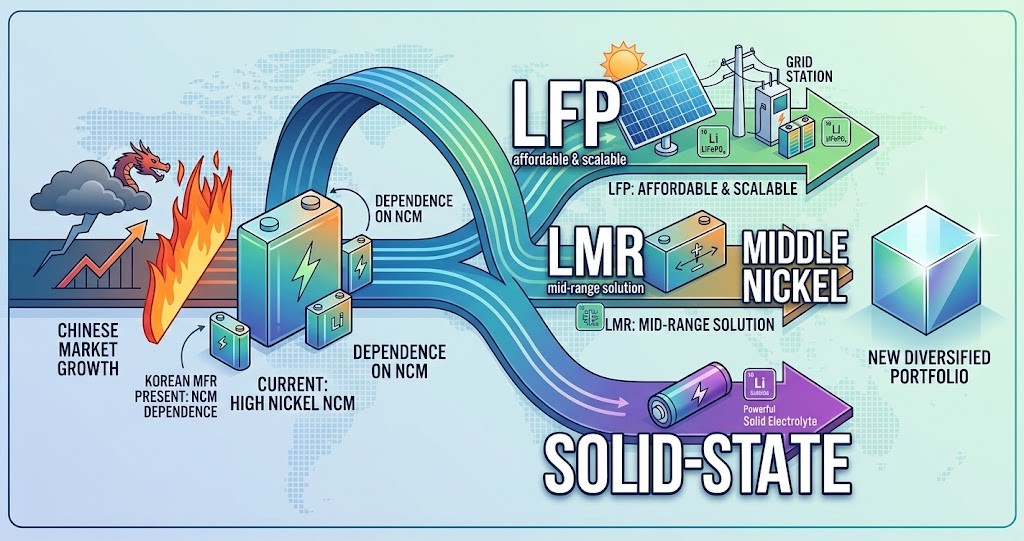
韓国のバッテリー正極材メーカー3社が、急速に市場を拡大する中国勢に対抗するため、事業構造の抜本的な再編を進めています。これまで得意としてきたハイニッケル三元系(NCM等)中心の戦略から脱却し、低価格なリン酸鉄リチウム(LFP)、次世代の中低価格帯向けリチウムマンガンリッチ(LMR)、そして将来の本命とされる全固体電池向け素材へとポートフォリオを急ピッチで拡張しています。
1. 市場環境と韓国勢の危機感
- 中国勢の台頭: CATLやBYDをはじめとする中国企業は、価格競争力に優れたLFPバッテリーを武器に非中国市場へ本格進出しています。2026年1月〜7月の非中国市場(使用量316.2ギガワット時、前年同期比25.8パーセント増)において、CATLとBYDの合計シェアは44.6パーセント(前年同期比7.0ポイント増)に拡大しました。
- 韓国バッテリーメーカーの苦戦: LGエナジーソリューション、SKオン、サムスンSDIの韓国バッテリー3社の非中国市場における使用量は86.1ギガワット時(8.9パーセント減)に落ち込み、合算シェアは37.6パーセントから27.2パーセントへと急減しました。電気自動車(EV)市場全体の伸び悩み(キャズム現象)や北米市場での苦戦が影響しています。
2. 韓国正極材3社の新戦略と動向
従来の高級EV向けハイニッケルだけでなく、普及型EVや需要が急増しているエネルギー貯蔵装置(ESS)市場を取り込む狙いです。
- POSCO Future M:
- LMR推進: マンガン比率を高めて原価を抑えつつ高いエネルギー密度を実現するLMR正極材のパイロット生産に成功。既存のNCMラインを活用できるため投資負担が少ない点が強みです。
- LFP量産: 浦項の既存NCMラインの一部をLFPに転換し2026年末に供給開始予定。合弁会社を通じて2027年量産目標のLFP専用工場(年産最大5万トン)も建設中です。SKオンと1兆700億ウォン(約1300億円)規模のLFP供給契約を締結しました。
- EcoPro BM:
- 商用化の加速: LMR正極材は主要顧客向けの最終検証段階にあり、ライン転換による迅速な量産体制を整えています。全固体電池向け固体電解質もパイロット運営中で、早ければ2027年の量産を目指しています。
- 脱中国工法: 梧倉に年産4000トン規模のLFPラインを運営するほか、中国依存度が高いリン酸鉄前駆体を経ず、原料を直接合成する「無前駆体LFP工法」の開発を完了しました。
- L&F:
- 多角化戦略: ウルトラハイニッケル(ニッケル比率95パーセント)の量産実績をベースに、2026年下半期に韓国初となるLFP商業化を推進。さらに高電圧ミッドニッケル、LMR、全固体電池用、ナトリウムイオン電池(SIB)用まで最も幅広く展開しています。
- 大型契約の獲得: サムスンSDIと1兆6067億ウォン(約1900億円)、SKオンと1600億ウォン(約190億円)規模のLFP正極材供給契約を相次いで締結しました。
3. 脱中国サプライチェーンと通商規制(関連情報)
- 米欧の通商障壁が追い風: 米国のインフレ抑制法(IRA)やEUの重要原材料法(CRMA)により、中国産の鉱物・素材を使用したバッテリーは補助金対象外や関税の不利益を被るため、グローバル自動車メーカーは「非中国系サプライチェーン」からの調達を強く求めています。
- 技術的ボトルネックの克服: 通常のLFP生産には中国企業が独占状態にある前駆体(リン酸鉄)が必要ですが、韓国勢は前駆体を介さない「直接合成法」や自社技術の開発を進めることで、中国企業に対して30〜40パーセント高かったコストの克服を目指しています。
電気自動車の低価格モデル拡充やAIデータセンター普及に伴うESS需要の拡大により、バッテリー市場は単一規格の争いから用途・価格帯に応じた細分化の時代に入りました。米欧の通商規制を背景に「脱中国サプライチェーン」を構築しつつ、需要の変化へ柔軟に対応できる製品ラインナップを確保できるかが、素材企業の今後の命運を握っています。
出典:https://finance.biggo.jp/news/2642ff23-1c49-4584-8f3f-aa5a01f47974
Next-Generation Survival Strategies of 3 South Korean Battery Material Companies Competing with LFP, LMR, and Solid-State Batteries
Three South Korean battery cathode material manufacturers are undertaking a radical restructuring of their business models to counter Chinese competitors expanding rapidly in global markets. Shifting away from their traditional focus on high-nickel ternary chemistries such as NCM, they are rapidly expanding their product portfolios to include cost-effective lithium iron phosphate (LFP), next-generation mid-to-low-price lithium-manganese-rich (LMR), and materials for solid-state batteries, which are considered the ultimate long-term solution.
1. Market Environment and the Sense of Crisis in South Korea
- Rise of Chinese Manufacturers: Chinese companies led by CATL and BYD are making aggressive inroads into non-Chinese markets using cost-competitive LFP batteries as a key driver. In the non-Chinese market from January to July 2026 (total usage of 316.2 GWh, up 25.8 percent year-on-year), the combined market share of CATL and BYD expanded to 44.6 percent (up 7.0 percentage points year-on-year).
- Struggle of South Korean Battery Makers: The combined battery usage of the three major South Korean battery manufacturers—LG Energy Solution, SK On, and Samsung SDI—in non-Chinese markets fell to 86.1 GWh (down 8.9 percent), with their combined market share dropping sharply from 37.6 percent to 27.2 percent. This decline was driven by a market-wide slowdown in electric vehicle (EV) demand growth (the EV chasm) and underperformance in the North American market.
2. New Strategies and Key Developments of the 3 South Korean Cathode Manufacturers
The goal is to capture market share not only in premium EVs with high-nickel chemistry, but also in mass-market entry EVs and the rapidly growing energy storage system (ESS) sector.
- POSCO Future M:
- Promoting LMR: Successfully produced pilot batches of LMR cathode materials, which lower production costs by increasing manganese content while maintaining high energy density. A key advantage is that existing NCM production lines can be reused, minimizing initial investment costs.
- LFP Mass Production: Plans to convert part of its existing NCM line in Pohang to LFP, with supply scheduled to begin by the end of 2026. A joint venture is also constructing a dedicated LFP plant targeting mass production by 2027 with an annual capacity of up to 50,000 metric tons. The company signed a 1.07 trillion KRW (approx. 130 billion JPY) LFP supply contract with SK On.
- EcoPro BM:
- Accelerating Commercialization: LMR cathode materials are in the final verification stage with key customers, with flexible line conversion set up for rapid mass production. Pilot production of solid electrolytes for solid-state batteries is also underway, targeting commercial mass production as early as 2027.
- De-China Production Methods: Operates an LFP line with an annual capacity of 4,000 metric tons in Ochang and has completed development of a precursor-free LFP manufacturing process that bypasses iron phosphate precursors, for which dependence on China is high, by directly synthesizing raw materials.
- L&F:
- Diversification Strategy: Building on its experience in commercializing ultra-high-nickel cathode materials (95 percent nickel content), L&F aims to launch South Korea’s first commercial LFP production in the second half of 2026. It is building the broadest product lineup in the industry, encompassing high-voltage mid-nickel, LMR, all-solid-state battery (ASSB) materials, and sodium-ion battery (SIB) materials.
- Securing Major Contracts: Signed a 1.6067 trillion KRW (approx. 190 billion JPY) mid-to-long-term LFP cathode supply contract with Samsung SDI, followed by a 160 billion KRW (approx. 19 billion JPY) supply agreement with SK On.
3. De-China Supply Chains and Trade Regulations (Related Context)
- Trade Barriers as Tailwinds: Trade regulations like the U.S. Inflation Reduction Act (IRA) and the EU Critical Raw Materials Act (CRMA) penalize batteries made with Chinese minerals and components through tariff burdens or subsidy exclusions, prompting global automakers to demand non-Chinese supply chains.
- Overcoming Technical Bottlenecks: Conventional LFP production requires iron phosphate precursors, a market dominated by Chinese suppliers. By developing precursor-free direct synthesis processes and proprietary technologies, South Korean companies aim to bridge the 30 to 40 percent cost advantage currently held by Chinese competitors.
Driven by the expansion of entry-level EV models and soaring demand for ESS powered by AI data centers, the battery market has entered an era of segmentation based on specific applications and price points, moving away from a single-standard competition. Against the backdrop of U.S. and European trade barriers, whether material suppliers can establish de-Chinese supply chains while flexibly adapting their product lineups to shifting market demands will determine their long-term survival.
コメント