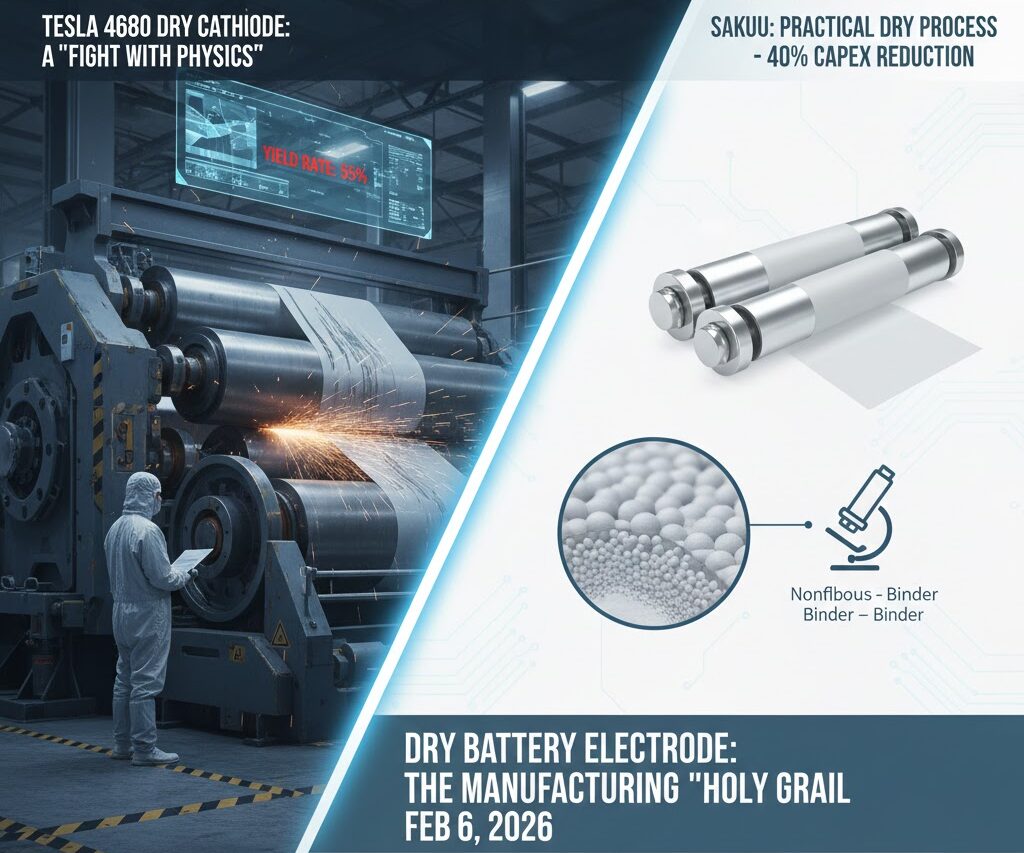
次世代バッテリー製造の「聖杯」とも称される乾電池電極(DBE)技術。湿式スラリーや巨大な乾燥炉を排除することで、コスト削減とエネルギー密度向上、さらには環境負荷の低減を約束するこの技術ですが、その量産化への道は想像以上に険しいものでした。
3Dプリンティング・バッテリーのパイオニアであるSakuu(サクウ)の最高技術責任者(CTO)、カール・リタウ氏は、テスラの4680セル製造における苦戦を分析し、革新的な材料特性が製造現場でいかに「物理法則との闘い」を引き起こしているのかを明らかにしています。
1. 技術の核心:テフロン(PTFE)がもたらす「繊維化の魔法」とその代償
テスラが2019年にマクスウェル・テクノロジーズを買収して獲得したDBEプロセスの核は、ポリテトラフルオロエチレン(テフロン/PTFE)をバインダーとして使用する手法です。
- 繊維化(Fibrillation)の仕組み: 直径約1ミクロンの極小テフロン粒子に特定のせん断力を加えると、粒子が解けて糸状の「繊維」になります。これが活物質を網目状に包み込み、強固な自立型フィルムを形成します。
- メリット: 従来の接着剤(液体バインダー)が不要になり、電極の厚膜化が可能。これによりエネルギー密度が大幅に向上します。
- 製造上の課題: この「魔法」を起こすには極めて高い圧力が必要です。1ミリ以下の隙間を持つ巨大ローラーに材料を押し込む際、ローラー自体が摩耗したり、圧力で押し広げられたりするため、ミクロン単位の均一性を維持することが困難になります。
2. 量産の障壁:ラボの成功と工場の現実
イーロン・マスク氏は2024年以降、乾式正極のスケールアップが「予想を遥かに超えて困難だった」と繰り返し述べています。
| 項目 | テスラ/マクスウェル方式の課題 |
| ローラーへの負荷 | 研磨性の高い粉末と高圧により、設備が早期に摩耗・損傷する。 |
| 厚みの不均一性 | 大量生産時、圧力変動により電極の厚さにばらつきが生じ、歩留まりが低下。 |
| 正極(カソード)の難易度 | 負極(グラファイト)に比べ、正極材料は硬く、均一なフィルム化が極めて困難。 |
| メンテナンスコスト | 設備の補修に長時間を要し、稼働率が低下。 |
最新情報(2026年2月時点): > テスラは2025年末から2026年初頭にかけて、テキサス州ギガファクトリーにおいて「正負極両方の完全乾式プロセス」による4680セルの量産に一定の目処を立てたと報告しています。しかし、依然として歩留まりの安定化が最大の焦点となっています。
3. Sakuuが提案する「実用的なDBE」へのアプローチ
Sakuuのリタウ氏は、テスラのような過酷な環境を必要とする特殊材料に頼らず、より既存の製造方法に近い形での簡素化を提言しています。
- 「接着」の再定義: 特殊な繊維化プロセスに依存するのではなく、粉末状のバインダーを均一に堆積させ、熱と圧力で密着させるシンプルな手法。
- プロセスの親和性: 顕微鏡レベルでは従来の湿式電極に近い構造を維持しつつ、溶剤(NMP等)と乾燥炉を排除することで、設備投資を40%以上、工場スペースを大幅に削減可能。
- Sakuuの視点: 「バッテリーはクールである必要はなく、確実に機能し、安価でなければならない」。製造の難易度を下げることが、真の社会実装への近道であると説いています。
まとめ:製造プロセスこそが「製品」である
テスラのDBEを巡る苦闘は、新しい「材料」を開発すること以上に、それを「安定して大量に作るプロセス」を確立することの難しさを示しています。
テフロンによる高度な繊維化ネットワークを完成させるテスラのアプローチか、あるいはSakuuが提唱するシンプルで堅牢な乾式プロセスか。どちらが次世代バッテリーのデファクトスタンダードになるかは、今後の数百万メートルに及ぶ「電極の均一性」と「コスト効率」の勝負にかかっています。
Tesla’s “High-Pressure Dilemma”: Technical Challenges in Scaling Dry Battery Electrode Processes
Dry Battery Electrode (DBE) technology is often hailed as the “Holy Grail” of next-generation battery manufacturing. By eliminating wet slurries and massive drying ovens, it promises significant cost reductions, higher energy density, and a smaller environmental footprint. However, the road to mass production has proven far steeper than imagined.
Karl Littau, Chief Technology Officer at Sakuu—a pioneer in 3D-printed batteries—analyzes Tesla’s struggles with the 4680 cell, revealing how innovative material properties are triggering a literal “battle with the laws of physics” on the factory floor.
1. The Core Technology: The “Magic of Fibrillation” and Its Price
The heart of the DBE process Tesla acquired via Maxwell Technologies in 2019 is the use of polytetrafluoroethylene (PTFE/Teflon) as a binder.
- Mechanism of Fibrillation: When specific shear forces are applied to microscopic PTFE particles (roughly 1 micron in diameter), they unravel into thread-like “fibers.” These fibers wrap around the active materials in a web-like network, forming a strong, self-supporting film.
- Benefits: This eliminates the need for traditional liquid binders (adhesives), allowing for thicker electrodes and a dramatic boost in energy density.
- Manufacturing Challenges: Triggering this “magic” requires extreme pressure. As material is forced through giant rollers with gaps of less than 1 mm, the rollers themselves wear down or are pushed apart by the intensity. This makes maintaining micron-level uniformity nearly impossible at scale.
2. Barriers to Mass Production: Lab Success vs. Factory Reality
Since 2024, Elon Musk has repeatedly noted that scaling the dry cathode has been “orders of magnitude harder” than anticipated.
| Challenge Category | Issues with the Tesla/Maxwell Method |
| Equipment Load | High pressure combined with abrasive powders causes rapid wear and damage to machinery. |
| Thickness Variation | Pressure fluctuations during mass production lead to uneven electrode thickness, crashing yields. |
| Cathode Complexity | Cathode materials are harder than anode materials (graphite), making uniform filming extremely difficult. |
| Maintenance Costs | Frequent equipment repairs lead to long downtimes and low operational efficiency. |
Latest Update (as of February 2026): Tesla reported in early 2026 that it has made significant strides toward mass-producing 4680 cells using a “completely dry process for both anodes and cathodes” at Gigafactory Texas. However, stabilizing yields remains the primary focus.
3. Sakuu’s Approach: Toward a “Practical DBE”
Sakuu’s Littau advocates for a simplified approach that avoids the extreme environments required by Tesla’s specialized materials, staying closer to existing manufacturing logic.
- Redefining “Adhesion”: Instead of relying on a complex fibrillation process, Sakuu suggests a simpler method: depositing powdered binders uniformly and bonding them using heat and moderate pressure.
- Process Compatibility: This method maintains a structure similar to traditional wet electrodes at a microscopic level while eliminating solvents (like NMP) and drying ovens. This can reduce capital expenditure (CapEx) by over 40% and drastically shrink factory footprints.
- Sakuu’s Perspective: “Batteries don’t need to be cool; they just need to work reliably and be affordable.” Lowering manufacturing complexity is the fastest path to true social implementation.
Summary: The Manufacturing Process IS the Product
Tesla’s struggle with DBE highlights that developing a new “material” is only half the battle; establishing a “process” to produce it stably in massive quantities is the true hurdle.
Whether Tesla’s high-tech PTFE fiber network wins out or Sakuu’s proposal for a simpler, more robust dry process becomes the norm depends on who can master “electrode uniformity” and “cost efficiency” over the next millions of meters of production.


コメント