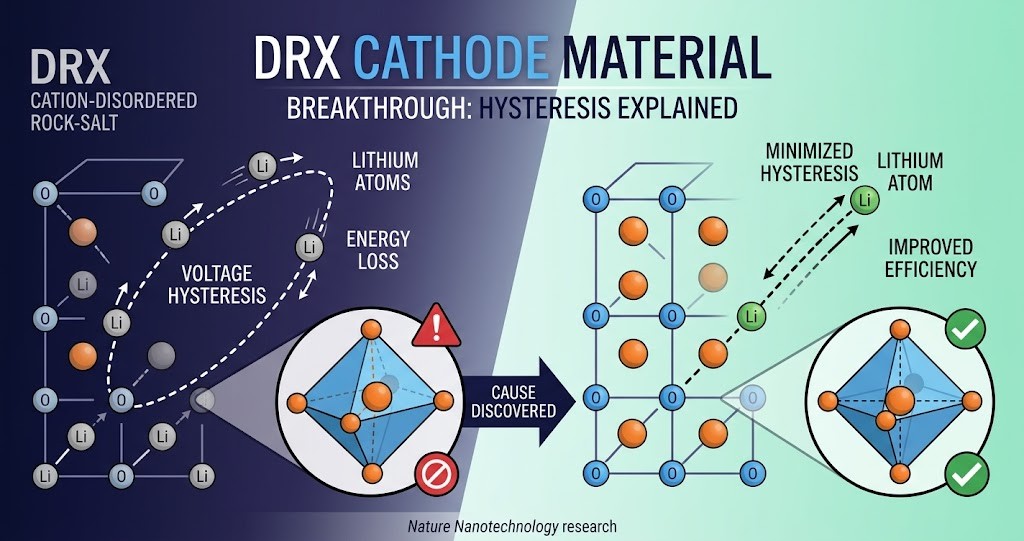
次世代リチウム電池の有望な正極材料として注目される「カチオン無秩序岩塩(DRX)」において、長年商業化の壁となっていた電圧ヒステリシス(充放電時の電圧差によるエネルギー損失)の発生機構が解明された。中南大学のYu Mei氏らがNature Nanotechnology誌に発表した研究によると、その根本原因は酸素配位構造の中心から金属原子がわずかにずれる「原子スケールの構造歪み」にあるという。
DRX正極が抱える「電圧ヒステリシス」問題
カチオン無秩序岩塩(DRX)化合物は、リチウムイオンと遷移金属イオンが格子点上に不規則に配置された結晶構造を持つ。リチウムを過剰に含有できる上、遷移金属だけでなく格子酸素自体の酸化還元反応(アニオン酸化還元)を活用できるため、極めて高い理論容量を実現できる点が大きな特長である。
しかし、充電時に投入した電気エネルギーの一部が放電時に回収されず、熱として逃げてしまう「電圧ヒステリシス」が著しく大きいという致命的な課題を抱えていた。このエネルギー損失は往復エネルギー効率を低下させ、バッテリーの熱管理を著しく複雑化させるため、実用化に向けた最大の障害となっていた。
原因は「d0遷移金属」の擬似ヤーン・テラー効果
研究チームは、シンクロトロンX線吸収分光法、X線・中性子対分布関数解析(PDF)、走査透過型電子顕微鏡(STEM)、および密度汎関数理論(DFT)計算を組み合わせ、原子スケールからナノスケールに至る構造変化を解明した。
その結果、最高酸化状態にあるニオブ(Nb)のような「d0遷移金属」(d電子殻が空のイオン)が果たす役割が明らかになった。
- 局所的歪みの発生: d0遷移金属イオンは、八面体酸素配位(酸素ケージ)の中心から自発的にずれる「擬似ヤーン・テラー効果」を起こす。
- 短距離秩序の抑制: この中心からの変位(原子歪み)が、格子内で有害な陽イオンの短距離秩序(偏り)を打ち破る。
速度論と熱力学のダブル改善メカニズム
この原子スケールの局所歪みは、電池の作動において二重のプラス効果をもたらす。
- リチウム輸送の加速(速度論的効果)歪みによってナノスケールの不必要な秩序ドメインが破砕されることで、リチウムイオンが移動するための連続的なパーコレーション経路(0-TM経路)が確保され、高速かつ可逆的な充放電が可能になる。
- 酸素酸化還元の可逆化(熱力学的効果)八面体の歪みがニッケル-酸素間の配位子-金属間電荷移動を最適化し、従来大きな電圧ギャップを引き起こしていた酸素酸化還元反応を可逆的な状態に保つ。
材料設計への波及効果と展望
本研究は、酸化還元に直接関与しないd0遷移金属の選定が、単なる安定化剤にとどまらず、局所構造を意図的に制御する「立体化学的ツール」として機能することを示した。
原子スケールの立体化学制御によって局所歪みを組み込んだDRX正極は、高容量を維持したまま電圧ヒステリシスを最小化できる。リチウム負極技術の成熟と合わさることで、サイクル効率に優れた次世代高エネルギー密度電池の実現が期待される。
How Atomic Distortion is Shaping the Future of Next-Generation Lithium Batteries
The mechanism behind voltage hysteresis—the energy loss caused by the voltage gap between charge and discharge that has long hindered commercialization—has been uncovered in cation-disordered rock-salt (DRX) cathodes, one of the most promising candidates for next-generation lithium batteries. According to a study published in Nature Nanotechnology by Yu Mei and colleagues from Central South University, the root cause lies in atomic-scale structural distortion, where individual metal atoms shift slightly off-center within their oxygen coordination cages.
The Voltage Hysteresis Problem in DRX Cathodes Cation-disordered rock-salt (DRX) compounds feature a crystal structure in which lithium ions and transition metal ions are distributed randomly across lattice sites. Their primary advantage is an exceptionally high theoretical capacity, achieved not only by accommodating excess lithium but also by harvesting redox reactions from both transition metals and lattice oxygen itself (anionic redox). However, DRX cathodes suffer from a fatal drawback: severe voltage hysteresis, in which a substantial portion of the electrical energy input during charging cannot be recovered during discharge and is lost as heat. This energy loss reduces round-trip energy efficiency and significantly complicates thermal management, posing the ultimate obstacle to commercial implementation.
The Root Cause: Pseudo Jahn-Teller Effect in d0 Transition Metals By combining synchrotron X-ray absorption spectroscopy, X-ray and neutron pair distribution function (PDF) analysis, scanning transmission electron microscopy (STEM), and density functional theory (DFT) calculations, the research team elucidated structural changes spanning from the atomic scale to the nanoscale. Their findings highlighted the critical role played by d0 transition metals—ions with empty d-electron shells in their highest oxidation state, such as niobium (Nb).
- Generation of Local Distortion: The d0 transition metal ions undergo a pseudo Jahn-Teller effect, causing them to spontaneously displace from the center of their octahedral oxygen coordination cages.
- Suppression of Short-Range Order: This off-center displacement (atomic distortion) disrupts the harmful cation short-range ordering (local clustering) within the lattice.
Dual Kinetic and Thermodynamic Improvement Mechanisms This atomic-scale local distortion delivers a double benefit during battery operation.
- Acceleration of Lithium Transport (Kinetics): By disrupting unfavorable nanoscale ordered domains, the distortion opens up continuous percolation pathways (0-TM pathways) for lithium ions, enabling fast and reversible charge-discharge dynamics.
- Reversibility of Oxygen Redox (Thermodynamics): The distortion in the octahedral cages optimizes ligand-to-metal charge transfer between nickel and oxygen, keeping the oxygen redox reactions highly reversible—reactions that previously drove large voltage gaps.
Implications for Materials Design and Future Outlook This study demonstrates that selecting redox-inactive d0 transition metals is not merely a method for structural stabilization, but a powerful stereochemical tool to deliberately tailor local atomic architecture. DRX cathodes engineered with localized distortion through atomic-scale stereochemical control can minimize voltage hysteresis while retaining high capacity. Combined with the maturation of lithium metal anode technologies, this approach paves the way toward next-generation high-energy-density batteries with superior round-trip efficiency.


コメント