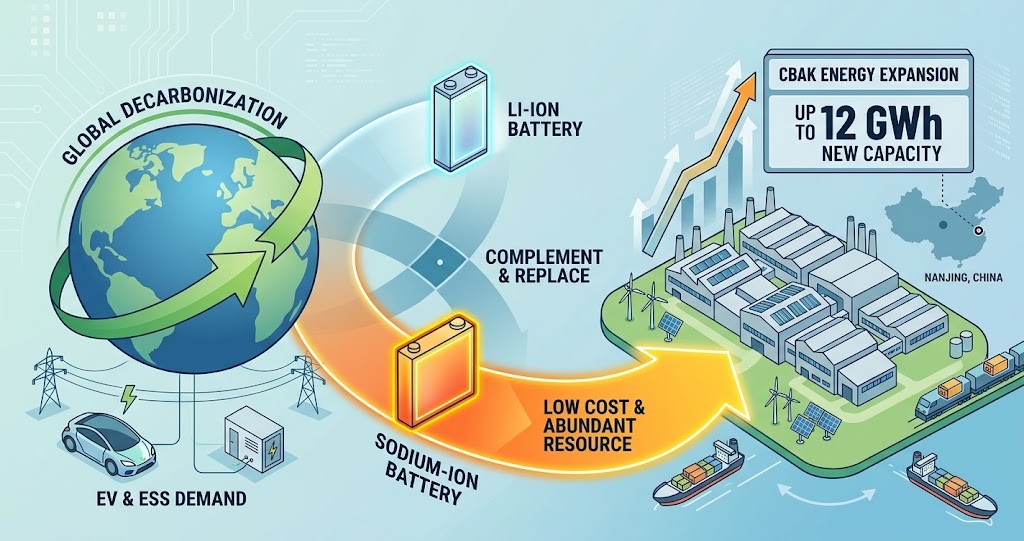
グローバルな脱炭素化の潮流と電気自動車(EV)、エネルギー貯蔵システム(ESS)の需要急増や価格競争の激化に伴い、バッテリー産業では新たな技術や材料への投資が加速しています。そのなかでも、資源が豊富で低コストかつ安定した供給が期待できる「ナトリウムイオン電池」は、従来のリチウムイオン電池を補完・一部代替する次世代電池として世界的な注目を集めています。
本記事では、中国の大手電池メーカーであるCBAK Energy(中比エネルギー)が発表した、南京高春経済開発区における最大12 GWhの新規生産能力追加および既存工場の拡張計画に関する最新動向と、それに伴う業界の関連背景をまとめて解説します。
CBAK Energyの南京における生産能力拡張計画の概要
1. 12 GWh規模の新プロジェクトと投資協定
- 計画概要: CBAK Energyは南京高春経済開発区と投資協定を締結し、年間12 GWh規模の大型円筒形ナトリウムイオン電池セルおよび統合型システム(モジュール、バッテリーパック)の研究開発・製造拠点を整備します。
- 柔軟な生産ライン: 本プロジェクトはナトリウムイオン電池戦略の一環ですが、製造ラインはナトリウムイオン電池とリチウムイオン電池の双方を生産できる柔軟な設計が採用されます。
- 想定収益と時期: リチウムイオン電池の市場価格ベースでフル稼働・全量販売した場合、年間48億元(7億1200万USドル)から50億元の追加収益が見込まれます。資金調達が順調に進めば、2027年後半からの本格推進を計画しており、市場需要や準備状況に応じて段階的に進められます。
- ターゲット市場: 住宅用・携帯用エネルギー貯蔵装置(ESS)および電気自動車(EV)向けに、すでに顧客によるサンプルテストが実施されています。
2. 既存南京工場の6 GWh拡張計画
- 現状と拡張: 既存の南京工場は現在、モデル32140セル(年間4.5 GWh)を生産しています。強い市場需要に応えるため、2026年末までに6 GWhを追加し、総生産能力を10.5 GWhへ引き上げる予定です。
- 対象モデル: 大型円筒形セル「モデル60150」への強い需要に対応することを目的としており、モデル60150専用ライン2本、あるいはモデル32140とモデル60150各1本の構成が検討されています。
- 想定収益: 6 GWhのフル稼働・全量販売時には、年間24億元から27億元の追加収益を見込んでいます。
関連情報・背景解説
- ナトリウムイオン電池が注目される理由
- 資源の豊富さとコスト優位性: リチウムは地域的偏在や価格変動のリスクがありますが、ナトリウムは海水などから豊富に採取でき、原材料コストを大幅に抑えられます。
- すぐれた温度特性と安全面: CBAK Energyのテスト結果にもある通り、極低温(-40 ℃)から高温(70 ℃)にわたる広い動作温度範囲(110 ℃幅)に対応し、厳しい環境下でも安定した性能を発揮します。
- 鉄系ポリアニオン正極(NFPP)の特性
- 今回採用されている「リン酸鉄ナトリウムピロリン酸(NFPP)」は、ポリアニオン系材料の一種であり、優れた熱安定性とサイクル寿命(充放電の耐久性)を備えています。特に安全性や長期使用が重視される住宅用・産業用の定置型エネルギー貯蔵システム(ESS)に適した材料として開発が進んでいます。
- 「モデル32140」「モデル60150」規格の意味
- 円筒形電池の型番はサイズを表しています。「32140」は直径32 mm・長さ140 mm、「60150」は直径60 mm・長さ150 mmを意味します。大型化(60150)することで1セルあたりの容量を増やし、パック組み立て時の部品点数削減や製造コストの低減を図っています。
- マルチ化学組成(フレキシブルライン)による戦略
- CBAK Energyのようにリチウムイオンとナトリウムイオンの双方に対応可能なラインを構築することで、リチウム価格の変動リスクを回避しつつ、顧客需要や市場動向に応じた最適な電池供給を可能にしています。
At the Forefront of Next-Generation Batteries: CBAK Energy Advances 12 GWh Sodium-Ion Battery Production Plan in Nanjing
Driven by global decarbonization trends, soaring demand for electric vehicles (EVs) and energy storage systems (ESS), and intensifying price competition, investments in new technologies and materials are accelerating across the battery industry. Among these technologies, sodium-ion batteries—which offer raw material abundance, low cost, and reliable supply—are attracting worldwide attention as a next-generation battery to complement and partially replace traditional lithium-ion batteries.
This article summarizes the latest developments regarding the expansion plans announced by major Chinese battery manufacturer CBAK Energy, including the addition of up to 12 GWh in new production capacity at the Nanjing Gaochun Economic Development Zone and the expansion of its existing plant, along with the relevant industry background.
Overview of CBAK Energy’s Production Capacity Expansion Plans in Nanjing
- New 12 GWh Project and Investment Agreement
- Project Overview: CBAK Energy has signed an investment agreement with the Nanjing Gaochun Economic Development Zone to build an R&D and manufacturing base for large cylindrical sodium-ion battery cells and integrated systems (modules and battery packs) with an annual capacity of 12 GWh.
- Flexible Production Lines: While this project is part of its sodium-ion battery strategy, the production lines are designed with the flexibility to produce both sodium-ion and lithium-ion batteries.
- Projected Revenue and Timeline: Based on current market prices for lithium-ion batteries, operating at full capacity and selling all output could generate an additional 4.8 billion yuan (712 million US dollars) to 5.0 billion yuan in annual revenue. Pending secured financing, the company plans to move the project forward in the second half of 2027, progressing in phases depending on market demand and readiness.
- Target Markets: Customer testing of battery samples is already underway for residential and portable energy storage systems (ESS) as well as electric vehicle (EV) applications.
- 6 GWh Expansion Plan for the Existing Nanjing Plant
- Current Status and Expansion: The existing Nanjing plant currently produces Model 32140 cells with an annual capacity of 4.5 GWh. To meet strong market demand, the company plans to add 6 GWh by the end of 2026, bringing total production capacity to 10.5 GWh.
- Target Models: Designed to respond to robust demand for the large cylindrical Model 60150 cells, the company is considering two production lines dedicated to Model 60150, or one line for Model 32140 and one for Model 60150.
- Projected Revenue: At full capacity and full output sales, the additional 6 GWh is estimated to generate between 2.4 billion yuan and 2.7 billion yuan in annual revenue.
Related Information and Background Context
- Why Sodium-Ion Batteries Are Drawing Attention
- Resource Abundance and Cost Advantage: While lithium carries risks related to geographical concentration and price volatility, sodium is abundantly available from sources like seawater, significantly reducing raw material costs.
- Excellent Temperature Performance and Safety: As demonstrated by CBAK Energy’s test results, these batteries operate stably across a wide temperature range of 110 deg C, from extreme cold (-40 deg C) to high heat (70 deg C), delivering reliable performance even in harsh environments.
- Characteristics of Iron-Based Polyanion Cathodes (NFPP)
- The sodium iron pyrophosphate (NFPP) used in this project is a type of polyanion-based material known for its outstanding thermal stability and cycle life (charge-discharge durability). It is being actively developed as a material especially suited for stationary residential and industrial energy storage systems (ESS), where safety and long-term durability are critical.
- Meaning of “Model 32140” and “Model 60150” Specifications
- Model numbers for cylindrical batteries indicate their dimensions. “32140” refers to a diameter of 32 mm and a length of 140 mm, while “60150” indicates a diameter of 60 mm and a length of 150 mm. Scaling up to larger cells (60150) increases capacity per cell, reduces the number of components required during pack assembly, and helps lower manufacturing costs.
- Strategy Behind Multi-Chemistry (Flexible) Production Lines
- Building production lines capable of manufacturing both lithium-ion and sodium-ion batteries—like those planned by CBAK Energy—helps hedge against lithium price fluctuation risks while enabling optimal battery supply tailored to shifting customer demand and market trends.
コメント