リチウムメタル電池(LMB)の実用化における最大の障壁は、「急速充電(高速析出)」時のデンドライト(樹枝状結晶)成長と、「低速放電(緩やかな溶出)」時の不均一な剥離による容量低下です。
ソウル大学のJang Wook Choi教授らのチームは、電解液の希釈剤(Diluent)の静電ポテンシャル(ESP)を精密に制御することで、この相反する課題を解決する新しい電解液設計戦略を提案しました。
開発のポイント
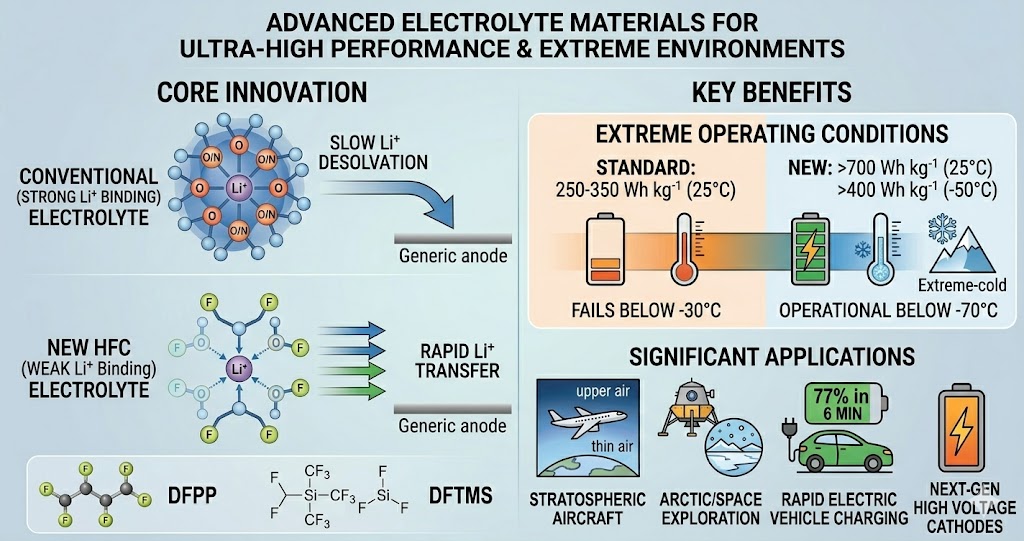
- 新希釈剤の導入: 既存の (trifluoromethyl)trimethylsilane (TFTMS) に代わり、より大きな静電ポテンシャル差(Delta ESP)を持つ (difluoromethyl)trimethylsilane (DFTMS) を採用。
- イオンクラスターの小型化: DFTMSの強い静電遮蔽効果により、電解液中のリチウムイオンクラスターを小型化し、固体電解質界面(SEI)層内での輸送をスムーズにしました。
- 電極分極の最適化: 適切な電極分極(オーバーポテンシャル)を生じさせることで、低速放電時でもリチウムの溶出箇所を均一化し、「デッドリチウム」の発生を抑制しました。
技術的な詳細と成果
1. 急速充電の実現(10Cレート)
従来の localized high-concentration electrolytes (LHCE) では、イオンクラスターが大きく、SEI層内での移動が制限されていました。DFTMSベースの電解液は小型のイオンクラスター(CIPやAGG1)を多く含み、SEI層を効率よく透過します。
- 成果: 10C(約6分で77.3%充電)という極めて高い充電レートにおいて、200サイクル後も81.3%の容量を維持。
2. 高いクーロン効率
不均一なリチウムの析出・剥離が抑えられた結果、非常に高い可逆性を実現しました。
- 成果: 12 mA cm-2 という過酷な電流密度下において、平均クーロン効率 98.12% を達成(Li||Cu非対称セル)。
3. 実用的なフルセル試験
正極にNCM811を使用し、負極リチウムの量を制限した実用的な条件下(N/P比 2.5)でも高い安定性を示しました。
- 成果: 15分での急速充電(SOC 87.0%)を含むサイクル試験で、300サイクル後に78.5%の容量を維持。
補足:なぜ「急速充電・低速放電」が難しいのか
通常、電池の研究は「低速充電・高速放電」の条件下で進められがちですが、実生活(EVなど)では「短時間で充電し、長時間かけて使う」という逆のパターンが求められます。
| 操作モード | 課題 | 本技術による解決 |
| 急速充電 | リチウムイオン供給が追いつかずデンドライトが発生 | 小型イオンクラスターによりSEI層内の輸送を高速化 |
| 低速放電 | 特定の欠陥部位から優先的にリチウムが溶出し、孤立したリチウム(デッドリチウム)が発生 | 電極分極の増大により反応サイトを活性化し、均一に溶出 |
まとめ表
| 項目 | 詳細 |
| 主要材料 | 2M LiFSI DME-DFTMS (1/2 v/v) |
| 新開発希釈剤 | (difluoromethyl)trimethylsilane (DFTMS) |
| 設計指標 | 静電ポテンシャル差 (Delta ESP) の最大化 |
| 充電性能 | 10Cレート (6分でSOC 77.3%) |
| 放電性能 | 低電流密度下での均一なリチウム剥離 |
| サイクル寿命 | フルセルにて300サイクル以上 (SOC 87%充電時) |
この研究は、電解液の分子設計において「静電ポテンシャル」が重要なパラメータであることを示しており、次世代の高エネルギー密度電池の商用化に向けた大きな一歩となります
出典:https://www.nature.com/articles/s41467-026-69870-7
Seoul National University Develops New Electrolyte Enabling Fast Charging for Lithium Metal Batteries
The primary obstacles to the commercialization of Lithium Metal Batteries (LMBs) are dendritic growth during fast charging (high-speed plating) and capacity degradation caused by non-uniform stripping during slow discharging (gradual elution).
A research team led by Professor Jang Wook Choi at Seoul National University has proposed a new electrolyte design strategy to resolve these conflicting challenges by precisely controlling the Electrostatic Potential (ESP) of the electrolyte diluent.
Key Development Points
- Introduction of a New Diluent: Replaced the conventional (trifluoromethyl)trimethylsilane (TFTMS) with (difluoromethyl)trimethylsilane (DFTMS), which possesses a larger electrostatic potential difference (Delta ESP).
- Downsizing Ion Clusters: The strong electrostatic shielding effect of DFTMS minimizes the size of lithium-ion clusters within the electrolyte, facilitating smooth transport through the Solid-Electrolyte Interphase (SEI) layer.
- Optimization of Electrode Polarization: By inducing appropriate electrode polarization (overpotential), the team achieved uniform lithium stripping sites even during slow discharging, suppressing the formation of “dead lithium.”
Technical Details and Achievements
1. Realization of Fast Charging (10C Rate)
In conventional Localized High-Concentration Electrolytes (LHCE), large ion clusters restricted movement within the SEI layer. The DFTMS-based electrolyte contains a high proportion of small ion clusters (CIP and AGG1), allowing them to permeate the SEI layer efficiently.
- Result: Maintained 81.3% capacity after 200 cycles at an extremely high charging rate of 10C (achieving 77.3% State of Charge in approximately 6 minutes).
2. High Coulombic Efficiency
The suppression of non-uniform lithium plating and stripping resulted in exceptionally high reversibility.
- Result: Achieved an average Coulombic Efficiency (CE) of 98.12% under a harsh current density of 12 mA cm-2 (in Li||Cu asymmetric cells).
3. Practical Full-Cell Testing
The technology demonstrated high stability under practical conditions using an NCM811 cathode and a limited lithium anode (N/P ratio of 2.5).
- Result: Retained 78.5% capacity after 300 cycles in tests including fast charging to 87.0% SOC within 15 minutes.
Note: Why “Fast Charging and Slow Discharging” is Difficult
Battery research is often conducted under “slow charge and fast discharge” conditions. However, real-world applications like EVs require the opposite: “charge in a short time, use over a long period.”
| Operational Mode | Challenge | Solution by This Technology |
| Fast Charging | Lithium-ion supply cannot keep up, leading to dendrites. | Small ion clusters accelerate transport within the SEI layer. |
| Slow Discharging | Lithium strips preferentially from specific defect sites, creating isolated “dead lithium.” | Increased electrode polarization activates more reaction sites for uniform stripping. |
Summary Table
| Item | Details |
| Main Material | 2M LiFSI DME-DFTMS (1/2 v/v) |
| Developed Diluent | (difluoromethyl)trimethylsilane (DFTMS) |
| Design Metric | Maximization of Electrostatic Potential Difference (Delta ESP) |
| Charging Performance | 10C Rate (SOC 77.3% in 6 minutes) |
| Discharging Performance | Uniform lithium stripping at low current densities |
| Cycle Life | Over 300 cycles in full-cells (at 87% SOC charging) |
This research demonstrates that “electrostatic potential” is a vital parameter in electrolyte molecular design, marking a significant step toward the commercialization of next-generation high-energy-density batteries.
コメント