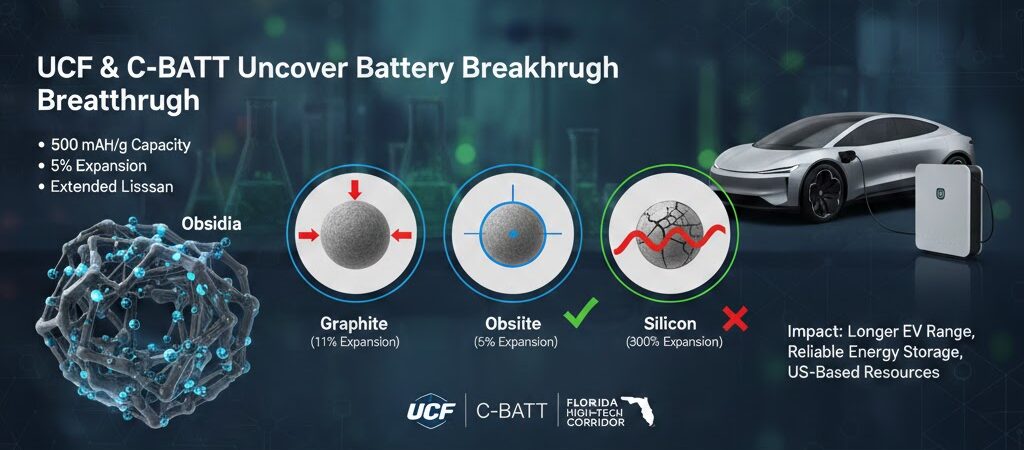
セントラルフロリダ大学(UCF)の研究チームは、ICACC 2026において、C-BATT社が開発した独自の負極材「Obsidia(オブシディア)」が、リチウムイオン電池の寿命を飛躍的に延ばす可能性があることを発表しました。
1. バッテリー故障の根本原因「膨張」への対策
リチウムイオン電池は充放電の際、イオンの出入りによって材料が物理的に膨らんだり縮んだりします。
- 課題: この体積変化(膨張)を繰り返すと、材料に亀裂が入り、最終的にバッテリーの故障を招きます。
- 現状: 現在主流のグラファイトは約11%膨張し、次世代の高容量材料であるシリコンは最大300%も膨張してしまいます。
- Obsidiaの成果: 試験の結果、Obsidiaの膨張率はわずか5%程度であることが確認されました。これはグラファイトの半分以下という驚異的な数値です。
2. Obsidiaの主要な特徴と性能
Obsidiaは、これまでのアノード設計において両立が困難だった「高容量」と「低膨張」を同時に実現しています。
- 高い貯蔵容量: 500 mAh/g 以上の容量を持ちます(一般的なグラファイトは約372 mAh/g)。
- 極めて低い膨張率: 初期のリチウム化および脱リチウム化において約5%の膨張に抑制。
- 独自性: グラファイトより高容量でありながら、グラファイトより膨張が少ない唯一のアノード材料と考えられています。
アノード材料の比較:グラファイト vs. Obsidia(オブシディア)
| 特徴 | グラファイト (一般的) | Obsidia (C-BATT) | シリコン (高容量型) |
| リチウム貯蔵容量 | 約 372 mAh/g | 500 mAh/g 以上 | 最大 約 3579 mAh/g |
| リチウム化時の膨張率 | 約 11% | 約 5% | 最大 約 300% |
| コスト | 比較的低い | 高い費用対効果 | 比較的高い |
| 寿命・信頼性 | 良好 | 大幅な向上の期待 | 膨張により限定的 |
3. 背景と戦略的意義
- 米国発の持続可能な資源: Obsidiaは、CONSOL Innovationsが提供する米国産の炭素資源を活用しています。これにより、特定の国へのサプライチェーン依存を減らす効果が期待されます。
- コスト削減: バッテリーの寿命が延び、信頼性が高まることで、消費者にとっての長期的なコスト削減につながります。
- 産学連携: この研究は、UCFの久島明宏教授のチームとC-BATT社、そしてフロリダ・ハイテク・コリドーの支援によって進められています。
関連・補足情報:なぜ「5%の膨張」が画期的なのか?
通常、リチウムをたくさん詰め込める材料(高容量材料)ほど、物理的な膨張は激しくなるのが一般的です。
- シリコンのジレンマ: シリコンはグラファイトの10倍近い容量を持ちますが、300%も膨らむため、材料が粉々に砕けやすく、寿命が短いのが難点でした。
- Obsidiaの優位性: Obsidiaは「グラファイトよりも多くリチウムを蓄えられるのに、グラファイトよりも形が変わらない」という、材料工学における理想的な特性を示しています。これにより、既存の製造ラインを大きく変えずに、電池の長寿命化と高密度化を両立できる可能性があります。
今後の展開
C-BATT社は今後、より大規模なセルでの電極膨張試験や、独立した第三者機関による検証を実施する予定です。この技術が実用化されれば、電気自動車(EV)や定置用蓄電池の信頼性が大幅に向上すると期待されています。
C-BATT’s New Material “Obsidia”: A Low-Expansion, High-Capacity Anode Beyond Graphite
A research team at the University of Central Florida (UCF) announced at ICACC 2026 that C-BATT’s proprietary negative electrode material, “Obsidia,” has the potential to dramatically extend the lifespan of lithium-ion batteries.
1. Addressing “Expansion” – A Root Cause of Battery Failure
During charge and discharge cycles, lithium-ion battery materials physically expand and contract due to the movement of ions.
- Challenge: Repeated volume changes (expansion) cause cracks in the material, ultimately leading to battery failure.
- Current Situation: Graphite, the current mainstream material, typically expands by approximately 11%. Next-generation high-capacity materials like silicon can expand by up to 300%.
- Obsidia’s Achievement: Test results confirmed that Obsidia’s expansion rate is remarkably low, at only about 5%. This is less than half that of graphite.
2. Key Features and Performance of Obsidia
Obsidia simultaneously achieves “high capacity” and “low expansion,” a combination that has been difficult to realize in previous anode designs.
- High Storage Capacity: Over 500 mAh/g (compared to approximately 372 mAh/g for typical graphite).
- Extremely Low Expansion Rate: Expansion is suppressed to about 5% during initial lithiation and delithiation.
- Uniqueness: It is believed to be the only anode material that offers higher lithium storage capacity than graphite while exhibiting less intrinsic material expansion than graphite.
3. Background and Strategic Significance
- Sustainable US Resources: Obsidia utilizes US-sourced carbon resources provided by CONSOL Innovations. This is expected to reduce supply chain dependence on specific countries.
- Cost Reduction: Extended battery lifespan and increased reliability will lead to long-term cost savings for consumers.
- Academic-Industrial Collaboration: This research is a joint effort between Professor Akihiro Kushima’s team at UCF, C-BATT, and is supported by a matching grant from Florida High Tech Corridor.
Related & Supplementary Information: Why is “5% Expansion” Groundbreaking?
Generally, materials that can store a large amount of lithium (high-capacity materials) tend to exhibit more severe physical expansion.
- Silicon’s Dilemma: Silicon offers nearly 10 times the capacity of graphite but expands by up to 300%, making the material prone to pulverization and resulting in a short lifespan.
- Obsidia’s Advantage: Obsidia demonstrates an ideal material engineering characteristic: “it can store more lithium than graphite, yet changes shape less than graphite.” This means it has the potential to achieve both longer battery life and higher energy density without requiring significant changes to existing manufacturing lines.
Future Developments
C-BATT plans to conduct electrode expansion tests in larger cells and further independent third-party verification. If this technology is commercialized, it is expected to significantly improve the reliability of electric vehicles (EVs) and stationary energy storage systems.
Anode Material Comparison: Graphite vs. Obsidia
| Feature | Graphite (Typical) | Obsidia (C-BATT) | Silicon (High Capacity) |
| Lithium Storage Capacity | ~372 mAh/g | >500 mAh/g | Up to ~3579 mAh/g |
| Expansion During Lithiation | ~11% | ~5% | Up to ~300% |
| Cost | Relatively Low | Cost-Effective | Relatively High |
| Lifespan/Reliability | Good | Significantly Improved (Expected) | Limited (due to expansion) |

コメント