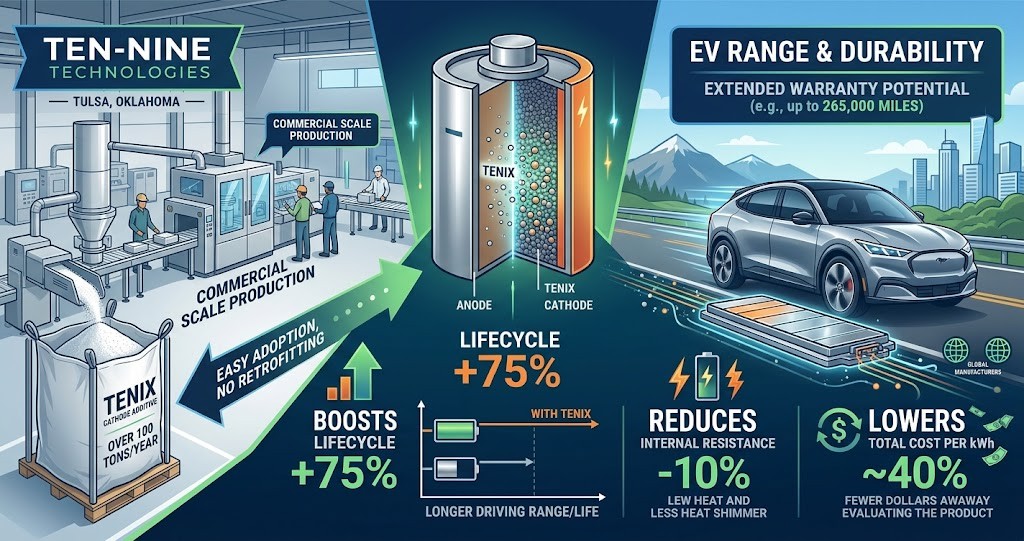
米国の先端電池材料企業Ten-Nine Technologies社が、オクラホマ州タルサの工場にて正極添加剤「Tenix」の商業規模生産(100トン規模)を開始したと発表しました。既存の製造ラインを変えずに電池の寿命延長と低コスト化を実現する新技術の要点と、背景情報をまとめています。
要約と関連解説
1. 今回の発表の要点
- 商業規模生産の開始: オクラホマ州タルサ工場でTenix正極添加剤の生産能力を100トン(EV用バッテリーパック5万〜20万台分に相当)に拡大し、2026年〜2027年納入分の受注を開始。
- 高い汎用性と導入の容易さ: 正極材重量に対して0.5%〜2%を添加・混合する仕様。電池メーカーは設備投資やセル設計の変更を行うことなく、既存の生産ラインにそのまま組み込み可能。
- 優れた「アンチエイジング」効果と性能向上:
- 第三者機関の試験において充放電サイクルが75%以上増加(EVの保証寿命を15万マイルから26.5万マイル以上へ延ばせる可能性)。
- 内部抵抗を10%低減し、生涯における累積発熱量を約40%削減。
- サイクル寿命の延長に伴い、バッテリーの全寿命期間における1 kWhあたりの供給コストを約40%削減。
- マンガンリッチ正極への注力: ニッケルやコバルトの使用量を減らせるものの劣化が早い「マンガンリッチ正極」の課題(マンガン溶出や構造劣化)を独自の表面化学技術で克服することを主目的として開発。
- 評価状況と企業の規模: 世界の電池生産量の過半数を占める大手メーカー各社で評価が進行中。同社は2014年設立で従業員約30名、累計4,500万ドルの資金調達を実施し、正極化学に関する特許67件を保有。
2. 関連情報・背景解説
正極添加剤が注目される背景
リチウムイオン電池の長寿命化・高安全化を図る際、従来は電解液への機能性添加剤(VCやFEC、PSTなど)の投入や負極側のSEI(固体電解質界面)形成技術が中心でした。しかし、高電圧動作時やマンガンリッチ系正極(LMRやLMFPなど)では、正極表面からの遷移金属(マンガン等)の溶出や構造崩壊、正極界面での電解液の酸化分解が深刻な劣化要因となります。正極材そのものの表面状態を化学的に安定化させる「正極添加剤」や「表面コーティング技術」は、次世代電池開発の最重点領域の一つです。
マンガンリッチ正極と「コバルトフリー」トレンド
バッテリー業界では、コバルトやニッケルの高騰・サプライチェーンリスクを回避するため、安価で豊富なマンガンを活用した「マンガンリッチ系正極」の開発が加速しています。一方で、マンガンが電解液中に溶出して負極皮膜を破壊する現象や、高電圧下でのガス発生が実用化の壁となっていました。Tenixのような表面安定化添加剤が確立されれば、コバルトフリー正極の商用化が一気に加速すると期待されます。
既存プロセスへのドロップイン(無改造導入)の利点
新しい電池化学を採用する場合、通常は工場設備の改修や大規模なプロセス設計の変更が必要となり、巨額の設備投資(CAPEX)と検証期間を要します。Tenixのように既存の正極合成・混合ラインに少量添加するだけで導入できる「ドロップイン技術」は、電池メーカーにとって導入ハードルが極めて低く、早期量産化を可能にする強力なアドバンテージとなります。
出典:https://www.bestmag.co.uk/ten-nine-scales-tenix-production/
US-Based Ten-Nine Technologies Launches Commercial Production of Tenix Cathode “Anti-Aging” Additive: Achieving 75% Life Cycle Improvement and 40% Heat Reduction Simultaneously
US advanced battery materials startup Ten-Nine Technologies has announced the commercial-scale production (100-ton capacity) of its Tenix cathode additive at its plant in Tulsa, Oklahoma. Below is a summary of the key technical features and background context surrounding this new technology, which extends battery lifespan and reduces costs without requiring modifications to existing manufacturing lines.
Summary and Contextual Overview
- Key Takeaways from the Announcement
- Launch of Commercial-Scale Production: Expanded Tenix cathode additive production capacity to 100 tons (sufficient to treat cathode materials for an estimated 50,000 to 200,000 EV battery packs) at its Tulsa, Oklahoma facility, accepting orders for 2026-2027 delivery.
- High Versatility and Ease of Integration: Blended into cathode materials at 0.5% to 2% by weight. Battery manufacturers can incorporate the additive directly into existing production lines without capital expenditure on new equipment or cell design changes.
- Outstanding “Anti-Aging” Effects and Performance Enhancement:
- Third-party testing confirmed an increase in charge-discharge cycle life of over 75% (potentially extending EV battery warrantied lifespan from 150,000 miles to over 265,000 miles).
- Reduced internal resistance by 10%, cutting cumulative heat generation over the battery’s lifespan by approximately 40%.
- Extended cycle life translates to an estimated 40% reduction in delivery cost per kWh over the total battery lifetime.
- Focus on Manganese-Rich Cathodes: Specifically engineered to address the rapid degradation challenges (manganese dissolution and structural instability) of manganese-rich cathodes—which reduce reliance on nickel and cobalt—through proprietary surface chemistry.
- Evaluation Status and Company Scale: Currently under evaluation by major battery manufacturers accounting for over half of global battery production. Founded in 2014, Ten-Nine has approximately 30 employees, has raised $45 million in funding, and holds 67 granted patents related to cathode chemistry.
- Related Context and Background Analysis
Growing Attention on Cathode Additives To extend the lifespan and enhance the safety of lithium-ion batteries, functional electrolyte additives (such as VC, FEC, PST) and anode-side SEI (solid electrolyte interphase) engineering have historically been the primary focus. However, under high-voltage operation or in manganese-rich cathodes (such as LMR and LMFP), transition metal (manganese) dissolution from the cathode surface, structural collapse, and oxidative electrolyte decomposition at the cathode interface serve as severe degradation mechanisms. Cathode additives and surface coating technologies that chemically stabilize the cathode surface state represent one of the most critical focus areas in next-generation battery development.
Manganese-Rich Cathodes and the “Cobalt-Free” Trend To mitigate supply chain risks and price volatility associated with cobalt and nickel, the battery industry is accelerating the development of manganese-rich cathodes that leverage abundant, low-cost manganese. However, issues such as manganese dissolution destroying the anode film and gas generation under high voltages have hindered commercialization. The establishment of surface-stabilizing additives like Tenix is expected to significantly accelerate the commercial deployment of cobalt-free cathodes.
Advantages of Drop-In Integration into Existing Processes Adopting a new battery chemistry typically requires retooling factory equipment and redesigning processes, incurring massive capital expenditures (CAPEX) and lengthy validation periods. A “drop-in technology” like Tenix, which can be introduced simply by adding small quantities into existing cathode synthesis and mixing lines, presents an exceptionally low barrier to entry for battery manufacturers, serving as a powerful advantage that enables rapid mass commercialization.


コメント