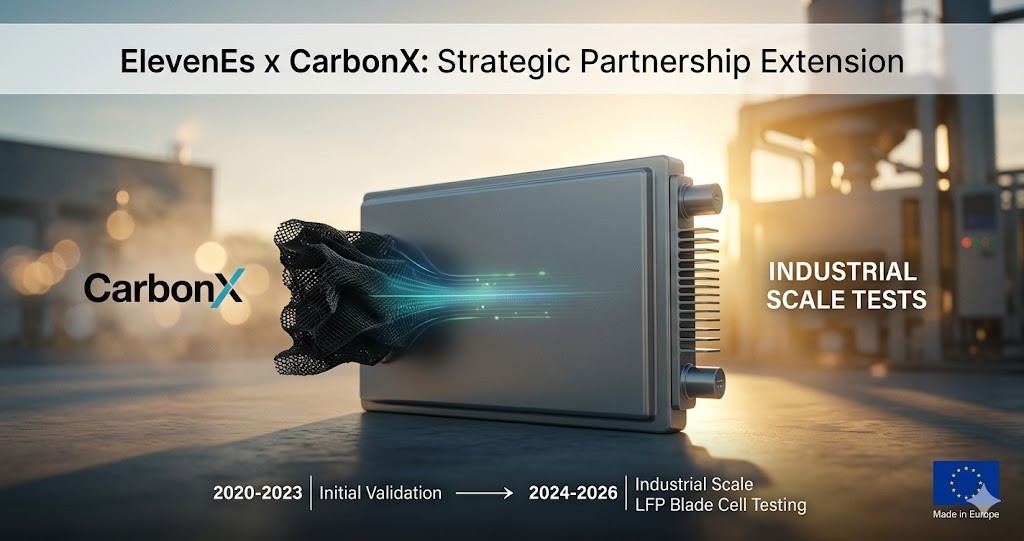
2026年5月11日、セルビアの電池メーカーElevenEsと、オランダの炭素材料企業CarbonXは、戦略的パートナーシップを2026年まで延長することを発表しました。これまでの初期検証段階を終え、実際の製造ラインに近い規模での「工業規模試験」へと移行します。
1. 提携の主要ポイント
- 実機への統合: ElevenEsの研究開発拠点「EdgeLabs」にて、CarbonX独自の炭素系負極材料を実物大の「LFPブレードセル」に組み込み、厳格なベンチマークテスト(性能、寿命、安全性の検証)を実施。
- 市場投入の加速: ElevenEsが産業プラットフォームを提供することで、CarbonXの革新的な材料を研究段階から商業生産レベルへと引き上げる「触媒」の役割を果たします。
- 将来の契約: 技術的なマイルストーンを達成した場合には、条件付きの製品引き取り(オフテイク)契約への発展を目指しています。
2. 両社の役割と強み
- ElevenEs(セルビア): 欧州唯一のLFPエッジセルメーカー。大型の角型ブレードセル技術に強みを持ち、2020年代末までに欧米で合計49GWhの生産能力確保を目指しています。
- CarbonX(オランダ): 天然・合成グラファイトを凌駕する次世代の炭素系負極活物質を開発。2014年設立以来、自動車業界向けに持続可能な材料を提供しています。
【関連情報】LFP電池と欧州サプライチェーンの背景
ニュースをより深く理解するための補足情報です。
LFP(リン酸鉄リチウム)電池の重要性
LFP電池は、日本や韓国のメーカーが主流としてきたNMC(ニッケル・マンガン・コバルト)電池と比較して、以下の特徴があります。
- 安全性と低コスト: 高価なコバルトやニッケルを使用しないため安価で、熱暴走のリスクが低いため安全性が高い。
- 長寿命: 充放電サイクルに強く、電気自動車(EV)だけでなく定置型エネルギー貯蔵システム(ESS)にも適している。 現在、テスラをはじめとする世界の自動車メーカーが、中低価格帯のEVにLFP電池の採用を急拡大させています。
負極材における「炭素」のイノベーション
電池の負極(アノード)には一般的にグラファイト(黒鉛)が使われますが、その供給の多くを中国に依存しています。CarbonXが開発するような独自の炭素材料は、以下のメリットを狙っています。
- エネルギー自立: 欧州域内で調達可能な材料を使用することで、特定の国への依存度を下げ、供給網の寸断リスクを回避する。
- 性能向上: 従来のグラファイトよりも高速充電が可能になったり、低温下での性能低下を防いだりする設計が可能。
欧州の「エネルギー自立」戦略
欧州連合(EU)は、域内のバッテリー製造能力を高めるため、巨額の補助金や規制(バッテリー規則など)を導入しています。今回のようなセルメーカー(ElevenEs)と材料メーカー(CarbonX)の協力は、欧州産の「クリーンで安全な電池」を実現するための不可欠なピースとなっています。
まとめ:今後の展望
今回の提携継続は、欧州のLFP電池が「ラボの試作品」から「世界に通用する工業製品」へと脱皮する重要なプロセスです。両社の技術が融合することで、より安価で持続可能なEVや蓄電システムの普及が期待されます。
Enhancing the Competitiveness of “European LFP”: ElevenEs and CarbonX Enter a New Phase of Energy Autonomy
On May 11, 2026, Serbian battery manufacturer ElevenEs and Dutch carbon materials company CarbonX announced the extension of their strategic partnership through 2026. Having completed the initial validation phase, the collaboration is now transitioning to “industrial-scale testing” at a level close to actual production lines.
1. Key Points of the Partnership
- Integration into Real-Scale Units: CarbonX’s proprietary carbon-based anode materials will be integrated into full-scale “LFP Blade Cells” at ElevenEs’s R&D center, “EdgeLabs.” Rigorous benchmark testing will be conducted to verify performance, cycle life, and safety.
- Accelerating Market Entry: By providing an industrial platform, ElevenEs serves as a “catalyst” to elevate CarbonX’s innovative materials from the research stage to commercial production levels.
- Future Agreements: Upon the successful achievement of technical milestones, the partnership is structured to evolve into a conditional off-take agreement.
2. Roles and Strengths of Both Companies
- ElevenEs (Serbia): The only LFP edge-cell manufacturer in Europe. Specializing in large-format prismatic blade cell technology, the company aims to secure a total production capacity of 49GWh across Europe and the US by the end of the 2020s.
- CarbonX (Netherlands): Developer of next-generation carbon-based anode active materials designed to outperform conventional natural and synthetic graphite. Founded in 2014, it has been supplying sustainable materials to the automotive industry.
[Related Information] LFP Batteries and the Context of the European Supply Chain
Supplementary information to provide a deeper understanding of this news.
The Importance of LFP (Lithium Iron Phosphate) Batteries
Compared to NMC (Nickel Manganese Cobalt) batteries, which have been the mainstay for Japanese and South Korean manufacturers, LFP batteries offer the following:
- Safety and Low Cost: They are more affordable because they do not use expensive cobalt or nickel, and they offer higher safety due to a lower risk of thermal runaway.
- Long Cycle Life: Highly durable during charge/discharge cycles, they are ideal not only for electric vehicles (EVs) but also for stationary energy storage systems (ESS). Global automakers, including Tesla, are rapidly expanding the use of LFP batteries for mid-to-low-priced EV models.
Innovation in “Carbon” for Anode Materials
While graphite is generally used for battery anodes, its supply is heavily dependent on China. Proprietary carbon materials, such as those developed by CarbonX, aim for the following benefits:
- Energy Autonomy: By using materials that can be sourced within Europe, companies can reduce dependence on specific countries and mitigate the risk of supply chain disruptions.
- Performance Enhancement: These materials can be engineered to enable faster charging or prevent performance degradation in low-temperature environments compared to traditional graphite.
Europe’s “Energy Autonomy” Strategy
The European Union (EU) has introduced massive subsidies and regulations (such as the EU Battery Regulation) to boost regional battery manufacturing capacity. Collaborations between cell manufacturers (ElevenEs) and material innovators (CarbonX) are essential pieces for realizing “clean and safe batteries” made in Europe.
Summary: Future Outlook
The continuation of this partnership marks a critical process in which European LFP batteries evolve from “laboratory prototypes” into “world-class industrial products.” By merging the expertise of both companies, the industry anticipates the broader adoption of more affordable and sustainable EVs and energy storage systems.


コメント