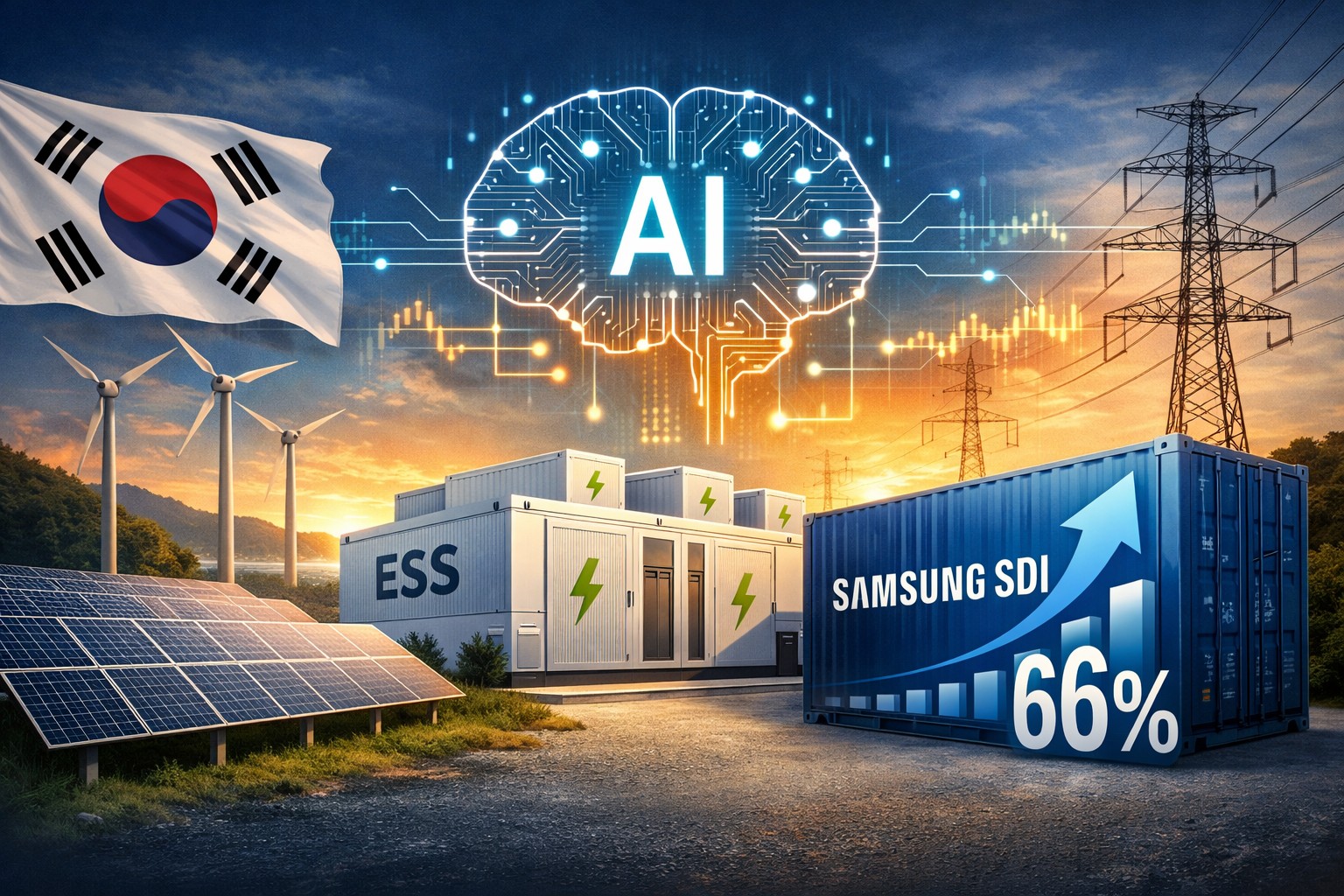
韓国政府が主導する初の「AIベース配電網エネルギー貯蔵装置(ESS)構築事業」において、国内バッテリー大手の明暗と戦略の違いが浮き彫りになりました。本稿では、Samsung SDIが圧倒的なシェアを獲得した背景や各社の戦略をまとめるとともに、電力網の現状や次世代市場を見据えた全固体電池の動向などの関連情報を交えて解説します。
- 1. 「AI活用ESS構築支援事業」の背景と概要
- 2. 韓国バッテリー3社の実績と差別化戦略
- 3. 次世代「全固体電池」の商用化競争と市場展望
- 1. Background and Overview of the “AI-Utilizing ESS Construction Support Project”
- 2. Track Records and Differentiation Strategies of South Korea’s Big Three Battery Makers
- 3. Commercialization Race and Market Outlook for Next-Generation “Solid-State Batteries”
1. 「AI活用ESS構築支援事業」の背景と概要
- 事業の目的: 再生可能エネルギー(太陽光発電など)が集中する韓国の湖南地方や済州島では、発電量が地域の需要や送電容量を上回り、電力網が耐えきれなくなる「電力網飽和(系統接続の制限や出力制御)」が深刻な課題となっています。本事業は、配電線路付近にESSを設置し、AIで充放電を自動制御することで系統の効率を高めることを目指しています。
- 関連情報(追加背景): 太陽光や風力などの再生可能エネルギーは天候による出力変動が大きく、電気が余ると停電のリスク(周波数の乱れ)が生じるため、これまでは発電を強制的に止める「出力制御」が行われていました。AIを活用してリアルタイムで需要と供給を予測し、ESSで精密に充放電をコントロールする試みは、クリーンエネルギーの無駄を減らし、莫大な費用がかかる送電線の増設を抑える画期的な解決策として世界的に注目されています。
- 事業規模: 2026年から5年間で国費5586億ウォン(約600億円)を投入。第1次事業では32の配電線路に計128MW規模のESSを構築し、約182.4MW規模の太陽光発電設備を新たに接続可能にします。
2. 韓国バッテリー3社の実績と差別化戦略
今回の第1次事業では、三者三様の戦略が展開されました。これは9月に予定されている「第3次ESS中央契約市場入札」の前哨戦とも目されています。
Samsung SDI(シェア66%で圧倒的首位)
- 実績: 最終選定された9つの事業者コンソーシアムのうち6社に、自社のESS統合ソリューション「SBB 1.5」を供給。全体の66%にあたる21カ所(電力容量84MW、貯蔵容量420MWh)を確保しました。
- 強み: 20フィートコンテナにニッケル・コバルト・アルミニウム(NCA)角形バッテリーや安全装置を一体化した製品で、設置後すぐに稼働できる点が特徴です。過去の政府入札での実績に加え、火災に対する安全性とメンテナンスの容易さが評価されました。
LG Energy Solution(シェア22%・サービスへの進出)
- 実績: 7配電線路(28MW、140MWh)を確保。
- 強み: 単なるバッテリーの供給にとどまらず、仮想発電所(VPP)の運営事業者として直接参加する差別化戦略をとりました。将来的にESS市場が「ハードウェアの納品」から「電力網の運営・再生可能エネルギーの制御」というソフト面へシフトすることを見据え、長期的な主導権を握る狙いがあります。
SK On(シェア12%・需要先の多角化)
- 実績: 4配電線路に供給。
- 強み: これまでの電気自動車(EV)向け中心の事業構造から、ESS分野への多角化を進めています。今回はリン酸鉄リチウム(LFP)パウチセルベースのESS製品「GRIDON」を供給し、電力網向けの実績作りに成功しました。
3. 次世代「全固体電池」の商用化競争と市場展望
ESS市場での激突と並行して、3社は次世代のゲームチェンジャーと呼ばれる「全固体電池」の開発でも火花を散らしています。
各社の開発ロードマップ
- Samsung SDI: 来年(2027年)の量産を目標に、ヒューマノイドやEV向けにサンプル評価を実施中。銀と炭素の特殊コーティングを施した無負極技術により、エネルギー密度の極大化と長寿命化を両立しています。
- LG Energy Solution: 2029年までに電気自動車用(黒鉛系)、2030年までに次世代機器用(無負極系)の商用化を目指します。乾式工法によるコスト削減を追求しており、全固体電池の特許出願数は世界2位(1位は日本のトヨタ)を誇ります。
- SK On: 2029年の商用化を目標に、イオン伝導性に優れた硫化物系に集中。米国のSolid Powerへの投資や設備検証を通じて開発を加速させています。
市場見通しと関連情報(追加背景)
- 市場の急成長: 世界の全固体電池市場は2026年の23億ドル(約3700億円)から2033年には157億ドル(約2.5兆円)へ、年平均31.8%で成長すると予測されています。
- 関連情報(中国勢との対抗): 現在、世界の車載・ESS向けリチウムイオン電池市場は、安価なLFP(リン酸鉄リチウム)電池を大量生産する中国勢(CATLやBYDなど)が圧倒的なシェアを握っています。韓国勢としては、液体電解質を使わず安全性が極めて高い「全固体電池」を中国より一歩早く商用化することで、技術的な優位性を確立し、プレミアム市場を先取りしたいという強い思惑があります。
- 今後の課題: 中国CATLの会長が「技術的限界とコストから2030年以前の商用化は難しい」と指摘するように、初期の全固体電池の生産単価は既存バッテリーの約5倍に達すると試算されています。先行して商用化に成功したとしても、素材・セル・システム全般にわたるサプライチェーンの協力を通じて、いかに早く量産化し、コストを下げられるかが大衆化(普及)の絶対条件となります。
出典:https://finance.biggo.jp/news/b279200f-cb78-4e77-b528-54b6c34d1cfc
South Korea’s First AI-Based Distribution Grid ESS Project Launches: Samsung SDI Dominates with 66% of Orders
South Korea’s first government-led “AI-Based Distribution Grid Energy Storage System (ESS) Construction Project” has clearly highlighted the differing fortunes and strategies of the nation’s major battery manufacturers. This article outlines the factors behind Samsung SDI’s overwhelming market share and details the strategies of each company. It also provides context regarding the current state of the power grid and the latest trends in solid-state batteries aimed at the next-generation market.
1. Background and Overview of the “AI-Utilizing ESS Construction Support Project”
- Project Objective: In regions like Honam and Jeju Island, where renewable energy sources like solar power are highly concentrated, “grid saturation” (restrictions on grid connection and output curtailment) has become a severe issue because power generation frequently exceeds local demand and transmission capacity. This project aims to install ESS units near distribution lines and automatically control charging and discharging using AI to improve overall grid efficiency.
- Related Information (Additional Context): Renewable energy sources, such as solar and wind, suffer from high output volatility due to weather conditions. When excess electricity is generated, it poses a blackout risk by disrupting grid frequency, which has historically forced operators to implement “output curtailment” (intentionally shutting down generation). Utilizing AI to predict supply and demand in real time and precisely control ESS charging and discharging is drawing global attention as a breakthrough solution that minimizes clean energy waste and avoids the massive costs of expanding transmission lines.
- Project Scale: The South Korean government will invest 558.6 billion won (approximately 60 billion yen) of state funds over five years starting in 2026. In the first phase of the project, a total of 128 MW of ESS capacity will be built across 32 distribution lines, enabling approximately 182.4 MW of new solar power infrastructure to connect to the grid.
2. Track Records and Differentiation Strategies of South Korea’s Big Three Battery Makers
The first phase of this project saw three distinct strategies unfold, serving as a prelude to the “3rd ESS Central Contract Market Tender” scheduled for September.
Samsung SDI (The Overwhelming Leader with a 66% Share)
- Track Record: The company will supply its integrated ESS solution, “SBB (Samsung Battery Box) 1.5,” to 6 out of the 9 final selected business consortia. It secured 21 locations—equivalent to 66% of the total—representing a power capacity of 84 MW and a storage capacity of 420 MWh.
- Strengths: SBB 1.5 integrates nickel-cobalt-aluminum (NCA) prismatic battery cells, modules, racks, and safety devices into a 20-foot container, allowing it to operate immediately upon grid connection. Its track record in previous government tenders, combined with high marks for fire safety and ease of maintenance, drove this success.
LG Energy Solution (A 22% Share and Move into Energy Services)
- Track Record: Secured 7 distribution lines (28 MW, 140 MWh).
- Strengths: Moving beyond simple hardware supply, LG engaged in a differentiation strategy by directly participating as a Virtual Power Plant (VPP) operator. Anticipating that the ESS market will shift from “hardware delivery” to “grid management and renewable energy control,” the company aims to secure long-term market leadership in software and services.
SK On (A 12% Share and Diversifying Demand)
- Track Record: Supplying 4 distribution lines.
- Strengths: SK On is actively diversifying its business model, moving away from its heavy reliance on electric vehicle (EV) batteries into the ESS sector. For this project, it will supply “GRIDON,” an ESS product based on lithium iron phosphate (LFP) pouch cells, successfully building its track record in grid-scale ESS.
3. Commercialization Race and Market Outlook for Next-Generation “Solid-State Batteries”
Parallel to the clash in the ESS market, the three companies are also competing fiercely in the development of solid-state batteries, often called the next-generation “game changer.”
Development Roadmaps by Company
- Samsung SDI: Aiming for mass production next year (2027), the company is currently conducting sample evaluations for humanoids and EVs. Its anode-less technology, featuring a special silver-carbon coating, maximizes energy density while extending battery lifespan.
- LG Energy Solution: Targets the commercialization of graphite-based solid-state batteries for EVs by 2029, and anode-less solid-state batteries for next-generation applications by 2030. The company is pursuing cost reductions via a dry-coating process and holds the world’s second-highest number of solid-state battery patent applications (with Japan’s Toyota holding the top spot).
- SK On: Targeting commercialization by 2029, SK On is focusing on sulfide-based solid-state batteries, which offer excellent malleability and high ionic conductivity. It completed equipment validation with its key US partner, Solid Power, following the completion of a pilot production line at its Daejeon facility.
Market Outlook and Related Information (Additional Context)
- Rapid Market Growth: According to market research, the global solid-state battery market is projected to grow from 2.3 billion dollars (about 370 billion yen) in 2026 to 15.7 billion dollars (about 2.5 trillion yen) by 2033, expanding at a compound annual growth rate (CAGR) of 31.8%.
- Related Information (Competing with Chinese Rivals): Currently, Chinese manufacturers (such as CATL and BYD) dominate the global EV and ESS lithium-ion battery markets by mass-producing low-cost LFP batteries. South Korean companies strongly intend to establish a technical edge and capture the premium market by commercializing highly safe, liquid-free solid-state batteries ahead of China.
- Future Challenges: As CATL’s chairman recently noted that commercialization before 2030 is difficult due to technical limits and high manufacturing costs, initial solid-state battery production costs are estimated to be roughly five times higher than existing batteries. Even if South Korean firms achieve early commercialization, scaling production and reducing costs through organic supply-chain cooperation across materials, cells, and systems remains the ultimate prerequisite for widespread adoption.
コメント