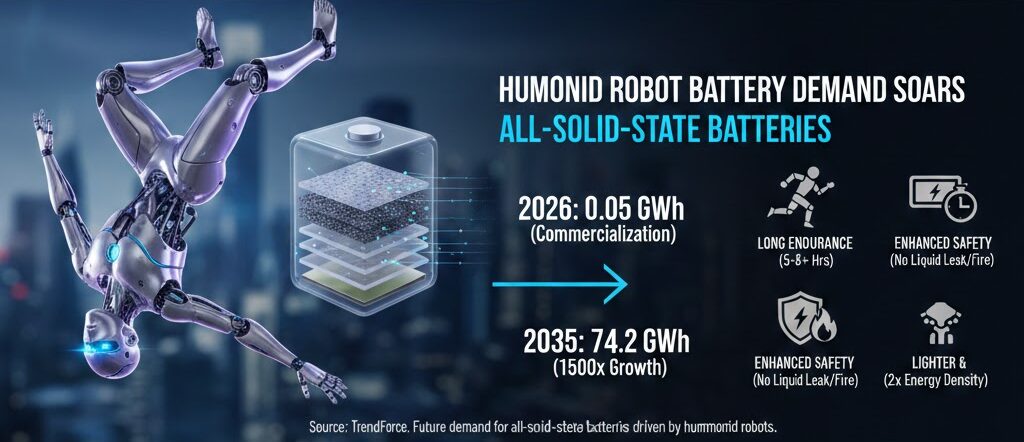
TrendForceの発表によると、ヒューマノイドロボット向け全固体電池の需要は、今後10年間で急拡大する見通しです。2035年には需要が74.2GWhに達すると予測されており、これは商業化の転換点となる2026年(0.05GWh予想)と比較して、実に約1500倍という驚異的な成長を意味します。
1. ニュースのハイライト
- 成長の背景: ヒューマノイドロボットが普及するにつれ、現在の「2〜4時間」という短い稼働時間が最大のボトルネックとなっています。この課題を解決するため、エネルギー密度が極めて高い固体リチウム電池が主流になると見られています。
- 2026年が「商業化元年」: TrendForceは2026年に世界のヒューマノイドロボット出荷台数が5万台を超え、前年比700%以上の成長を記録すると予測しています。
- 技術の棲み分け:
- 高ニッケル三元系(NMC/NCA): 高いエネルギー密度が必要な高性能ロボットに採用。
- リン酸鉄リチウム(LFP): コスト重視の会話型・サービス用ロボットに採用。
- 全固体電池: 5〜8時間以上の連続駆動や、高負荷な動作が必要な次世代機の本命。
2. 主要ロボットのバッテリースペック比較
現在の主流モデルは、まだ液体電解質のリチウム電池が中心です。
| ロボット名 | バッテリー容量 | 稼働時間(目安) | 備考 |
| Unitree H1 | 0.864kWh | 約4時間未満(静止時) | 液体リチウム電池 |
| Tesla Optimus Gen2 | 2.3kWh | 約2時間 | 高ニッケル三元系 |
| Xpeng Iron | (固体電池採用) | 4時間以上 | 固体電池による軽量・長寿命化 |
【関連知識:なぜヒューマノイドに「全固体電池」なのか?】
ヒューマノイドロボットにおいて、全固体電池が理想とされる理由は、単なる「容量」だけではありません。
- 「バク転」にも耐える高出力: ロボットが複雑な動作(ジャンプやバックステップなど)を行う際、瞬間的に通常の電池の100倍以上の電流を放電する必要があります。固体電池はこの「高出力放電」に強い特性を持っています。
- 人と共存するための安全性: 液体電解質を使用しないため、転倒や衝突による破損時でも液漏れや発火(熱暴走)のリスクが極めて低く、家庭やオフィスでの利用に不可欠です。
- 軽量化(エネルギー密度の向上): ロボットにとって「重さ」はエネルギー消費を早める敵です。固体電池(特にリチウム金属負極を採用したもの)は、同じ重さでリチウムイオン電池の約2倍近いエネルギーを蓄えられるため、機体の軽量化に直結します。
出典:https://cnevpost.com/2026/01/28/demand-for-solid-state-batteries-humanoid-robots-74-gwh-2035/
2035 Forecast: Solid-State Battery Demand for Humanoid Robots to Reach 74GWh, Representing 1,500x Explosive Growth in a Decade
According to a report from TrendForce, demand for solid-state batteries in humanoid robots is expected to expand rapidly over the next ten years. Demand is projected to reach 74.2GWh by 2035, which represents a staggering growth of approximately 1,500 times compared to 2026 (projected at 0.05GWh), the year considered the tipping point for commercialization.
1. News Highlights
- Background of Growth: As humanoid robots become more common, their current short operating time of 2 to 4 hours has become the biggest bottleneck. To solve this, high-energy-density solid-state lithium batteries are expected to become the mainstream solution.
- 2026 as “Year One” for Commercialization: TrendForce predicts that global shipments of humanoid robots will exceed 50,000 units in 2026, recording a year-on-year growth rate of over 700%.
- Technological Segmentation:
- High-Nickel Ternary (NMC/NCA): Adopted for high-performance robots requiring high energy density.
- Lithium Iron Phosphate (LFP): Used primarily in cost-sensitive conversational or service robots.
- Solid-State Batteries: The definitive choice for next-generation machines requiring over 5 to 8 hours of continuous operation or high-load movements.
2. Battery Specifications Comparison of Major Robots
Current mainstream models still primarily utilize lithium batteries with liquid electrolytes.
| Robot Name | Battery Capacity | Operating Time (Est.) | Notes |
| Unitree H1 | 0.864kWh | Under 4 hours (static) | Liquid lithium battery |
| Tesla Optimus Gen2 | 2.3kWh | Approx. 2 hours | High-nickel ternary system |
| Xpeng Iron | (Uses Solid-State) | Over 4 hours | Lightweight/Long-life via solid-state |
Related Knowledge: Why Solid-State Batteries for Humanoids?
The reason solid-state batteries are considered ideal for humanoid robots goes beyond mere “capacity.”
- High Power for “Backflips”: When a robot performs complex maneuvers (such as jumping or back-stepping), it needs to discharge currents up to 100 times higher than usual instantaneously. Solid-state batteries are highly resistant to the stress of such “high-power discharge.”
- Safety for Coexistence with Humans: Because they do not use liquid electrolytes, the risk of leakage or fire (thermal runaway) is extremely low even if the battery is damaged during a fall or collision. This is essential for use in homes and offices.
- Lightweighting (Increased Energy Density): For a robot, “weight” is the enemy of energy efficiency. Solid-state batteries (especially those using lithium metal anodes) can store nearly twice as much energy as lithium-ion batteries of the same weight, leading directly to lighter robot frames.
With 2026 shaping up to be a massive year for both NEO’s silicon batteries and the commercial launch of humanoid robots, we are seeing a perfect convergence of hardware and energy.
コメント