1. はじめに
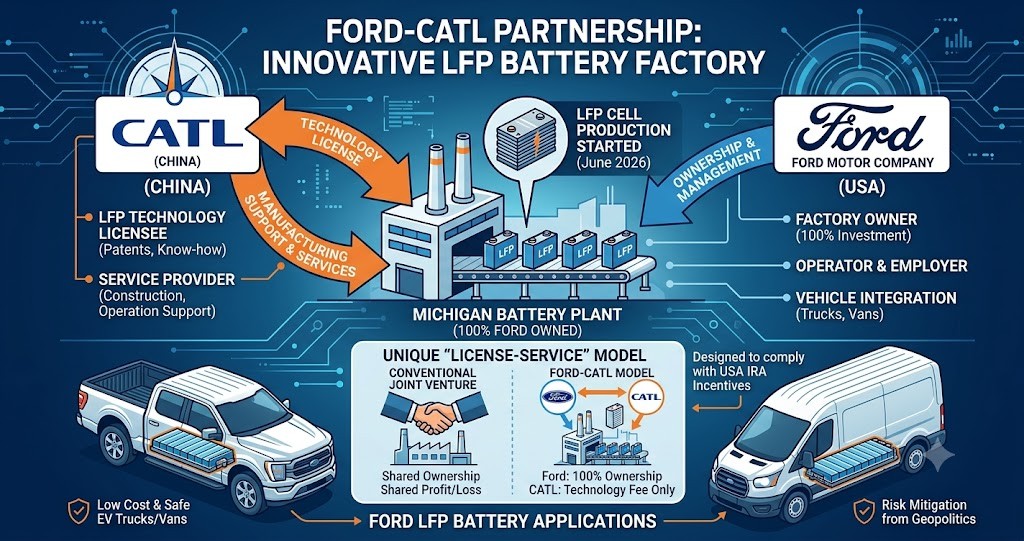
世界の自動車産業が電動化(EVシフト)を進める中、車載用バッテリーの確保とコスト削減は自動車メーカーにとって最優先の課題となっています。こうした中、米国の自動車大手フォード・モーターと、車載用バッテリー世界最大手である中国の寧徳時代新能源科技(CATL)が連携して進めていた米ミシガン州のバッテリー工場が、2026年6月に完成し、本格的な生産・プロセス試験を開始しました。
本プロジェクトは、米中間の政治的緊張や米国の補助金政策(インフレ抑制法:IRA)による制約をクリアするため、従来の「合弁会社(ジョイントベンチャー)」ではなく、技術を供与する「ライセンスモデル」という極めてユニークな形態をとっています。本サマリーでは、このニュースの概要と、背景にある関連情報をまとめて解説します。
2. ニュースの主要なポイント(まとめ)
- 生産開始と進捗: 2026年6月中旬、工場にて最初の角型LFP(リン酸鉄リチウム)セルの本格的なプロセス試験が完了しました。現在、CATLの仕様に基づいた検証が進められており、2026年後半には最初の車載用バッテリーが納入され、フォードの低価格帯および中型の電気ピックアップトラックへ搭載される予定です。
- 独自の「ライセンス・サービス」モデル: この工場はフォードが100パーセント所有します。CATLは資金出資を行う合弁相手ではなく、LFP電池の技術ライセンス(特許・製造技術)を供与し、工場の建設や操業をサポートするサービスプロバイダーとして関わっています。
- 計画の変遷(政治的圧力による縮小): 2023年2月の当初計画では、35億ドルの投資と年間35ギガワット時(EV約40万台分)の生産能力を予定していました。しかし、中国企業との連携に対する米国内の政治的批判が高まり、プロジェクトは一時中断を余儀なくされました。2023年11月に再開された際は、投資額を20億ドル、生産能力を20ギガワット時に縮小しています。
- 用途の拡大(エネルギー貯蔵への展開): 生産能力は縮小したものの、中核となる技術協力関係は維持されています。さらに、生産される容量の一部はEV用だけでなく「エネルギー貯蔵製品(定置型蓄電システム)」にも割り当てられる計画で、フォードは既存工場の転換も視野に入れています。
3. 関連情報・背景の補足解説
プロジェクトの意義を理解するために、技術的・政治的な背景を解説します。
LFP(リン酸鉄リチウム)バッテリーの特徴と重要性
- プレーンテキスト解説: 化学式は LiFePO4。
- メリット: 現在主流の三元系(ニッケル、マンガン、コバルトを使用するNMCなど)に比べ、高価なコバルトやニッケルを使用しないため「製造コストが劇的に安い」という最大のメリットがあります。また、熱安定性が非常に高く、発火リスクが極めて低い(安全性が高い)、長寿命であるという特徴もあります。
- デメリット: 三元系に比べて「エネルギー密度が低い(同じ重さ・体積で蓄えられる電気の量が少ない)」ため、一回の充電での航続距離が短くなりやすいという弱点があります。
- 採用の背景: フォードがこの技術を導入する理由は、大衆向けの「低価格EV」や、商用・普及型の電気ピックアップトラックを市場に投入し、テスラや中国製低価格EVに対抗するためです。
なぜ合弁ではなく「ライセンスモデル」なのか?
米国では2022年に成立したインフレ抑制法(IRA)により、EV購入時に最大7500ドルの税額控除(補助金)が受けられます。しかし、補助金を受け取るためには、バッテリーの材料や部品が「懸念される外国の事業体(FEOC:主に中国企業など)」から調達されたものであってはならないという厳格なルールがあります。 もしフォードとCATLが一般的な合弁会社を作ってしまうと、中国企業が関与しているとみなされ、そのバッテリーを積んだEVは補助金の対象外になる恐れがありました。 そこで「工場は100パーセント米国企業(フォード)が所有し、中国企業(CATL)からは技術だけをお金(ライセンス料)を払って買う」という形式にすることで、米国の法規制を回避しつつ、世界最高峰の中国のバッテリー技術を取り入れる道を選んだのです。
定置型蓄電システム(エネルギー貯蔵)への転換の意味
EV市場の成長が世界的に一時的な減速(クアドラティック・プラトー、いわゆるEVキャズム)を迎える中、バッテリーの需要先として「太陽光や風力発電の電力を蓄える大型蓄電システム(ESS)」の市場が急成長しています。LFPバッテリーは、重量があまり問題にならない定置型蓄電システムと非常に相性が良いため、フォードが生産容量の一部をエネルギー貯蔵に回すのは、EV市場の変動に対する賢明なリスク分散と言えます。
4. 結論
フォードとCATLのミシガン工場稼働は、米中対立という地政学的な逆風の中でも、自動車の電動化とコスト削減を進めるためには中国のバッテリー技術が不可欠であるという現実を示しています。この「技術ライセンスモデル」が成功すれば、補助金規制に悩む他の自動車メーカーにとっても、今後の新しい国際協調のビジネスモデルとなる可能性があります。
出典:https://battery-news.de/en/2026/07/01/ford-catl-battery-project-in-michigan-begins-production/
Ford and CATL Launch Production at Michigan LFP Battery Plant: A New Attempt at US-China Cooperation
1. Introduction
As the global automotive industry advances its transition toward electric vehicles (EV shift), securing vehicle batteries and reducing costs have become top priorities for automakers. Under these circumstances, the battery factory in Michigan, US—a collaborative effort between US automotive giant Ford Motor and the world’s largest vehicle battery manufacturer, China’s Contemporary Amperex Technology Co., Limited (CATL)—was completed in June 2026 and has commenced full-scale production and process testing.
To bypass constraints stemming from geopolitical tensions between the US and China, as well as US subsidy policies under the Inflation Reduction Act (IRA), this project adopts a highly unique “licensing model” to provide technology rather than a traditional joint venture. This summary outlines the news and explains the relevant background information.
2. Key Points of the News (Summary)
- Production Launch and Progress: In mid-June 2026, the factory completed full-scale process testing for its first prismatic LFP (lithium iron phosphate) cells. Verification based on CATL specifications is currently underway, and the first automotive batteries are scheduled for delivery in late 2026, intended for installation in Ford’s affordable and mid-sized electric pickup truck models.
- Unique “Licensing and Service” Model: This factory is 100 percent owned by Ford. CATL is not a joint venture partner providing equity investment; instead, it is involved as a service provider that licenses LFP battery technology (patents and manufacturing techniques) and supports factory construction and operations.
- Evolution of the Plan (Downsizing due to Political Pressure): The initial plan in February 2023 anticipated an investment of 3.5 billion dollars and an annual production capacity of 35 gigawatt-hours, enough to produce batteries for approximately 400,000 electric vehicles. However, rising political criticism within the US regarding collaboration with a Chinese company forced a temporary suspension of the project. When restarted in November 2023, the investment was scaled down to 2 billion dollars and the production capacity to 20 gigawatt-hours.
- Expansion of Applications (Deployment into Energy Storage): Although the production capacity was reduced, the core technical cooperation remains unchanged. Furthermore, a portion of the generated capacity is planned to be allocated to “energy storage products (stationary storage systems)” rather than being exclusively for EVs, and Ford is also considering converting existing factories for this purpose.
3. Related Information and Supplementary Background Explanation
To better understand the significance of this project, this section explains the technical and political background.
Characteristics and Importance of LFP (Lithium Iron Phosphate) Batteries
- Plain-Text Explanation: The chemical formula is LiFePO4.
- Advantages: Compared to currently mainstream ternary systems (such as NMC, which uses nickel, manganese, and cobalt), its greatest advantage is that manufacturing costs are dramatically lower because it does not use expensive cobalt or nickel. It also features exceptionally high thermal stability, extremely low ignition risk (high safety), and a long lifespan.
- Disadvantages: Its weakness is that its energy density is lower compared to ternary systems (meaning it stores less electricity for the same weight and volume), making it prone to shorter driving ranges per single charge.
- Background of Adoption: Ford is introducing this technology to launch affordable mass-market EVs and popular commercial electric pickup trucks to compete against Tesla and low-cost Chinese EVs.
Why a “Licensing Model” Instead of a Joint Venture?
Under the Inflation Reduction Act (IRA) enacted in the US in 2022, consumers can receive a tax credit (subsidy) of up to 7500 dollars when purchasing an EV. However, to qualify for the subsidy, strict rules dictate that battery materials and components must not be procured from a “Foreign Entity of Concern (FEOC),” which primarily targets Chinese companies.
If Ford and CATL had formed a standard joint venture, a Chinese company would be deemed involved, risking disqualification of EVs equipped with those batteries from receiving subsidies. Therefore, they chose a framework where the factory is 100 percent owned by a US company (Ford) and technology is bought from a Chinese company (CATL) by paying licensing fees. This allows them to bypass US legal regulations while adopting world-class Chinese battery technology.
Significance of shifting to Stationary Storage Systems (Energy Storage)
As global EV market growth experiences a temporary slowdown (a quadratic plateau, often called the EV chasm), the market for “large-scale energy storage systems (ESS)” to store solar and wind power is rapidly expanding. LFP batteries are highly compatible with stationary storage systems where weight is not a primary concern. For Ford, reallocating a portion of its production capacity to energy storage is a prudent strategy to diversify risks against EV market fluctuations.
4. Conclusion
The launch of Ford and CATL’s Michigan plant demonstrates that even amidst geopolitical headwinds like the US-China rivalry, Chinese battery technology remains indispensable for advancing vehicle electrification and cost reductions. If this “technology licensing model” proves successful, it could serve as a new international business model for other automakers navigating subsidy regulations in the future.
コメント