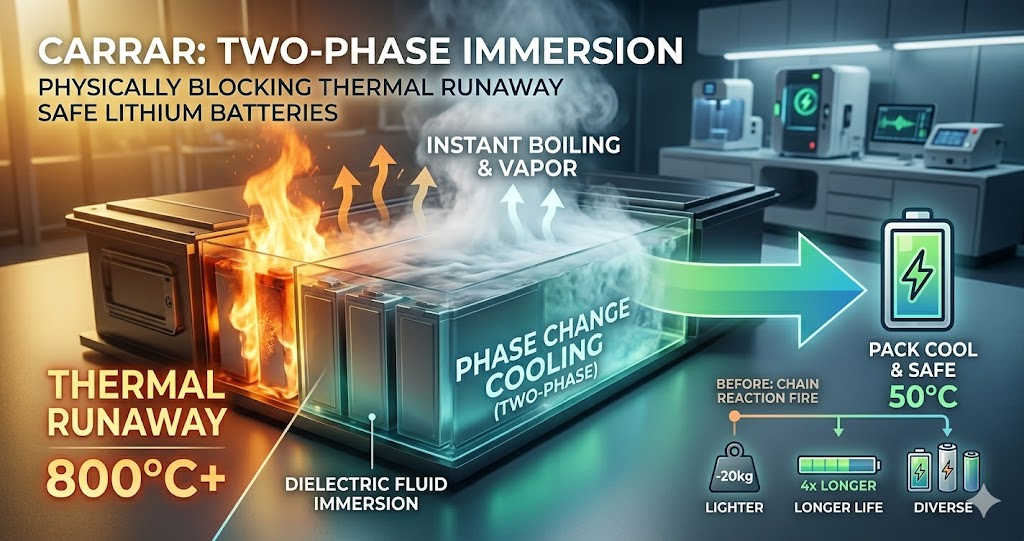
イスラエルのスタートアップ企業CARRAR社は、バッテリーセルの故障時に発生する熱暴走が隣接するセルへ広がるのを物理的に防ぐ「二相浸漬アーキテクチャ」を発表しました。
1. 革新的な冷却メカニズム:相変化冷却
- 物理的原理: バッテリーセルを特殊な「誘電性流体(電気を通さない液体)」に浸漬します。
- 熱吸収の仕組み: セルが異常発熱すると、接触している液体が即座に沸騰・蒸発します。この時の「蒸発潜熱」を利用して、膨大な熱エネルギーを瞬間的に吸収します。
- 驚異的な温度制御: 故障したセルが800度Cを超えた場合でも、隣接するセルを50度C前後に保つことに成功しました。これにより、連鎖的な発火(熱伝播)を完全に食い止めます。
2. システムのメリット:軽量化と長寿命化
- 軽量化: 従来の消火装置や重い断熱材(マイカシートなど)が不要になるため、100kWhのバッテリーパックあたり約20kgの軽量化が可能です。
- 長寿命化: パック内の温度を均一に保ち、熱ストレスによる劣化の偏りを防ぐことで、バッテリー寿命を最大で4倍に延ばせると謳っています。
- 柔軟性: NMC(ニッケル・マンガン・コバルト)やLFP(リン酸鉄リチウム)など、セルの化学組成や形状を問わず適用可能です。
3. 今後の展望と課題
- 規制対応: 2025年施行予定の中国GB 38031-2025やUL9540Aなど、極めて厳しい国際的な安全基準を上回る性能を目指しています。
- 商用化: 2026年末までに定置用蓄電池(BESS)向けの商用化を予定しており、製造・サプライチェーンの構築においてシステムインテグレーターとの提携を推進しています。
関連情報:背景と技術のポイント
熱暴走(Thermal Runaway)とは
リチウムイオン電池が過充電や内部短絡などによって制御不能な高温状態に陥る現象です。一つのセルが発火すると、その熱が隣のセルを加熱し、次々と連鎖反応を起こすことがEV火災の主な原因となっています。
「二相」と「浸漬」の意味
- 浸漬(Immersion): セルを冷却液に直接ドボンと浸す方式。従来の「冷却プレート(コールドプレート)」を介した間接冷却よりも効率が圧倒的に高いのが特徴です。
- 二相(Two-phase): 液体が気体に変わる(相変化)サイクルを利用すること。液体が蒸発する際に奪う熱量は、単に液体の温度が上がる(顕熱)際に奪う熱量よりも桁違いに大きいため、極限状態での冷却に優れています。
国際規格の動向(GB 38031-2025など)
中国の新しい国家規格「GB 38031-2025」では、単一セルの熱暴走が発生しても、乗員が脱出するための時間を稼ぐため、あるいは隣接セルへの伝播を防ぐための極めて高い安全性が要求されています。CARRARの技術は、この規制をクリアし、グローバル市場で戦う自動車メーカー(OEM)にとって強力な武器になると期待されています。
固体電池(Solid-State Battery)との関係
現在、火災リスクを抑える次世代技術として「固体電池」が注目されていますが、CARRARの技術は既存の「液系」リチウムイオン電池の安全性を飛躍的に高めるものです。固体電池の実用化にはまだ時間がかかるため、現行電池の安全性を構造的に解決するこのアプローチは非常に現実的なソリューションと言えます。
この技術は、電気自動車(EV)だけでなく、データセンターや家庭用の大型蓄電池(BESS)の安全性を根底から変える可能性を秘めています。
Preventing Heat Spread: CARRAR’s Two-Phase Immersion Technology Redefines Battery Safety Standards
CARRAR, an Israeli startup, has unveiled its “Two-Phase Immersion Architecture,” which physically prevents thermal runaway from spreading to adjacent battery cells during a cell failure.
1. Innovative Cooling Mechanism: Phase-Change Cooling
- Physical Principle: Battery cells are submerged in a specialized “dielectric fluid” (a non-conductive liquid).
- Heat Absorption Mechanism: When a cell overheats abnormally, the surrounding liquid boils and evaporates instantly. It absorbs a massive amount of thermal energy using “latent heat of vaporization.”
- Remarkable Temperature Control: Even when a failing cell exceeds 800 degrees C, the system successfully keeps adjacent cells at approximately 50 degrees C. This completely stops the chain reaction of ignition (thermal propagation).
2. System Benefits: Weight Reduction and Longer Lifespan
- Weight Reduction: By eliminating the need for conventional fire suppression systems and heavy insulation materials (such as mica sheets), the system can reduce the weight of a 100kWh battery pack by approximately 20kg.
- Extended Lifespan: By maintaining uniform temperatures within the pack and preventing uneven degradation caused by thermal stress, the company claims battery life can be extended by up to 4 times.
- Flexibility: The technology is compatible with various cell chemistries and formats, including NMC (Nickel Manganese Cobalt) and LFP (Lithium Iron Phosphate).
3. Future Outlook and Challenges
- Regulatory Compliance: The technology aims to exceed extremely strict international safety standards, such as China’s GB 38031-2025 and UL9540A.
- Commercialization: Commercial launch for Battery Energy Storage Systems (BESS) is planned by the end of 2026. The company is actively pursuing partnerships with system integrators to build its manufacturing and supply chain.
Related Information: Background and Technical Key Points
What is Thermal Runaway?
Thermal runaway is a phenomenon where a lithium-ion battery enters an uncontrollable high-temperature state due to overcharging or internal short circuits. When one cell ignites, the heat triggers adjacent cells, leading to a chain reaction. This is the primary cause of EV fires.
Meaning of “Two-Phase” and “Immersion”
- Immersion: A method where cells are directly submerged in a cooling liquid. This is significantly more efficient than indirect cooling using conventional “cold plates.”
- Two-Phase: Utilizing the cycle where liquid turns into gas (phase change). The amount of energy absorbed when a liquid evaporates is orders of magnitude greater than when a liquid simply increases in temperature (sensible heat), making it superior for cooling under extreme conditions.
Trends in International Standards (GB 38031-2025, etc.)
China’s new national standard, “GB 38031-2025,” requires extremely high safety levels, mandating that thermal propagation must be prevented for a certain period after a single-cell thermal runaway to allow passengers time to escape. CARRAR’s technology is expected to be a powerful tool for global OEMs to meet these regulations.
Relationship with Solid-State Batteries
While solid-state batteries are gaining attention as a next-generation technology to reduce fire risks, CARRAR’s technology dramatically improves the safety of existing “liquid-electrolyte” lithium-ion batteries. Since the mass adoption of solid-state batteries is still years away, this approach of structurally solving the safety of current batteries is a highly realistic solution.
This technology has the potential to fundamentally transform safety not only for electric vehicles (EVs) but also for data centers and large-scale home energy storage systems (BESS).

コメント