フィンランドのバッテリースタートアップ、Donut Lab(ドーナツ・ラボ)が、自社開発の全固体電池に関する第2回独立テスト結果を公開しました。 「I Donut Believe(私は信じない)」という自虐的なキャンペーン名とは裏腹に、公的研究機関VTTが実施したテスト結果は、バッテリー業界の常識を根底から覆す驚異的なものでした。
1. 驚異のテスト結果:熱を「味方」にする次世代性能
通常のリチウムイオン電池が致命的な劣化を起こす80℃から100℃の環境下で、性能が低下するどころか向上するという、直感に反するデータが記録されました。
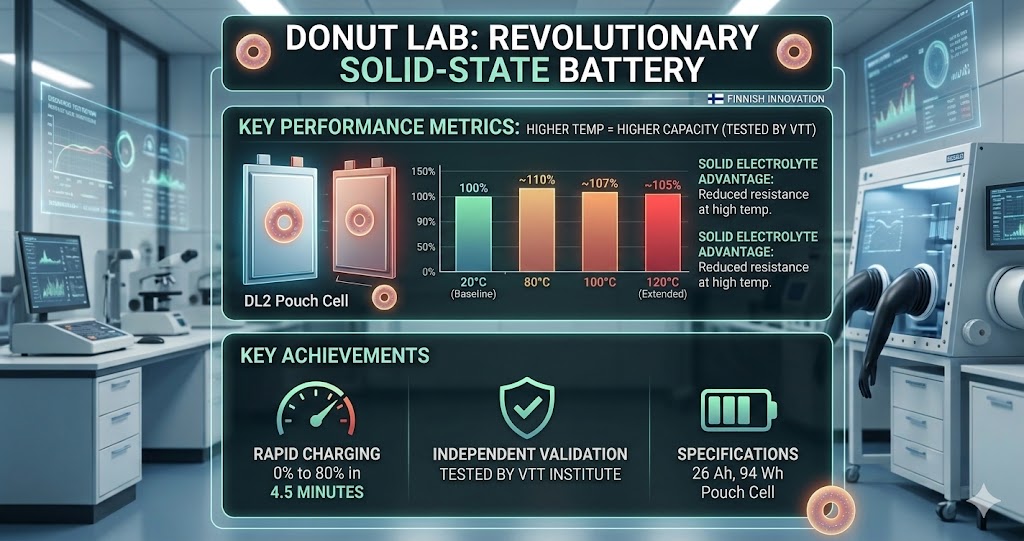
- 80℃環境: 室温時(20℃)の基準容量に対し、110.5%(27.5 Ah)の放電容量を記録。
- 100℃環境: 水の沸点に匹敵する環境下で、基準値の107.1%(27.6 Ah)を維持。
- 急速充電性能: 前回のテストでは、0%から80%までの充電をわずか4.5分で完了できることが実証されています。
2. 詳細な検証プロトコルとメカニズム
VTTのレポート(VTT-CR-00124-26)によると、テストは極めて厳格な条件下で行われました。
- セルの詳細(DL2): 公称容量 26 Ah、公称エネルギー 94 Wh(3.6V)のパウチセルを使用。
- 圧力制御: セル全体に均一な熱伝導と界面接触を維持するため、2.4kgの鋼鉄製の重りを乗せて物理的圧力をかけながら計測。
- なぜ高温で性能が上がるのか?: 液体電解質と異なり、固体電解質は温度が上がると「イオン伝導度(イオンの動きやすさ)」が向上する物理的特性を持ちます。熱によって内部抵抗が低下し、室温時よりも効率的にエネルギーを引き出せたことが、容量増加の要因と考えられます。
3. 残された課題と専門家による「3つの疑念」
この画期的な成果の一方で、実用化に向けた懸念点や物理的な矛盾も指摘されています。
- 真空の喪失(アウトガス): 100度Cのテスト後、セルのパウチ内の真空が失われていました。内部で何らかのガスが発生した可能性があり、長期的な膨張や劣化への影響が懸念されます。
- エネルギー密度のブラックボックス: 同社は400 Wh/kgを主張していますが、今回のレポートにセルの「重量」は記載されていません。400 Wh/kg達成には、このセルが約235g以下である必要がありますが、その証拠は未提示です。
- 10万サイクルの現実味: 業界巨人が数千サイクルで苦戦する中、10万回という寿命をどう検証したのか。短期テストでは判明しない「デンドライト(結晶成長)問題」への回答も待たれます。
出典:https://xenospectrum.com/donut-lab-solid-state-battery-vtt-test-extreme-heat/
Detailed Report on the 2nd VTT Independent Test: Donut Lab’s Solid-State Battery Maintains Capacity Even at 100 ℃
Finnish battery startup Donut Lab has released the results of the second independent test of its proprietary solid-state battery (SSB). Despite the self-deprecating campaign name “I Donut Believe,” the test results conducted by the public research institute VTT were astonishing, defying the conventional wisdom of the battery industry.
1. Remarkable Results: Next-Gen Performance that Turns “Heat” into an Ally
The test recorded counter-intuitive data showing that performance actually improved in environments between 80 degrees C and 100 degrees C—conditions where conventional lithium-ion batteries typically suffer fatal degradation.
- 80 Degrees C Environment: Recorded a discharge capacity of 110.5% (27.5 Ah) relative to the baseline capacity at room temperature (20 degrees C).
- 100 Degrees C Environment: Maintained 107.1% (27.6 Ah) of the baseline value in conditions equivalent to the boiling point of water.
- Rapid Charging Performance: A previous test demonstrated that the battery can complete a charge from 0% to 80% in just 4.5 minutes.
2. Detailed Verification Protocol and Mechanism
According to the VTT report (VTT-CR-00124-26), the testing was conducted under extremely rigorous conditions.
- Cell Details (DL2): A pouch cell with a nominal capacity of 26 Ah and nominal energy of 94 Wh (at 3.6V).
- Pressure Control: To maintain uniform thermal conduction and interface contact across the entire cell, measurements were taken while applying physical pressure using a 2.4 kg steel weight.
- Why does performance improve at high temperatures?: Unlike liquid electrolytes, solid electrolytes possess a physical property where “ionic conductivity” (the ease of ion movement) improves as temperature rises. The heat reduces internal resistance, which is believed to be the primary factor allowing the battery to extract energy more efficiently than at room temperature.
3. Remaining Challenges and “Three Doubts” from Experts
Despite these groundbreaking achievements, experts have pointed out concerns regarding practical application and physical inconsistencies.
- Loss of Vacuum (Outgassing): Following the 100 degrees C test, the vacuum inside the cell pouch was lost. This strongly suggests that some form of gas was generated internally, raising concerns about long-term swelling and degradation.
- The Energy Density “Black Box”: The company claims an energy density of 400 Wh/kg, but the VTT report does not list the “weight” of the cell. To achieve 400 Wh/kg, this specific cell would need to weigh approximately 235g or less, but no proof of this has been presented yet.
- The Reality of 100,000 Cycles: While industry giants struggle to reach even several thousand cycles, the method used to verify a 100,000-cycle lifespan remains unclear. Answers regarding the “Dendrite (crystal growth) problem,” which cannot be determined by short-term testing, are still awaited.


コメント