電気自動車(EV)への世界的なシフトや、再生可能エネルギーを支える系統用蓄電池(BESS)の爆発的普及に伴い、その中核素材である「リチウム」の需要が急増しています。しかし、従来のリチウム生産(太陽光蒸発法)は、数ヶ月から数年という膨大な時間、広大な土地、そして深刻な水不足を引き起こす環境負荷の高さが大きな課題でした。
2026年5月、コロンビア大学の研究チームは、学術誌「Joule」にて温度変化に反応する溶媒を用いた新技術「S3E(Switchable Solvent Solid-phase Extraction)」を発表しました。この技術は、従来の蒸発池を不要にし、これまで採掘が困難だった低品質の塩水資源からも高速かつクリーンにリチウムを抽出できる可能性を秘めています。本まとめでは、この革新技術の詳細と、グローバルなリチウム市場の最新動向という関連情報を補足して解説します。
- 1. 画期的技術「S3E」のメカニズムと優位性
- 2. ターゲットとなる「ソルトン湖」と米国独自の資源戦略
- 3. 【関連情報】世界で加速する直接リチウム抽出(DLE)の商業化競争
- 結論:真に「グリーン」なEVサプライチェーンの実現へ
- 1. Mechanism and Advantages of the Breakthrough Technology “S3E”
- 2. The Target “Salton Sea” and America’s Unique Resource Strategy
- 3. [Related Information] Accelerating Global Competition for Commercializing Direct Lithium Extraction (DLE)
- Conclusion: Toward Achieving a Truly “Green” EV Supply Chain
1. 画期的技術「S3E」のメカニズムと優位性
コロンビア大学が開発したS3E技術は、従来の直接リチウム抽出(DLE)技術とも異なり、化学的な結合剤や大量の後処理を必要としない革新的なアプローチです。
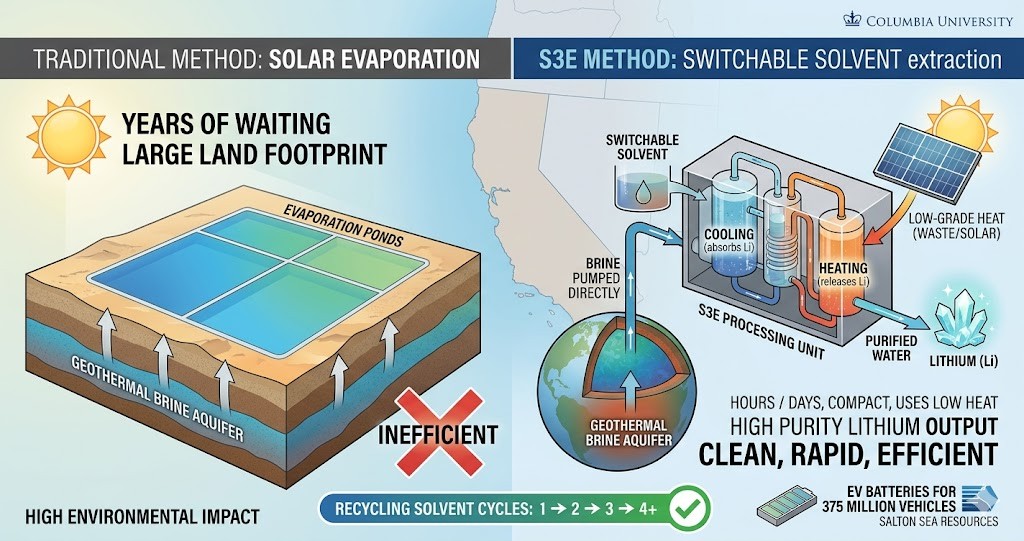
- 温度に反応するユニークな溶媒構造: 室温では、溶媒が塩水からリチウムと水を同時に吸収します。その後、システムを加熱するだけで、精製されたリチウムと水が放出され、溶媒は自動的に再生されて繰り返し利用可能(実証実験では4サイクル連続使用に成功)になります。
- 圧倒的な選択性と不純物除去: 試験において、リチウムをナトリウムの最大10倍、カリウムの最大12倍の速度で抽出する高い選択性を示しました。また、最も厄介な不純物であるマグネシウムも、化学沈殿工程によって効率的に分離します。
- 低品位の熱源で稼働可能: このシステムは、工場の廃棄物や太陽熱集熱器から発生する「低品位熱(低温の廃熱など)」を動力源として利用できるため、運用コストや追加の二酸化炭素(CO2)排出を劇的に抑えられます。
2. ターゲットとなる「ソルトン湖」と米国独自の資源戦略
研究チームは、カリフォルニア州にある地熱地帯「ソルトン湖(Salton Sea)」の環境を模した合成塩水を使用して実験を行い、リチウムの約40%を回収することに成功しました。
- ソルトン湖の潜在能力: ソルトン湖の地下塩水には、約3億7500万台分のEV用バッテリーを供給できる量のリチウムが埋蔵されていると推定されています。しかし、この地域の塩水は不純物が多く、従来の太陽光蒸発法は全く使用できませんでした。
- 【関連情報】米国のエネルギー安全保障(バイ・アメリカン): 現在、米国政府はインフレ抑制法(IRA)に基づき、リチウムなどの重要鉱物の調達において「中国依存からの脱却」を強力に推し進めています。ソルトン湖のような国内資源からS3E技術を用いて迅速に商業生産ができるようになれば、米国内のサプライチェーンの自給率は一気に高まります。
3. 【関連情報】世界で加速する直接リチウム抽出(DLE)の商業化競争
コロンビア大学の発表は概念実証(PoC)段階ですが、世界のリチウム産業では今、まさにこうした「蒸発池を使わない直接リチウム抽出(DLE)」の商業化競争が激化しています。
関連情報①:南米「リチウム三角地帯」の環境規制とDLEへの移行
世界のリチウム供給量の約40%を占めるチリやアルゼンチン、ボリビアの「リチウム三角地帯」では、太陽光蒸発法による地域の地下水枯渇が深刻な社会問題となっています。チリ政府などは今後、新規のリチウム開発において、使用した塩水を地下に戻すことができる「DLE技術の導入」を事実上義務付ける方針を打ち出しており、S3Eのような技術の需要は世界規模で高まっています。
関連情報②:既存のDLE(吸着剤・イオン交換)との違いとS3Eの強み
現在商業化が進んでいる初期のDLE技術の多くは、特殊な「吸着剤」や「イオン交換樹脂」を使用し、その後、大量の淡水(酸やベース)を使ってリチウムを洗い流す必要があります。これに対し、S3Eは「温度変化だけで動作する溶媒」を使用するため、化学薬品の使用量やプロセス全体の水消費量をさらに削減できる可能性があり、次世代のDLEとして優位性を持っています。
結論:真に「グリーン」なEVサプライチェーンの実現へ
「私たちは常にグリーンエネルギーについて話していますが、サプライチェーンの一部がいかに環境負荷が高いかについてはほとんど語られていません」と、研究チームのイン・イップ氏は指摘します。
EVが本当に環境に優しい乗り物であるためには、その原材料の採掘段階からクリーンでなければなりません。コロンビア大学のS3E技術は、リチウム生産のスピードを飛躍的に高め、コストを下げると同時に、これまで見捨てられていた国内資源を宝の山へと変えるポテンシャルを持っています。持続可能なクリーンエネルギー移行に向けた、極めて重要なファーストステップとなる技術です。
出典:https://www.sciencedaily.com/releases/2026/05/260522023132.htm
New Technology to “Absorb and Release” Lithium via Temperature Changes: The Impact of Columbia University’s Solvent Extraction Method (S3E)
With the global shift toward electric vehicles (EVs) and the explosive expansion of Battery Energy Storage Systems (BESS) supporting renewable energy, demand for “lithium,” its core material, is surging. However, traditional lithium production (the solar evaporation method) faces major challenges due to its high environmental impact, requiring an immense amount of time ranging from several months to years, vast areas of land, and causing severe water shortages.
In May 2026, a research team at Columbia University published a new technology in the journal “Joule” that uses a temperature-responsive solvent, called “S3E” (Switchable Solvent Solvent Extraction). This technology eliminates the need for traditional evaporation ponds and holds the potential to extract lithium quickly and cleanly even from low-quality brine resources that were previously difficult to mine. This summary explains the details of this innovative technology, supplemented with relevant information on the latest trends in the global lithium market.
1. Mechanism and Advantages of the Breakthrough Technology “S3E”
The S3E technology developed by Columbia University is an innovative approach that differs from conventional Direct Lithium Extraction (DLE) technologies, as it requires no chemical binding agents or extensive post-treatment.
- Unique Solvent Structure Responsive to Temperature: At room temperature, the solvent simultaneously absorbs lithium and water from brine. Then, simply by heating the system, the purified lithium and water are released, and the solvent automatically regenerates for repeated use (successfully demonstrated for four consecutive cycles in laboratory tests).
- Overwhelming Selectivity and Impurity Removal: In testing, it demonstrated high selectivity, extracting lithium at up to 10 times the rate of sodium and up to 12 times the rate of potassium. Furthermore, magnesium, one of the most troublesome impurities, is efficiently isolated through a chemical precipitation process.
- Operable with Low-Grade Heat Sources: The system can utilize “low-grade heat” (such as low-temperature waste heat) generated from factory waste or solar thermal collectors as its power source. This drastically reduces operating costs and additional carbon dioxide (CO2) emissions.
2. The Target “Salton Sea” and America’s Unique Resource Strategy
The research team conducted experiments using synthetic brine designed to mimic the conditions of the “Salton Sea,” a geothermal area in California, and successfully recovered approximately 40% of the lithium.
- The Potential of the Salton Sea: The underground brine of the Salton Sea is estimated to contain enough lithium to supply batteries for approximately 375 million EVs. However, the brine in this region is high in impurities, making the traditional solar evaporation method completely unusable.
- [Related Information] US Energy Security (Buy American): Under the Inflation Reduction Act (IRA), the US government is currently pushing hard to “break dependency on China” regarding the procurement of critical minerals like lithium. If S3E technology can be used to quickly start commercial production from domestic resources like the Salton Sea, the self-sufficiency rate of the US domestic supply chain will increase dramatically.
3. [Related Information] Accelerating Global Competition for Commercializing Direct Lithium Extraction (DLE)
While Columbia University’s announcement is at the Proof of Concept (PoC) stage, commercial competition for this type of “evaporation pond-free Direct Lithium Extraction (DLE)” is currently intensifying across the global lithium industry.
- Related Information 1: Environmental Regulations in South America’s “Lithium Triangle” and the Shift to DLE: In the “Lithium Triangle” of Chile, Argentina, and Bolivia, which accounts for about 40% of the world’s lithium supply, the depletion of local groundwater caused by solar evaporation has become a serious social issue. Governments like Chile’s are moving toward effectively mandating the “introduction of DLE technology” for new lithium developments to allow used brine to be reinjected underground, increasing global demand for technologies like S3E.
- Related Information 2: Differences from Existing DLE (Adsorbents/Ion Exchange) and S3E’s Strengths: Many early DLE technologies currently undergoing commercialization use special “adsorbents” or “ion exchange resins,” which require large amounts of fresh water (acids or bases) to wash out the lithium afterward. In contrast, S3E uses a “solvent that operates solely on temperature changes,” which has the potential to further reduce chemical consumption and water usage across the entire process, giving it an edge as a next-generation DLE.
Conclusion: Toward Achieving a Truly “Green” EV Supply Chain
“We always talk about green energy, but we rarely talk about how environmentally intensive parts of the supply chain are,” notes Ngai Yin Yip, a researcher on the team.
For EVs to be truly environmentally friendly vehicles, the extraction stage of their raw materials must be clean. Columbia University’s S3E technology dramatically increases the speed of lithium production and lowers costs while holding the potential to turn previously abandoned domestic resources into a treasure trove. This technology represents a crucial first step toward a sustainable transition to clean energy.
コメント