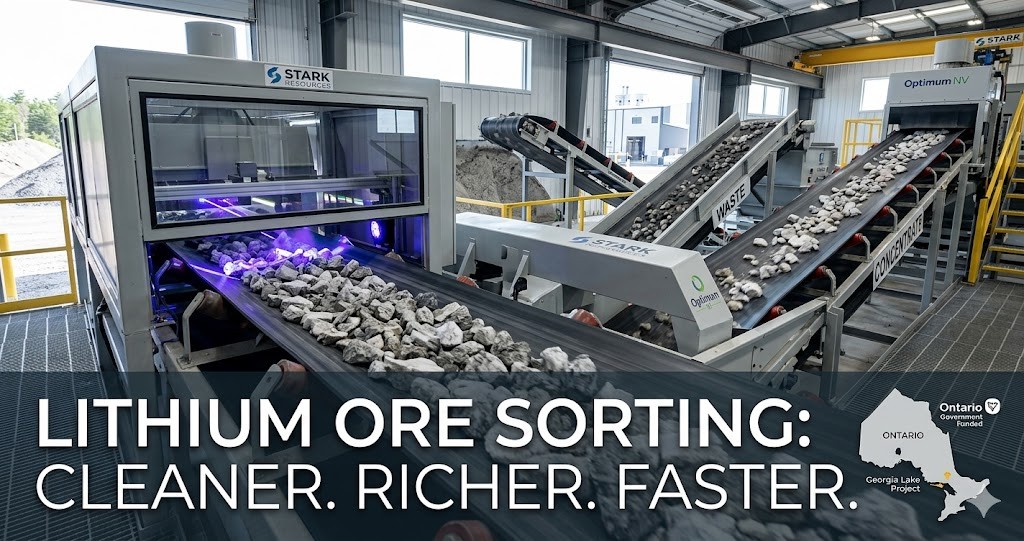
世界的なクリーンエネルギーへの移行と電気自動車(EV)市場の急拡大に伴い、バッテリーグレードのリチウムを安定的かつコスト競争力高く確保することは、北米およびヨーロッパにおいて極めて重要な課題となっています。こうした需要を背景に、ロックテック・リチウム社は2026年5月19日、カナダ・オンタリオ州のジョージア湖リチウムプロジェクトにおける大きな技術的進歩を発表しました。州政府の資金援助を受けて実施された革新的な「鉱石選別プログラム」の成功は、プロジェクトの経済性を根本から改善する可能性を秘めています。本レポートでは、この発表の詳細に重要な市場・地政学的背景を交え、防衛およびバッテリー材料の国内サプライチェーン構築に向けた同社の取り組みを解説・集約します。
1. 発表の概要と主な成果
ロックテック・リチウム社は、オンタリオ州北部にあるジョージア湖リチウムプロジェクトにおいて、鉱石選別試験プログラムを成功裏に完了しました。オンタリオ州の重要鉱物イノベーション基金(CMIF)の支援を受けたこのプログラムでは、下流工程(破砕・選鉱など)の前に鉱石を事前濃縮するための先進的なセンサーベース選別技術が評価されました。
代表的な試料を用いた予備試験では、以下のような極めて有望な結果が示されています:
- 廃棄物の削減: 鉱石選別プロセスにより、下流工程に進む前に約25パーセントから45パーセントの廃棄物(不要な岩石)を除去することに成功しました。
- 品位の向上: 材料の流れを改良したことで、選別されたリチウム鉱石の品質(品位)が元の原料に比べて約1.4倍から1.8倍に向上しました。
- 設備投資(CAPEX)の削減: 初期段階のエンジニアリング作業により、将来の破砕および選鉱設備の設備投資コストを最大50パーセント削減できる可能性のある道筋が特定されました。
2. 戦略的提携とプロジェクトのプロファイル
今回のイノベーションは、政府、産業界、そして研究機関の強固な連携によって実現しました。
- 共同開発の体制: ロックテック社は、クイーンズ大学(クリティカルミネラル処理研究所)および、センサーベースの鉱石選別・鉱物処理技術の専門企業であるドイツのSTARK Resources社と協力しました。
- 採用された技術: Optimum NV社のUVレーザーベース選別技術と、allmineral Aufbereitungstechnik社のX線透過(XRT)センサーベース選別技術が評価されました。
- ジョージア湖プロジェクトの基準値: 同社が2022年に実施した予備実現可能性調査(PFS)では、年間100万トンの選鉱施設を想定し、9年間の鉱山寿命で年間約10万トンの6パーセントスポジュメン精鉱を生産する計画でした。当時の資源量は確定鉱物資源量が約1,060万トン(Li2O含有率0.88パーセント)、推定鉱物資源量が約420万トン(Li2O含有率1.00パーセント)です。今回1.4倍から1.8倍の品位向上が確認されたことで、将来の鉱山計画において、従来は見送られていた低品位の鉱石も経済的に活用できる可能性が出てきました。
3. 【関連情報】背景の補足(市場・政策動向)
ロックテック社の今回の成果が持つ重要性を深く理解するためには、以下のグローバルな要因を考慮する必要があります。
- 地政学的リスクとサプライチェーンの主権確保: 北米およびヨーロッパの政府は、外国の敵対勢力への依存度を低減し、自国内で完結する重要鉱物サプライチェーンの構築を急いでいます。リチウムの加工・精製は世界的に特定の地域へ依存しているのが現状です。ロックテック社は、ジョージア湖での採掘、計画中のオンタリオ州レッドロック・コンバーター、およびドイツのグーベン・コンバーターを連動させることで、厳格なESG(環境・社会・ガバナンス)基準を遵守した透明性の高い「鉱山から加工工場まで」の統合サプライチェーンの構築を目指しています。
- リチウム市場の価格変動への耐性: 長期的なリチウム需要は世界の気候目標(脱炭素化)を背景に堅調ですが、短期的には価格の乱高下が見られます。2022年のPFSでは、精鉱価格を1トン当たり1,500米ドルと仮定していました。鉱石選別技術の導入は、無駄な材料の処理を減らすことで操業コスト(OPEX)と初期投資額を劇的に引き下げるため、市場の低迷期(価格の下落サイクル)であってもプロジェクトが利益を維持できる強靭性(回復力)をもたらします。
- 環境負荷の低減とサステナビリティ: 従来の採掘では、大量の不要な岩石も一緒に破砕・処理されるため、莫大なエネルギーと水が消費されます。メインの選鉱に回す前に最大45パーセントの廃棄物を除去できるこの技術は、リチウム生産1トン当たりの環境負荷やエネルギー消費を大幅に削減し、廃棄物(尾鉱)の量も最小限に抑えることができるため、現代の循環型経済の原則に合致しています。
4. 今後の展望と次のステップ
今回のプログラムの成功を受けて、ロックテック社はジョージア湖開発における主要な活動を再開しています。現在は、資源量の増加や地質学的信頼性の向上、そして将来の鉱山計画に向けた追加データ収集を目的に、次段階の掘削計画や最終実現可能性調査(DFS)の準備を進めています。
今後のバリューエンジニアリング(価値工学)段階において、同社は鉱石選別の統合、プラント設計の最適化、および破砕・選鉱プラントや関連インフラ全体の設計変更がもたらす複合的な影響を評価していく予定です。今回の成果は概念的な段階であり、最終的な埋蔵量や経済的成果を確定するものではありませんが、オンタリオ州の重要鉱物セクターの可能性を大きく引き出す確実な一歩となります。
Rock Tech’s Advancement of the Georgia Lake Lithium Project and Relevant Background
With the global transition to clean energy and the rapid expansion of the electric vehicle (EV) market, securing a stable and cost-competitive supply of battery-grade lithium has become a crucial challenge for North America and Europe. Against the backdrop of this demand, Rock Tech Lithium Inc. announced a major technical breakthrough at its Georgia Lake Lithium Project in Ontario, Canada, on May 19, 2026. The success of this innovative “ore-sorting program,” carried out with financial support from the provincial government, holds the potential to fundamentally improve the project’s economics. Blending the details of this announcement with important market and geopolitical contexts, this report explains and synthesizes the company’s efforts toward establishing a domestic supply chain for defense and battery materials.
1. Overview of the Announcement and Key Results
Rock Tech Lithium Inc. has successfully completed its ore-sorting test program at the Georgia Lake Lithium Project located in northern Ontario. Supported by the Ontario Critical Minerals Innovation Fund (CMIF), the program evaluated advanced sensor-based sorting technologies to pre-concentrate mineralized material prior to downstream processing (such as crushing and beneficiation). Preliminary testing utilizing representative samples demonstrated the following highly promising results:
- Waste Reduction: The ore-sorting process successfully removed approximately 25 to 45 percent of waste rock before entering the downstream processing stage.
- Grade Enhancement: By improving the material flow, the quality (grade) of the sorted lithium ore increased by approximately 1.4 to 1.8 times compared to the original feed material.
- Capital Expenditure (CAPEX) Reduction: Initial engineering work identified potential pathways to reduce capital expenditure costs for future crushing and beneficiation facilities by up to 50 percent.
2. Strategic Partnerships and Project Profile
This innovation was achieved through a strong collaboration linking government, industry, and academia.
- Collaborative Development Framework: Rock Tech partnered with Queen’s University (the Critical Minerals Processing Laboratory) and STARK Resources, a Germany-based specialist in sensor-based ore sorting and mineral processing technology.
- Technologies Utilized: The program evaluated UV laser-based sorting technology from Optimum NV and X-ray transmission (XRT) sensor-based sorting technology from allmineral Aufbereitungstechnik.
- Georgia Lake Project Baseline: In the Preliminary Feasibility Study (PFS) conducted by the company in 2022, the plan outlined a conventional development concept based on a 1,000,000-tonne-per-annum concentrator facility, targeting an annual production of roughly 100,000 tonnes of 6 percent spodumene concentrate over a 9-year mine life. At that time, mineral resources stood at approximately 10.6 million tonnes of Indicated resources (at 0.88 percent Li2O) and 4.2 million tonnes of Inferred resources (at 1.00 percent Li2O). With the newly confirmed 1.4x to 1.8x grade enhancement, there is now a possibility that lower-grade ores, which were previously overlooked, can be utilized economically in future mine planning.
3. [Related Information] Background Context (Market and Policy Trends)
To fully grasp the significance of Rock Tech’s recent achievements, the following global factors must be considered:
- Geopolitical Risks and Supply Chain Sovereignty: North American and European governments are moving aggressively to establish self-contained critical mineral supply chains within their borders to reduce dependence on foreign adversaries. Currently, the processing and refining of lithium heavily relies on specific regions globally. By linking mining at Georgia Lake with the planned Red Rock Converter in Ontario and the Guben Converter in Germany, Rock Tech aims to build a highly transparent “mine-to-converter” integrated supply chain that strictly complies with Environmental, Social, and Governance (ESG) standards.
- Resilience to Lithium Market Price Volatility: While long-term lithium demand remains robust due to global climate goals (decarbonization), the market experiences sharp price fluctuations in the short term. The 2022 PFS assumed an average spodumene concentrate price of 1,500 US dollars per tonne. Implementing ore-sorting technology drastically lowers operating costs (OPEX) and initial capital requirements by reducing the volume of waste material processed, providing the project with the resilience (recovery power) to maintain profitability even during market downturns (low-price cycles).
- Environmental Impact Reduction and Sustainability: In traditional mining, immense amounts of energy and water are consumed because vast quantities of unnecessary waste rock must be crushed and processed together with the ore. This technology, which can remove up to 45 percent of waste before sending it to the main concentrator, significantly reduces environmental impact and energy consumption per tonne of lithium produced, while also minimizing the volume of tailings (waste material), aligning perfectly with modern circular economy principles.
4. Future Outlook and Next Steps
Following the success of this program, Rock Tech is restarting major development activities at Georgia Lake. The company is currently preparing for next-stage drilling plans and a Definitive Feasibility Study (DFS) with the goals of increasing resource estimates, enhancing geological confidence, and collecting additional data for future mine planning. During the upcoming value engineering phase, Rock Tech plans to evaluate the combined impacts of ore-sorting integration, plant design optimization, and alternative execution strategies across the future crushing plant, concentrator, and related infrastructure. Although these results are conceptual and do not finalize mineral reserves or definitive economic outcomes, they represent a significant step toward unlocking the potential of Ontario’s critical mineral sector.


コメント