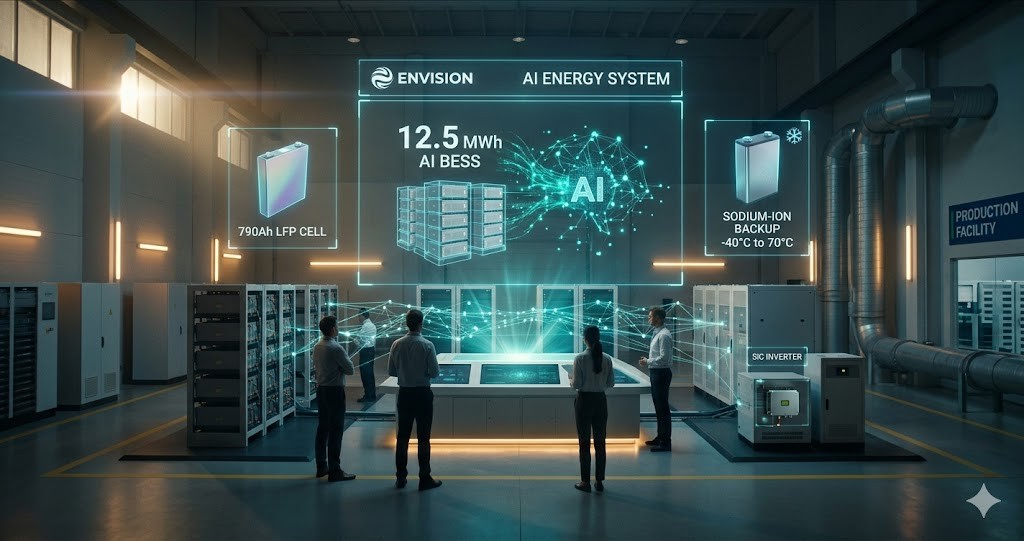
Envision社は「AIエネルギーシステムの構築」を掲げ、ハードウェアとAIを高度に融合させた次世代蓄電ソリューションを発表しました。
1. 世界最大級の790Ah LFPセル
ストレージシステムの核となるのは、自社開発された790Ahの角型巻線セルです。
- 主要スペック:
- エネルギー密度: 440Wh/L以上
- サイクル寿命: 15,000サイクル以上(耐用年数 最大30年)
- 充放電効率(RTE): 96%(セルレベル)
- 安全性と量産: 大容量化に伴う熱管理の課題に対し、高安全性電解質や独自の熱勾配設計を採用。滄州のスーパーファクトリーですでに量産を開始しています。
2. 12.5MWh AI蓄電システム(BESS)
新型の「EN 12.5 MWh」プラットフォームは、単なる大容量化ではなく、AIによる最適化を前提とした設計です。
- AI適応型PCS: 第3世代SiC(炭化ケイ素)技術を採用し、99.3%の効率を実現。55度Cの高温下でも出力低下なしで運転可能です。
- システム効率: プラットフォーム全体で92%以上の効率を達成。
- 経済性の向上: AIによる電力価格予測(精度90%超)を活用し、プロジェクトの内部収益率(IRR)を4%から8%向上させます。
- 省スペース: 大規模サブアレイ設計により、設置面積を37.6%削減しました。
3. ナトリウムイオン電池の補完的展開
リチウムイオン電池に加え、ナトリウムイオン電池の量産ライン稼働も発表されました。
- スペック: 容量180Ah以上、寿命20,000サイクル。
- 特長: -40度Cから70度Cという広い温度耐性を持ち、リチウムが苦手な極低温環境や、コスト制約の厳しいAIデータセンターのバックアップ電源としての活用を見込んでいます。
- 【補足】業界の背景と技術トレンド
- まとめ:Envisionの戦略的優位性
- The Era of 700Ah plus LFP Cells: Envision Launches Ultra-Long Life Battery with 15,000 Cycles
【補足】業界の背景と技術トレンド
LFPセルの大容量化トレンド(300Ah超から700Ah超へ)
これまで、電力貯蔵(ESS)向けLFPセルは280Ahや306Ahが主流でしたが、2025年から2026年にかけて500Ah、そして今回の790Ahへと急速に大型化が進んでいます。
- メリット: セル個数を減らすことで、BESS全体の部品点数、配線、BMS(バッテリー管理システム)の複雑さを低減し、システム全体のコストダウンと信頼性向上に直結します。
「Grid-forming(グリッドフォーミング)」技術
発表されたPCSがサポートする「グリッドフォーミング」は、再生可能エネルギー比率が高い系統において、蓄電池が自ら電圧と周波数を形成し、系統の安定化に寄与する技術です。従来の「系統追従型」から、より能動的な役割へのシフトを意味します。
AIデータセンターと電力需要
AI(人工知能)の進化に伴い、データセンターの電力消費量は爆発的に増加しています。Envisionが「AI資産」と呼ぶように、蓄電池は単なるバックアップではなく、AIによる需要予測と連動して電力を「取引」し、収益を生む戦略的デバイスへと進化しています。
まとめ:Envisionの戦略的優位性
Envisionは、以下の3つの柱でエネルギー貯蔵市場の再定義を図っています。
- 物理(ハード): 790Ahセルによる圧倒的なエネルギー密度。
- デジタル(ソフト): AIによる運用最適化と収益性の最大化。
- 多様性: リチウムとナトリウムの使い分けによる、あらゆる環境への適応。
これにより、ストレージを単なる「ハードウェア」から、投資価値を生む「AI資産」へと昇華させています。
The Era of 700Ah plus LFP Cells: Envision Launches Ultra-Long Life Battery with 15,000 Cycles
Under the theme of “Building AI Energy Systems,” Envision has announced a next-generation energy storage solution that integrates hardware with advanced AI.
1. World-Class 790Ah LFP Cell
At the core of the storage system is a self-developed 790Ah prismatic winding cell.
- Key Specifications:
- Energy Density: 440Wh/L or higher
- Cycle Life: 15,000 cycles or more (up to 30 years of service life)
- Round-Trip Efficiency (RTE): 96% (at cell level)
- Safety and Mass Production: To address thermal management challenges associated with large capacities, the cell utilizes high-safety electrolytes and a unique thermal gradient design. Mass production has already commenced at the battery super-factory in Cangzhou.
2. 12.5MWh AI Energy Storage System (BESS)
The new “EN 12.5 MWh” platform is designed with AI optimization as a core requirement rather than just focusing on increased capacity.
- AI-Adaptive PCS: Utilizing 3rd-generation SiC (Silicon Carbide) technology, it achieves 99.3% efficiency. It can operate at full load without derating even at high ambient temperatures of 55 degrees C.
- System Efficiency: The entire platform achieves an overall efficiency of over 92%.
- Improved Economics: By leveraging AI-based power price forecasting (with over 90% accuracy), the internal rate of return (IRR) for projects can be increased by 4% to 8%.
- Space Saving: The large-scale sub-array design reduces the installation footprint by 37.6%.
3. Complementary Deployment of Sodium-Ion Batteries
In addition to lithium-based batteries, the operation of a mass production line for sodium-ion storage batteries was also announced.
- Specifications: Capacity of 180Ah or more, cycle life of 20,000 cycles.
- Features: With a wide operating temperature range from -40 degrees C to 70 degrees C, these are intended for use in extreme cold environments where lithium struggles, as well as backup power for AI data centers where cost constraints are tight.
[Supplementary Information] Industry Background and Technical Trends
Trend of Increasing LFP Cell Capacity (From 300Ah plus to 700Ah plus)
While 280Ah and 306Ah LFP cells were previously the mainstream for Energy Storage Systems (ESS), capacities have scaled rapidly through 500Ah in 2025 to 790Ah in 2026.
- Benefits: Reducing the number of cells directly leads to a lower component count, simplified wiring, and less complex Battery Management Systems (BMS), resulting in overall cost reduction and improved system reliability.
“Grid-forming” Technology
The “grid-forming” capability supported by the new PCS is a technology where the battery system itself establishes voltage and frequency in grids with high renewable energy penetration. This represents a shift from “grid-following” to a more active role in grid stabilization.
AI Data Centers and Power Demand
With the evolution of Artificial Intelligence (AI), power consumption in data centers is increasing explosively. As Envision refers to them as “AI Assets,” storage batteries are evolving from simple backups into strategic devices that “trade” electricity in synchronization with AI-driven demand forecasting to generate revenue.
Summary: Envision’s Strategic Advantage
Envision aims to redefine the energy storage market through three pillars:
- Physical (Hardware): Overwhelming energy density provided by the 790Ah cell.
- Digital (Software): Operational optimization and maximization of profitability through AI.
- Diversity: Adaptability to all environments by utilizing both lithium and sodium technologies.
Through these advancements, Envision is elevating energy storage from mere “hardware” into “AI Assets” that generate significant investment value.


コメント