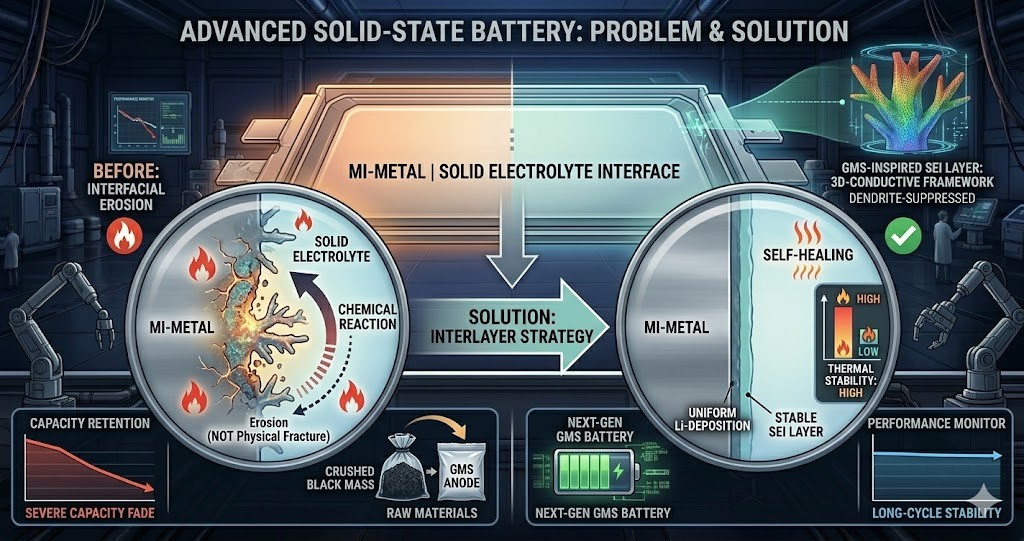
全固体電池は、現在のリチウムイオン電池よりも安全性が高く、エネルギー密度を劇的に向上させる(EVの航続距離を2倍にする等)技術として期待されています。しかし、充電中に「デンドライト」と呼ばれる微細な金属の結晶が電解質の中を突き破って成長し、プラス極とマイナス極を短絡(ショート)させてしまう問題が、数十年来の課題となっていました。
これまでは「物理的な硬さ」で解決できると考えられてきましたが、MITの研究は、真の原因が「化学反応による材料の脆化」にあることを突き止めました。
- MITによる新発見:デンドライト発生の真のメカニズム
- 関連情報:全固体電池開発への影響と今後の展望
- 全固体電池とリチウムイオン電池の比較
- New Development in the Dendrite Problem: Chemical Reactions Lead to Short Circuits in Solid-State Batteries
MITによる新発見:デンドライト発生の真のメカニズム
1. 「硬さ」だけでは防げない理由
研究チームは、特殊な可視化技術(複屈折顕微鏡法)を用いて、デンドライトが成長する際の応力を直接測定しました。その結果、以下の衝撃的な事実が判明しました。
- 逆説的な現象: 成長速度が速いデンドライトほど、周囲にかかる応力が低い。
- 強度の低下: 電解質(セラミック)は本来「歯」と同じくらいの強度がありますが、充電中には「棒付きキャンディー」のように脆くなり、通常の25%程度の力でひび割れてしまいます。
2. 化学的ストレスと機械的ストレスの相互作用
デンドライトの成長は、単なる物理的な押し込みではなく、電気化学的な反応が主因であることが示唆されました。
- 電気化学的腐食: リチウムイオンが流れる際、デンドライト先端部で化学反応が起こり、電解質材料が分解。その結果、体積収縮が起こり、材料に亀裂が入りやすくなります。
関連情報:全固体電池開発への影響と今後の展望
1. 材料設計のパラダイムシフト
これまでの研究開発は「いかに硬い電解質を作るか」に注力されてきましたが、今後は「リチウム金属と接触しても化学的に安定し、還元反応を起こさない材料」の探索が不可欠となります。
2. デンドライト対策の現状
現在、業界では以下の対策が並行して検討されています。
- 中間層の導入: リチウム金属と固体電解質の間に、反応を抑制する薄膜を挟む。
- 自己修復材料: 亀裂が入っても熱などで修復される特性を持つ材料の研究。
全固体電池とリチウムイオン電池の比較
| 項目 | リチウムイオン電池(現行) | 全固体電池(次世代) |
| 電解質 | 可燃性の液体 | 不燃性の固体(セラミック等) |
| 負極材 | 主にグラファイト | リチウム金属(高密度) |
| 主な課題 | 発火リスク、エネルギー密度の限界 | デンドライトによる短絡(脆化) |
| 期待される効果 | 普及済み、安価 | 航続距離2倍、超急速充電、高い安全性 |
イェットミン・チャン教授(MIT)のコメント
「デンドライトが成長する新たなメカニズムを発見したことで、それを回避する設計指針が得られました。これは、固体電池の成功につながる重要な一歩です。」
出典:https://news.mit.edu/2026/why-solid-state-batteries-keep-short-circuiting-0325
New Development in the Dendrite Problem: Chemical Reactions Lead to Short Circuits in Solid-State Batteries
All-solid-state batteries are expected to be safer than current lithium-ion batteries and possess the potential to dramatically improve energy density (e.g., doubling the range of EVs). However, for decades, they have been plagued by “dendrites”—microscopic metal crystals that grow through the electrolyte during charging, causing short circuits between the positive and negative terminals.
While it was previously believed that “physical hardness” could solve this, MIT research has pinpointed the true cause: material embrittlement caused by chemical reactions.
MIT’s New Discovery: The True Mechanism of Dendrite Formation
1. Why “Hardness” Alone Cannot Prevent Dendrites
The research team used a specialized visualization technique called “prying birefringence microscopy” to directly measure the stress during dendrite growth. This led to several shocking discoveries:
- Paradoxical Phenomenon: Dendrites that grow faster actually exhibit lower surrounding stress.
- Loss of Strength: While the electrolyte (ceramic) normally has the strength of a human tooth, it becomes as brittle as a “lollipop” during charging, cracking at only about 25% of its normal required force.
2. Interaction Between Chemical and Mechanical Stress
The study suggests that dendrite growth is primarily driven by electrochemical reactions rather than simple physical pressure.
- Electrochemical Corrosion: As lithium ions flow, a chemical reaction occurs at the tip of the dendrite, causing the electrolyte material to decompose. This results in volume contraction, making the material highly susceptible to cracking.
Related Information: Impact on Development and Future Outlook
1. Paradigm Shift in Material Design
Until now, R&D has focused on “how to make a harder electrolyte.” Moving forward, it will be essential to search for materials that remain chemically stable and do not undergo reduction reactions even when in contact with lithium metal.
2. Current State of Dendrite Countermeasures
The industry is currently exploring the following solutions in parallel:
- Introduction of Intermediate Layers: Inserting a thin film between the lithium metal and the solid electrolyte to suppress reactions.
- Self-Healing Materials: Researching materials with properties that allow cracks to be repaired via heat or other triggers.
Comparison: Solid-State vs. Lithium-Ion Batteries
| Item | Lithium-Ion Battery (Current) | All-Solid-State Battery (Next-Gen) |
| Electrolyte | Flammable liquid | Non-flammable solid (ceramic, etc.) |
| Anode Material | Primarily Graphite | Lithium Metal (High density) |
| Main Challenge | Fire risk, energy density limits | Short circuits due to dendrites (embrittlement) |
| Expected Effects | Mass-produced, affordable | 2x range, ultra-fast charging, high safety |
Comment from Professor Yet-Ming Chiang (MIT)
“By discovering this new mechanism of dendrite growth, we have gained design guidelines to avoid it. This is a critical step toward the success of solid-state batteries.”

コメント